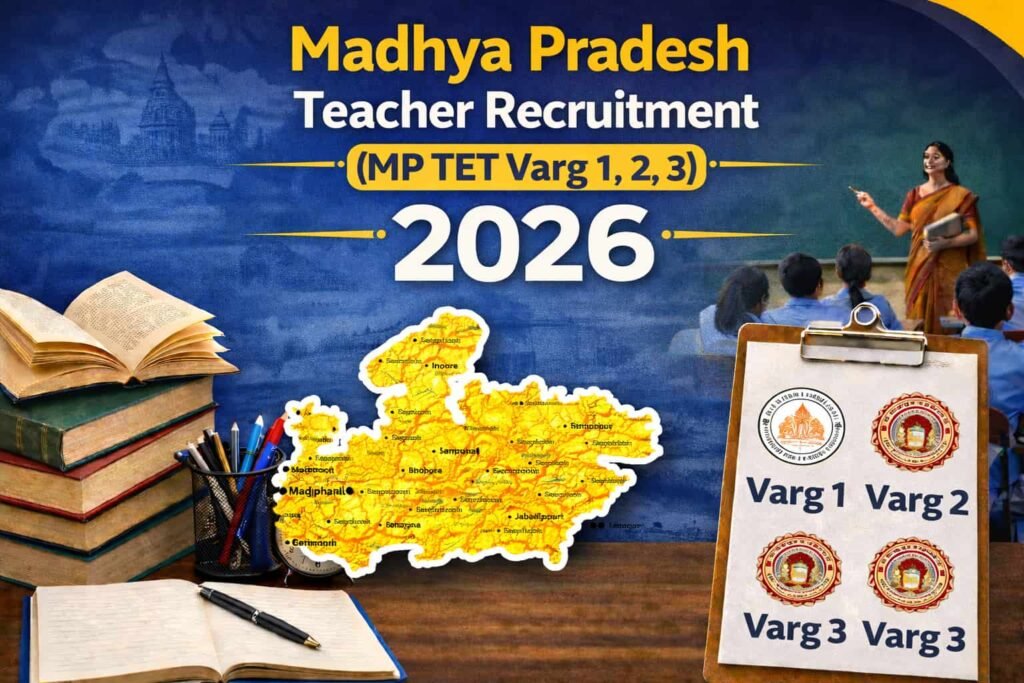
The educational recruitment landscape in Madhya Pradesh is managed by the Madhya Pradesh Employees Selection Board (MP ESB), previously known as Vyapam. The state categorizes its teaching professionals into three distinct tiers:
Thank you for reading this post, don't forget to subscribe!- Varg 3 (Primary School Teacher): For Classes 1 to 5.
- Varg 2 (Middle School Teacher): For Classes 6 to 8.
- Varg 1 (High School / Senior Secondary Teacher): For Classes 9 to 12.
Massive 2026 Policy Overhaul: Previously, aspiring teachers in MP had to go through a grueling two-step process: passing the Teacher Eligibility Test (TET/Patrata Pariksha) and then clearing a separate Selection Exam (Chayan Pariksha). However, the MP School Education Department has proposed a historic reform for 2026: The two-exam system is being scrapped. Moving forward, recruitment will be based solely on the merit of the MP TET (Patrata Pariksha) scores. Furthermore, MP TET scores will now be valid for a lifetime, and candidates can take the exam multiple times simply to improve their rank. With an estimated 30,000+ vacancies opening up this year, this simplified one-exam model is a massive relief for candidates.
2. Exam Methodology: CBT & OMR Sheet Filling Instructions
MP ESB currently conducts its major recruitment examinations via Computer Based Tests (CBT). However, for specific departmental offline exams or backup offline models, OMR (Optical Mark Recognition) sheets are utilized. The Board maintains extremely strict protocols to prevent cheating and optical scanner errors.
A. Computer-Based Test (CBT) Instructions:
- Candidates must log in using their Roll Number and a unique password/TAC code provided at the exam center.
- The screen displays a timer, and candidates can navigate between questions, mark them for review, or change their options before the final submission.
- Biometric (Aadhaar-based) verification is mandatory before logging into the terminal.
B. Strict OMR Sheet Filling Protocols (If Applicable):
If the exam is conducted via OMR, candidates must follow these rigid instructions to avoid immediate disqualification:
- Permitted Pen: Use ONLY a Blue or Black Ballpoint Pen. Pencils, gel pens, or ink pens are strictly prohibited as optical scanners cannot read them.
- Writing Personal Details: Write your Name, Father’s Name, and Mother’s Name in CAPITAL LETTERS in the provided rectangular boxes. Leave exactly one blank box between your first, middle, and last names.
- Filling the Roll Number and Booklet Code:
- Write the exact digits of your Roll Number and Question Booklet Set (A, B, C, or D) in the topmost boxes.
- Directly underneath each digit/letter, darken the corresponding circular bubble completely.
- Correct Bubbling Technique:
- The circle must be fully darkened from the center outwards.
- DO NOT use tick marks (✓), cross marks (✗), or half-fill the bubble.
- DO NOT darken more than one bubble per question. Multiple markings will be treated as invalid and yield zero marks.
- Strict Prohibition of Correction Fluid: The use of whiteners, erasers, or blade scraping on the OMR sheet is strictly banned. Any tampered bubble will lead to the rejection of the entire answer sheet.
3. Exam Pattern & Micro-Syllabus (Varg 1, 2, & 3)
Since the MP TET score will directly formulate the merit list, candidates must score exceptionally high out of the total 150 marks. There is no negative marking in the MP TET.
A. MP TET Varg 3 (Primary Teacher – Classes 1 to 5)
- Total Questions: 150 MCQs (150 Marks). Duration: 2.5 Hours.
- Child Development & Pedagogy (30 Marks): Cognitive, physical, and emotional development (ages 6-11). Piaget, Vygotsky, Kohlberg theories. Inclusive education and understanding children with special needs.
- Language I – Hindi/Sanskrit (30 Marks): Unseen passages (prose and poetry), Grammar (Sandhi, Samas, Noun, Pronoun, Adjectives, Prefix/Suffix), and Language Pedagogy.
- Language II – English (30 Marks): Reading comprehension, grammar (Tenses, Articles, Prepositions, Voice, Narration), and English teaching methodology.
- Mathematics (30 Marks): Number system, fractions, geometry, measurement, weight, time, volume, data handling, and Mathematical Pedagogy.
- Environmental Studies (EVS) (30 Marks): Family and friends, flora and fauna, shelter, water, travel, health & hygiene, and EVS Pedagogy.
B. MP TET Varg 2 (Middle School Teacher – Classes 6 to 8)
The exam pattern is divided into Part A (Compulsory for all) and Part B (Subject-Specific). Part A: Compulsory Section (30 Marks)
- General English (8 Marks): Basic grammar and comprehension.
- General Knowledge, Current Affairs, Reasoning & Numerical Ability (7 Marks).
- Child Development & Pedagogy (15 Marks): Focus on the adolescent age group (11-14 years).
Part B: Subject-Specific Section (120 Marks) Candidates must choose ONE subject based on their graduation degree. The difficulty level is equivalent to the graduation standard.
- Mathematics (120 Marks): Number Systems (Euclid’s Division Lemma), Polynomials, Linear Equations, Quadratic Equations, Calculus, Probability, Matrices, and Trigonometry.
- Science (120 Marks): Universe, Measurement, Matter and its states, Force and Motion, Light, Sound, Electricity, Chemical Reactions, Cell Biology, and Human Anatomy.
- Social Science (120 Marks): Ancient, Medieval, and Modern Indian History, World Geography, Indian Constitution, Democracy, and Economics.
- Hindi/English Literature (120 Marks): High-level grammar, literary theory, history of literature, and famous authors/poets.
C. MP TET Varg 1 (High School Teacher – Classes 9 to 12)
Similar to Varg 2, the Varg 1 exam consists of a compulsory Part A (30 marks) and a highly advanced Part B (120 marks) focusing on the candidate’s Post-Graduate subject (e.g., Physics, Chemistry, Commerce, Geography).
4. Salary Structure & Allowances (7th Pay Commission)
A major legal battle recently transformed the salary structure for MP Teachers. Previously, the government applied a 70%-80%-90% rule, where new teachers received only a percentage of their basic pay during their 3-year probation period. However, following High Court interventions stating “Equal Pay for Equal Work,” this staggered system is effectively being scrapped. Teachers are now expecting 100% Basic Pay from year one.
Furthermore, the Madhya Pradesh government has recently raised the Dearness Allowance (DA) to 58%, bringing it on par with Central Government standards.
Estimated Monthly Salary Breakdown (2026)
| Teacher Category | Pay Level | Basic Pay | Estimated DA (58%) | HRA & Allowances | Approximate Net In-Hand Salary |
|---|---|---|---|---|---|
| Varg 3 (Primary Teacher) | Level 4 | ₹25,500 | ₹14,790 | ~₹2,500 | ₹32,000 – ₹37,000 |
| Varg 2 (Middle Teacher) | Level 5 | ₹29,200 | ₹16,936 | ~₹3,000 | ₹38,000 – ₹44,000 |
| Varg 1 (PGT/Lecturer) | Level 7 | ₹44,900 | ₹26,042 | ~₹4,500 | ₹58,000 – ₹65,000 |
(Note: The gross salary is subject to a 10% deduction for the National Pension System (NPS) and State Professional Taxes before arriving at the Net In-Hand Salary).
5. Top 10 Frequently Asked Questions (FAQs) – MP Teacher Recruitment
1. Is the “Chayan Pariksha” (Selection Exam) officially cancelled for 2026? Yes. According to the latest Education Department proposals and updates, the two-exam system is being abolished. Recruitment will now be based strictly on the merit/scores obtained in the single MP TET (Patrata Pariksha) exam.
2. Are candidates from other states (like Bihar, UP, Rajasthan) eligible to apply? Yes, candidates from other states are fully eligible to apply for MP Teacher vacancies. However, they will not receive any reservation benefits and will be considered under the “General/Unreserved (UR)” category, meaning they must score the General category cut-off (90 out of 150) to qualify.
3. What is the minimum qualifying score for MP TET? Unreserved (General) candidates and candidates from other states must score 60% (90 out of 150 marks). Reserved category candidates (SC/ST/OBC/EWS/PwD) who possess an MP domicile must score 50% (75 out of 150 marks).
4. Is there any negative marking in the MP TET exam? No, there is absolutely no negative marking in the MP TET Varg 1, 2, or 3 examinations. Candidates should attempt all 150 questions without the fear of losing marks.
5. What is the validity period of the MP TET certificate? As per the latest NCTE and State Government guidelines, the MP TET certificate is now valid for a lifetime. Candidates who passed the exam in 2020, 2023, or 2024 are also eligible for upcoming direct recruitments without needing to retake the test (unless they wish to improve their score).
6. Are B.Ed. degree holders eligible for Varg 3 (Primary Teacher) posts? No. Following the landmark ruling by the Supreme Court of India, B.Ed. candidates are no longer eligible to teach Primary classes (Classes 1 to 5). Varg 3 posts are strictly reserved for candidates possessing a D.El.Ed. (Diploma in Elementary Education) or an equivalent qualification.
7. Will the 70%-80%-90% salary rule apply to new recruits in 2026? Following severe backlash and a High Court ruling striking down the staggered probation pay system as unconstitutional, the state government is transitioning to providing 100% base salary and arrears to teachers right from the start of their tenure.
8. What are the age limit criteria for MP Teacher Recruitment? The minimum age to apply is 21 years. The maximum age limit for unreserved male candidates is typically 40 years. Female candidates, Guest Teachers (Atithi Shikshak), and reserved categories receive age relaxations ranging from 5 to 9 years depending on the specific post norms.
9. Will Atithi Shikshaks (Guest Teachers) get any bonus marks or preference? Yes, Guest Teachers who have served in Madhya Pradesh government schools for a specified minimum number of days (usually 200 days across 3 academic sessions) receive a 25% reservation/weightage in the final recruitment merit list.
10. What is the exam structure for Varg 2 (Middle School)? The Varg 2 exam is 150 marks in total. It includes a compulsory Part A (30 marks) testing General English, GK, Reasoning, and Pedagogy. Part B (120 marks) strictly evaluates the candidate’s core graduation subject (like Maths, Science, Social Science, or Languages).