The Transformation of Global Strategic Stability
The geopolitical landscape of 2026 represents a definitive departure from the bilateral nuclear architecture that defined the late twentieth and early twenty-first centuries. The central pillar of this shift is the formal expiration of the New Strategic Arms Reduction Treaty (New START) in February 2026, which previously served as the final legal constraint on the nuclear arsenals of the United States and the Russian Federation. In the absence of a follow-on agreement, the world’s two largest nuclear powers have entered an era of unconstrained strategic competition, occurring simultaneously with the rapid nuclear breakout of the People’s Republic of China and the qualitative maturation of India’s long-range deterrent.
Thank you for reading this post, don't forget to subscribe!This new multipolar reality is often characterized by U.S. defense planners as a “Two Peer Plus” environment, necessitating a nuclear force posture capable of deterred two near-equal adversaries—Russia and China—while simultaneously addressing regional threats from actors such as North Korea. The land-based Intercontinental Ballistic Missile (ICBM) remains the cornerstone of this strategic calculus. These systems provide the “prompt response” capability of the nuclear triad, maintained at high readiness in hardened silos or on mobile launchers, capable of reaching any target on Earth in under thirty minutes.
The technical divergence between the primary ICBM systems—the American LGM-30G Minuteman III, the Russian RS-28 Sarmat, the Chinese DF-41, and the Indian Agni-V—reflects the unique strategic requirements and industrial philosophies of their respective nations. While the United States prioritizes reliability and accuracy through a legacy fleet currently undergoing a generational replacement, Russia and China have emphasized heavy payload capacities and sophisticated defense-evasion technologies, such as Hypersonic Glide Vehicles (HGVs). India, meanwhile, has focused on achieving a credible second-strike capability through mobility and the recent successful integration of Multiple Independently Targetable Re-entry Vehicle (MIRV) technology.
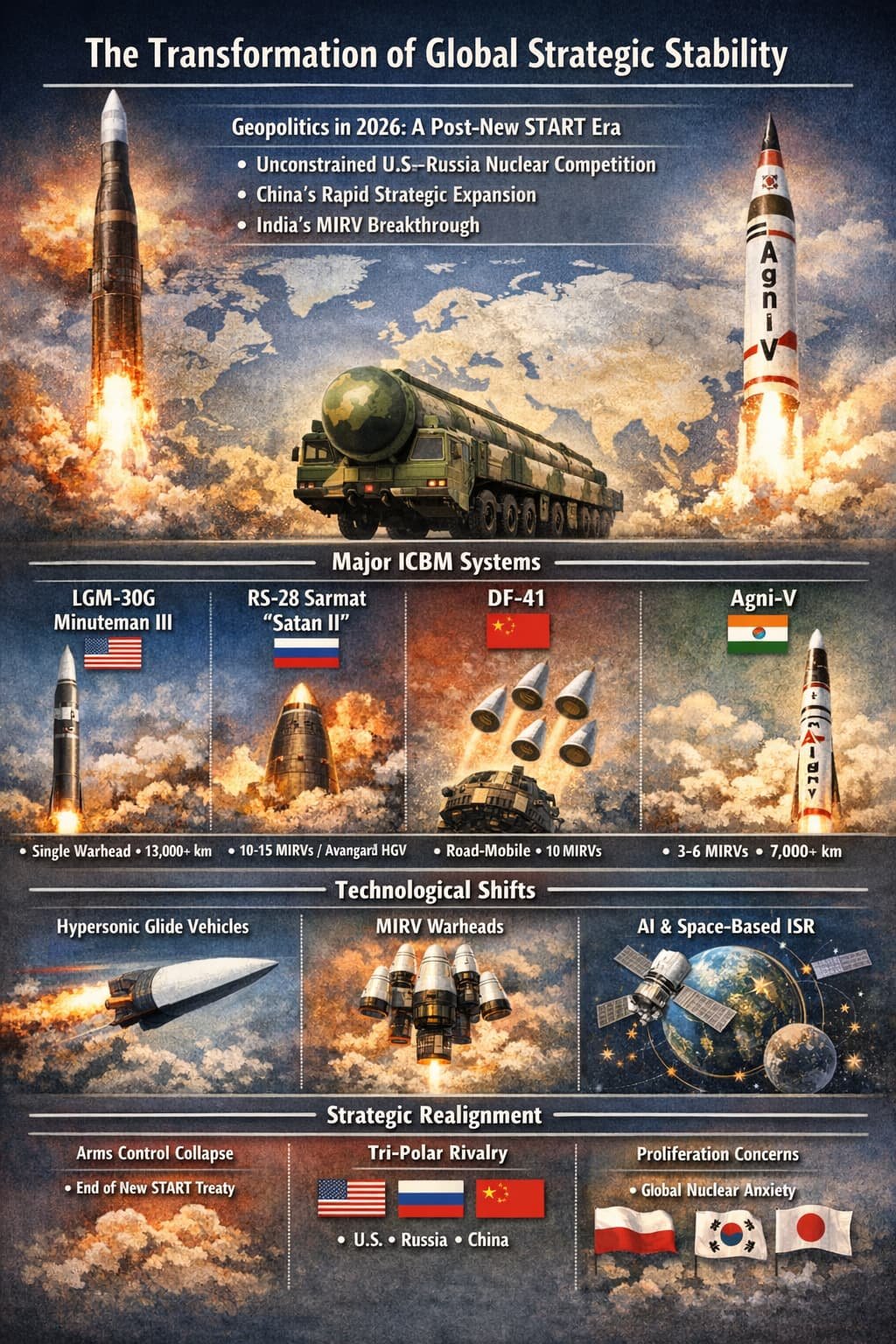
The United States: The Minuteman III Legacy and the Sentinel Transition
The land-based deterrent of the United States rests upon the LGM-30G Minuteman III, a weapon system that has remained in continuous service since 1970. Originally designed during the height of the Cold War to penetrate Soviet anti-ballistic missile (ABM) defenses around Moscow, the Minuteman III introduced the world to MIRV technology, although arms control agreements eventually reduced its operational deployment to a single warhead per missile.
Technical Architecture of the Minuteman III
The Minuteman III is a three-stage, solid-fuel ICBM characterized by its rapid launch capability and high operational reliability. Its propulsion system is a testament to 1960s and 70s engineering, refurbished over decades to maintain viability. The first stage, an Orbital ATK-refurbished M55, generates 202,600 pounds of thrust ($F$); the second stage, an SR19, produces 60,721 pounds; and the third stage, an SR73, delivers 34,400 pounds.
| Technical Specification | LGM-30G Minuteman III |
| Manufacturer |
Boeing |
| Propulsion |
Three-stage, Solid-propellant |
| Length |
18.2 meters |
| Diameter |
1.85 meters |
| Launch Weight |
34,467 kg |
| Operational Range |
13,000+ km |
| Payload |
Single W78 or W87 warhead (300-475 kt) |
| Accuracy (CEP) |
~120 meters |
| Basing Mode |
Hardened underground silos |
The Minuteman III utilizes an inertial guidance system, specifically the NS-50, which provides a Circular Error Probable (CEP) of approximately 120 meters. This precision, combined with a range of over 13,000 kilometers, allows the United States to hold at risk a wide array of hardened military targets globally. Despite its age, the system remains highly responsive, as solid fuel permits the missile to remain on “combat alert” for extended periods without the volatile fueling procedures required by liquid-fueled systems.
The LGM-35A Sentinel: A Modernization Crisis
By 2026, the urgency of the LGM-35A Sentinel program—the intended replacement for the Minuteman III—has reached a critical state. The Minuteman III has been extended decades beyond its original ten-year design life, and its supporting infrastructure, including silos and command centers, dates back to the 1960s. The Sentinel program is designed to provide a comprehensive modernization of the land-based triad, incorporating modular silos and a new missile with greater range, accuracy, and payload flexibility.
However, the Sentinel program has been plagued by significant delays and cost overruns, triggering a Nunn-McCurdy breach in 2024. One of the most complex aspects of the program is the infrastructure. While the Air Force initially planned to repurpose existing Minuteman III silos, it eventually determined that constructing 450 entirely new silos would be more efficient. These new silos utilize modern modular construction methods, avoiding the complications of refurbishing 60-year-old structures that would have been 150 years old by the end of the Sentinel’s service life.
Because the Sentinel’s Initial Operational Capability (IOC) has been pushed to the early 2030s, the United States must continue to operate the Minuteman III potentially into the 2050s. This requires an intensive sustainment effort to manage the risks associated with an aging fleet, including the refurbishment of motors and the modernization of guidance electronics to ensure the deterrent remains credible in a post-New START environment where Russia and China are deploying significantly newer systems.
Russia: The Super-Heavy Sarmat and Mobile Yars Systems
Russia’s strategic rocket forces (RVSN) follow a design philosophy that differs markedly from that of the United States. While the U.S. has favored a single, standardized, solid-fueled ICBM for its land-based leg, Russia maintains a diverse arsenal composed of both super-heavy silo-based liquid-fueled missiles and survivable, road-mobile solid-fueled systems.
RS-28 Sarmat: The “Satan II” Behemoth
The RS-28 Sarmat is the world’s most powerful ICBM, designed to replace the Soviet-era R-36M2 Voevoda (SS-18 Satan). As a “heavy” ICBM, the Sarmat is a three-stage, liquid-fueled missile of immense proportions, standing 35.3 meters tall with a diameter of 3.0 meters and a launch weight exceeding 208,000 kilograms.
| Technical Specification | RS-28 Sarmat (SS-X-30) |
| Designer |
Makeyev Rocket Design Bureau |
| Propulsion |
Three-stage, Liquid-fueled |
| Launch Weight |
208,100 kg |
| Maximum Range |
18,000 km |
| Payload Capacity |
10,000 kg |
| Warhead Config |
10-15 MIRVs or 3 Avangard HGVs |
| Unique Feature |
FOBS and South Pole Trajectory |
The Sarmat’s liquid-fuel propulsion provides a high specific impulse, allowing it to carry a massive payload of up to 10 tons. This payload can include 10 to 15 heavy MIRVs, each with a yield of 750 kilotons, or a combination of warheads and sophisticated countermeasures designed to overwhelm missile defenses. One of the Sarmat’s most strategically significant capabilities is its Fractional Orbital Bombardment System (FOBS) technology. This allows the missile to be launched on a sub-orbital trajectory over the South Pole, enabling it to approach targets in the United States from the south—bypassing the vast majority of U.S. early-warning radars and interceptors, which are oriented toward the North Pole.
Despite its formidable specifications, the Sarmat has faced developmental challenges. By late 2025, reports indicated that the system had experienced five failed tests since its initial 2022 flight, suggesting that Russia’s declaration of “combat alert” status for the missile in late 2023 may have been premature.
RS-24 Yars: Survivability through Mobility
The RS-24 Yars (SS-27 Mod 2) serves as the more flexible and survivable component of the Russian land-based leg. A three-stage, solid-fuel ICBM, the Yars is designed for both silo-based and road-mobile deployment. The mobile variant is carried by an 8-axle MZKT-79221 transporter-erector-launcher (TEL), making it exceptionally difficult for adversary ISR (Intelligence, Surveillance, and Reconnaissance) assets to locate and target.
The Yars is a MIRVed evolution of the Topol-M, carrying up to ten warheads with yields between 150 and 300 kilotons each. It features a rapid launch time of approximately seven minutes and incorporates advanced maneuverable re-entry vehicles (MaRVs) and active decoys to evade interceptors. This emphasis on mobility and penetration makes the Yars the foundational element of Russia’s second-strike capability, ensuring that a significant portion of the arsenal would survive an initial counterforce strike.
China: The Strategic Breakout and the “Great Wall of Silos”
China’s nuclear posture in 2026 is defined by a rapid and historic expansion, moving from a decades-long policy of “minimum deterrence” to a robust and diverse force capable of “Two Peer” competition. This expansion is anchored by the DF-41 ICBM and a massive construction program of hundreds of new silos.
DF-41: The Advanced Mobile Threat
The Dong Feng-41 (DF-41) is China’s most advanced ICBM, representing a significant leap in range and technology over the older liquid-fueled DF-5. A three-stage, solid-fuel missile, the DF-41 has a range estimated between 12,000 and 15,000 kilometers, allowing it to reach any point in the continental United States from deep within China.
| Technical Specification | DF-41 (CSS-20) |
| Class |
Intercontinental Ballistic Missile (ICBM) |
| Propulsion |
Three-stage, Solid-propellant |
| Length |
20–22 meters |
| Diameter |
2.25 meters |
| Launch Weight |
80,000 kg |
| Warheads |
Up to 10 MIRVs |
| Guidance |
Inertial with BeiDou/Stellar updates |
| Basing |
Road-mobile, Rail-mobile, Silo |
The DF-41 utilizes the BeiDou satellite navigation system and stellar updates to achieve an accuracy of approximately 100 meters CEP. Like the Russian Yars, its primary deployment mode is on a heavy road-mobile TEL, which provides high survivability. However, China has also successfully tested rail-mobile variants and has recently begun integrating the DF-41 and the newer DF-31B into vast new silo fields.
Silo Construction and the DF-31B
By late 2025, China had likely loaded more than 100 solid-propellant ICBMs into silos at three major fields in Yumen, Hami, and Hanggin Banner. These fields combined are capable of hosting up to 320 launchers, a massive increase from the roughly 20 liquid-fueled silos China operated for decades. The 2025 China Military Power Report (CMPR) confirmed the existence of the DF-31B, identifying it as the missile launched into the Pacific Ocean in September 2024.
This shift to silo-based solid-fueled missiles indicates that China is adopting a “launch-on-warning” posture, mirroring the high-readiness states of the U.S. and Russia. While satellite imagery has revealed potential corruption-related issues, such as malfunctioning silo lids, the overall trend is one of a rapidly modernizing and expanding force that is expected to reach 1,000 warheads by 2030.
India: Achieving Credible Reach with the Agni-V
India’s strategic evolution reached a watershed moment in March 2024 with “Mission Divyastra”—the first successful flight test of the Agni-V equipped with MIRV technology. This development elevates India into an exclusive group of nations possessing the capability to strike multiple, widely separated targets with a single missile, fundamentally altering the strategic balance in South Asia and beyond.
Agni-V Technical Specifications and Mission Divyastra
The Agni-V is a three-stage, solid-fuel ICBM developed by the Defence Research and Development Organisation (DRDO). While officially classified by India as an Intermediate Range Ballistic Missile (IRBM) with a 5,000-kilometer range, its performance parameters suggest a true intercontinental reach of 7,000 to 8,000 kilometers.
| Technical Specification | Agni-V |
| Development |
DRDO, India |
| Propulsion |
Three-stage, Solid-propellant |
| Launch Weight |
~50,000 kg |
| Warhead Config |
3–6 MIRVs (future capability 10–12) |
| Accuracy (CEP) |
< 10 meters |
| Guidance |
RLG-INS with NavIC/GPS support |
| Launch Mode |
Canisterized, Road-mobile |
The Agni-V represents the pinnacle of Indian missile engineering. It utilizes a canister-launch system, where the missile is kept in a hermetically sealed environment and “cold-launched” via pressurized gas before the first-stage ignition. This technology ensures high road mobility, rapid deployment, and increased survivability against a preemptive strike. The use of lightweight composite materials for the second and third stages has reduced the missile’s weight by 20% compared to earlier Agni variants, further enhancing its range and payload efficiency.
The accuracy of the Agni-V is among the highest for its class, with a CEP of less than 10 meters. This precision is achieved through a Ring Laser Gyroscope-based Inertial Navigation System (RLG-INS) and a Micro Inertial Navigation System (MINGS), supported by both the Indian NavIC and the American GPS constellations.
Doctrinal Significance
India’s nuclear posture is guided by the principles of “No First Use” (NFU) and “Credible Minimum Deterrence”. The Agni-V is not intended for aggressive first-strike scenarios but rather as a guaranteed second-strike weapon. The integration of MIRVs is a critical component of this strategy; it allows India to maintain a smaller overall arsenal while ensuring that even a few surviving missiles could overwhelm an adversary’s advanced missile defenses to deliver a devastating retaliatory blow. This capability is specifically viewed as a deterrent against China’s expanding anti-ballistic missile systems and its own growing ICBM fleet.
Technical Dissection: Propulsion Physics and Basing Modes
The choice between solid and liquid propulsion is not merely a matter of fuel chemistry but a fundamental strategic decision involving readiness, maintenance, and payload capacity.
Solid vs. Liquid Propulsion
Modern ICBM designers generally prefer solid fuel for its operational advantages. Solid propellants consist of a fuel and an oxidizer cast together into a single “grain”.
-
Readiness and Maintenance: Solid-fuel missiles like the Minuteman III, DF-41, and Agni-V can be stored for decades and launched in minutes, as they do not require fueling before flight. They are also safer to handle, as they do not involve the toxic and corrosive hypergolic fuels often used in liquid systems.
-
Physics of Performance: The performance of a rocket engine is measured by its specific impulse ($I_{sp}$), which defines the velocity the engine can impart to the rocket per unit of propellant mass.
$$I_{sp} = \frac{F}{\dot{m} g_0}$$Where $F$ is thrust, $\dot{m}$ is the mass flow rate, and $g_0$ is standard gravity. Liquid fuels generally offer a higher specific impulse than solid fuels, which is why Russia chose liquid propulsion for the massive Sarmat. To deliver a 10-ton payload over 18,000 kilometers using solid fuel, the missile would need to be prohibitively large and difficult to transport.
Basing Modes and Survivability
The “basing” of an ICBM—how and where it is stored—determines its vulnerability to a first strike.
-
Hardened Silos: The U.S. and Russia utilize underground silos made of reinforced concrete and steel to protect missiles from the overpressure of a nuclear blast. While silos offer high readiness, their locations are fixed and well-known to adversaries, making them targets for “counterforce” strikes.
-
Road and Rail Mobility: The Russian Yars and Chinese DF-41 utilize heavy Transporter-Erector-Launchers (TELs) to move through vast regions, making them “mobile targets”. This drastically increases survivability, as an adversary would need a constant real-time ISR loop to target a moving TEL.
-
The “Shell Game”: China’s recent construction of hundreds of silos may be intended to facilitate a “shell game” strategy, where a smaller number of missiles are moved between a large number of silos to complicate adversary targeting.
The MIRV Revolution and Defense Evasion
A primary driver of ICBM development in 2026 is the need to penetrate increasingly sophisticated missile defense systems.
MIRV and Post-Boost Vehicles
A MIRV-equipped missile carries a “bus” or post-boost vehicle (PBV) atop its final stage. After the missile reaches the vacuum of space, the PBV maneuvers using small thrusters to drop individual warheads onto different ballistic trajectories.
-
Saturation of Defenses: A single MIRVed missile can release 10 warheads, requiring a defender to launch 20 or more interceptors (assuming two interceptors per target) to ensure success.
-
Miniaturization: Mastering MIRV technology requires the ability to build high-yield nuclear warheads that are small and light enough for the PBV to carry multiple units. India’s Mission Divyastra signifies that DRDO has achieved this level of miniaturization.
Hypersonic and Maneuverable Re-entry
Beyond MIRVs, the advent of Hypersonic Glide Vehicles (HGVs) represents the next frontier in evasion.
-
Avangard (Russia): Integrated with the Sarmat, the Avangard HGV glides in the upper atmosphere at speeds of Mach 20-27. Because it maneuvers within the atmosphere rather than following a fixed ballistic curve, it can fly under the coverage of mid-course interceptors and strike with almost zero warning.
-
Countermeasures: Most modern ICBMs, including the Yars and DF-41, also deploy “penetration aids” (PENAIDS), such as inflatable decoys and chaff, designed to mimic the signature of a warhead and confuse enemy radars.
Emerging Technologies: AI, Space, and Cyber in 2026
The technological competition of 2026 extends beyond the physical missile to the digital and orbital domains.
AI in Strategic Force Management
Artificial Intelligence is being integrated across the nuclear enterprise to enhance decision-making and operational resilience.
-
Predictive Maintenance: For the aging U.S. Minuteman III fleet, AI algorithms analyze sensor data to predict component failure before it occurs, ensuring the missiles remain on alert.
-
Target Acquisition and ISR: AI-powered analysis of satellite imagery allows for faster detection of mobile TEL movements, while automated command and control (C2) systems can accelerate the “sensor-to-shooter” timeline in a crisis.
The Role of Space-Based Assets
Global Navigation Satellite Systems (GNSS) have become integral to ICBM accuracy.
-
Precision Updates: While ICBMs primarily use inertial guidance, modern systems like the Agni-V and DF-41 use satellite updates (NavIC and BeiDou) to correct for “drift” in the inertial gyroscopes, enabling near-pinpoint accuracy over 10,000+ kilometer flights.
-
Resilient PNT: In 2025-2026, there is an increased focus on “GNSS-denied” navigation, utilizing laser-aided inertial solutions and stellar navigation to ensure accuracy even if satellites are jammed or destroyed during a conflict.
Geopolitical Realignment: The Post-New START Environment
The expiration of New START has ushered in a period of profound strategic uncertainty. For decades, the treaty provided a framework for transparency through on-site inspections and data exchanges between the U.S. and Russia.
The Collapse of Arms Control
The demise of New START follows the previous collapses of the INF Treaty and the Open Skies Treaty, leaving the international system without any formal guardrails for nuclear competition.
-
Unconstrained Russia: Russia is now free to expand its strategic forces beyond the treaty limit of 1,550 warheads. While Moscow may not immediately rush into a massive buildup, the freedom to “upload” additional MIRVs onto the Yars and Sarmat creates an unpredictable environment for U.S. planners.
-
The China Factor: China’s refusal to join any arms control framework until it achieves numerical parity has become the primary driver of U.S. nuclear modernization. This “tri-polar” competition is fundamentally more unstable than the Cold War bilateral balance, as a move by one player can trigger reactive expansions by the other two.
The Erosion of Non-Proliferation
The renewed arms race between the “Big Three” has placed significant strain on the Non-Proliferation Treaty (NPT). Non-nuclear states in Europe and Asia, such as Poland, South Korea, and Japan, are increasingly questioning the reliability of the U.S. “nuclear umbrella” and may reconsider their own nuclear abstinence.