Romania: Global Diplomatic
Since emerging from communism in 1990, Romania has steadily integrated into Euro-Atlantic institutions. Today it is a NATO and EU member (joined 2004 and 2007 respectively) and a stable partner of the United States and European Union. Romania maintains friendly ties with neighbors (Hungary, Bulgaria, Moldova) and balances relations with major powers (it aligns with EU/U.S. policy toward Russia and China while deepening pragmatic cooperation with India and other global South partners). Economically, Romania’s trade is dominated by EU markets – Germany, Italy, France, Hungary, etc. – with growing exports in machinery, auto parts, and agriculture. It also engages India (bilateral trade ~$3B in 2023–24) and participates in global supply chains (energy pipelines, industry). In defense, Romania hosts NATO forces (U.S. missile-defense base in Deveselu) and participates in Alliance missions, while keeping Mediterranean and Black Sea security ties. Culturally, the Romanian diaspora of several million (especially in Italy, Spain, Germany) is influential. Romania champions climate and renewable goals in the EU (notably joining the International Solar Alliance in 2023) and cooperates on space and AI (via its space agency ROSA and EU R&D programs). The following sections detail Romania’s global ties under the requested headings.
1. Global Diplomatic Ties
Romania’s diplomacy is shaped by its EU and NATO memberships. It maintains close relations with EU partners and the U.S.. For example, Romania regularly aligns with U.S.-EU policy on Russia’s actions. It has a strategic partnership with France and Germany (large Romanian diasporas in each country). With China, Romania engages in trade and has joined Chinese-led initiatives (e.g. a 2017 Belt and Road MoU) but also adheres to EU positions on technology and human rights. Relations with Russia are cautiously neutral-to-guarded: Romania abides by EU sanctions against Russia post-2014, though it maintains dialogue (e.g. on gas transit) and has a Russian minority in the northeast.
Neighbors: Romania is traditionally close to Moldova (shared language); it supports Moldova’s EU aspirations. It has good relations with Bulgaria (economic cooperation, EU). With Hungary, relations were once tense over minority rights but now focus on trade and infrastructure. Romania has no active land border disputes. A notable exception was the Black Sea maritime frontier with Ukraine: Romania took the issue to the International Court of Justice (2009), winning about four-fifths of its claim to offshore oil/gas areas. Romania also participates in the EU’s Eastern partnership and has expressed solidarity with Ukraine after 2022, sending aid and accepting refugees.
Global South & India: Romania cultivates growing ties with Asia and Africa. It hosted the inaugural EU-India Summit in 2000 (Bucharest) and continues friendly India relations. India–Romania relations (75 years of ties as of 2023) are warm, with mutual support at the UN. Bilateral trade hit ~$3 billion in FY2023–24. Romania and India cooperate in tourism, culture and technology (Romania joined India’s International Solar Alliance in 2023). Romania also engages Latin America and Africa through EU channels and UN peacekeeping contributions.
- Anecdote: India and Romania marked 75 years of diplomatic relations in 2023, often backing each other in UN votes.
- Anecdote: Romania and Ukraine resolved their 2004 offshore border dispute at the ICJ (2009); the ruling granted Romania about 80% of the contested Black Sea gas reserves.
2. Geopolitics & Strategy
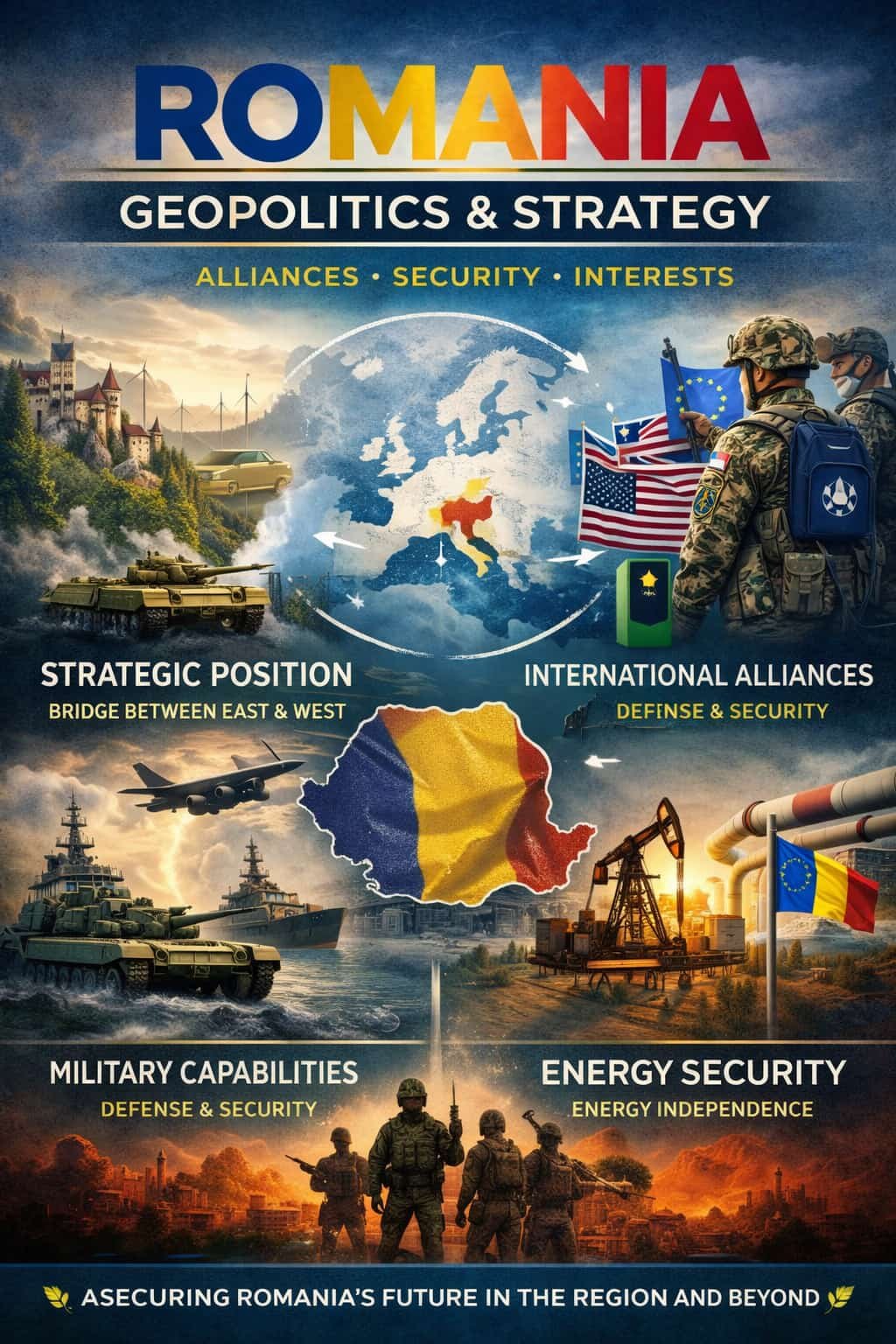
Romania’s strategy centers on anchoring in the EU/NATO while also projecting influence in its region. It has an active role in NATO, which it joined in 2004. Romania hosts NATO assets like the U.S. Aegis Ashore missile-defense base at Deveselu (operational from 2016), reflecting its strategic location near the Black Sea. It contributes to NATO missions (e.g. in Kosovo, Baltic air policing, and Afghanistan). In the EU Council, Romania supports deeper integration and “European strategic autonomy” (including in defense). Romania also co-founded the EU’s Eastern Partnership and is part of regional initiatives like the Danube Commission.
In the UN, Romania serves as a non-permanent Security Council member (for terms 2004–05, 2014–15, and again 2024–25). It uses this platform to advance peacekeeping and development agendas, and to voice concerns about regional security. At UN votes, Romania typically aligns with Western blocs, but it also emphasizes support for development goals.
Regional choke points: Control of the Black Sea and Danube are key. Romania patrols the Black Sea alongside NATO allies, wary of Russian moves. It shares the Danube River (an EU border with Serbia, Ukraine) and participates in the EU Danube strategy (investment in ports, flood control). Romania gained direct access to the Turkish Straits, making it a NATO frontline state.
- Anecdote: In 2023, Romania formally joined the International Solar Alliance (launched by India) as a founding member in December, reflecting its diplomatic engagement in climate-security forums.
3. Global Economy & Trade
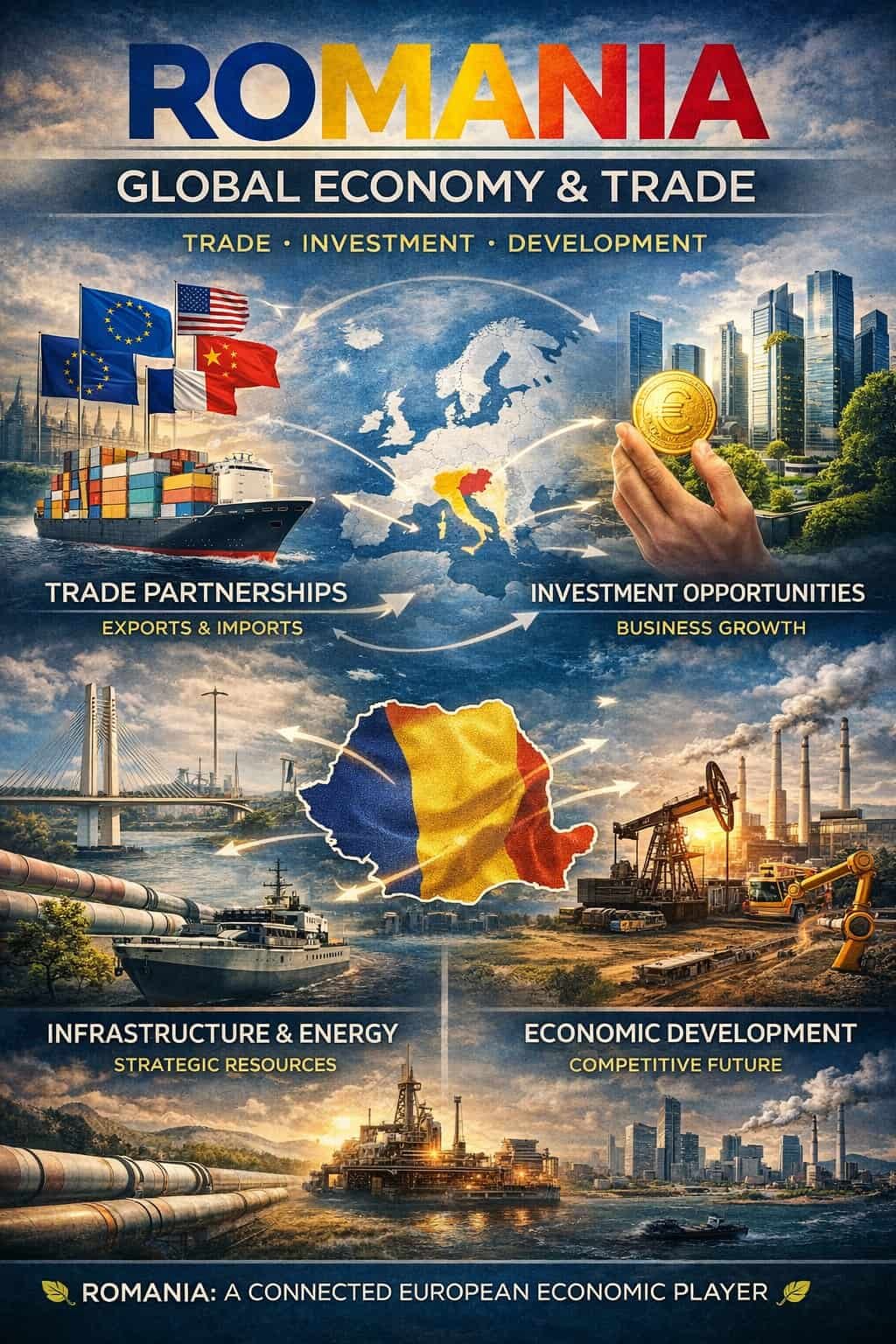
Romania’s economy is medium-sized (GDP ~$300B). As an EU member, over 70% of its exports stay within the EU. Its top trading partners (2024) were EU neighbors: Germany (20.5% of exports), Italy (9.6%), France (6.3%), Hungary (5.3%), Bulgaria (4.4%), and Poland (4.0%). Together these six accounted for ~50% of exports. Global distribution is heavily Euro-centric: 84.3% of exports go to Europe. Non-EU trade is smaller: Romania’s largest non-EU partner is Turkey (~3.6% of exports). China is a minor direct partner (~0.8%).
{chart} Figure: Romania’s top export markets (2024)
(Germany leads, followed by Italy, France, etc., totaling ~50% of exports.)
Exports: Romania sells machinery (cars, trucks, electrical equipment), metallurgy (steel, aluminum), and agricultural products (corn, wheat). It is an auto manufacturing hub (Dacia Renault, Ford) and a growing IT exporter. Imports: Energy (oil, gas, coal), machinery, electronics and consumer goods (often from Germany and Italy). Food and chemical imports also significant.
Energy & supply chains: Romania is a net exporter of electricity (mostly hydro and nuclear). It has natural gas and oil fields (but is still a net gas importer via pipelines from the Caspian and Hungary). It participates in regional gas corridors (e.g. via Ukraine) and in 2022 supported EU gas solidarity (receiving more Azeri gas). In global value chains, Romanian factories supply parts to Western European companies (especially autos and appliances). FDI flows mainly from the EU (e.g. in manufacturing, banking). As an EU member, it enjoys the EU’s free trade agreements (CETA with Canada, etc.) and shares in EU external tariff policies (e.g. US steel tariffs). It also has a small bilateral FTA network (e.g. with Turkey).
Trade with India: Bilateral trade is modest (~$3B in 2023-24). Romania mainly imports Indian pharmaceuticals, textiles and chemicals, while exporting to India industrial machinery, vehicles and agricultural products. They have a Joint Economic Committee (JEC) to explore opportunities. Romania’s EU membership means it largely trades with India under EU-India agreements. There is potential for growth, as seen by rising auto parts exports and IT partnerships.
4. Global Security & Defense
Romania is firmly in Western security structures. It is a NATO member, contributing troops to Alliance missions. It also partakes in EU defense initiatives (Battlegroups, CARD defense review). Romania maintains bilateral defense ties with the US (Stationing US troops, joint exercises like Saber Guardian) and with allies in Central Europe and the Black Sea.
Alliances & exercises: Besides NATO, Romania co-founded the Black Sea Cooperation initiative (with Turkey, Georgia) to secure maritime routes. It hosts joint NATO drills, e.g. with U.S. and other allies in C4I exercises. Romania also participates in UN peacekeeping (in Mali, Afghanistan, etc.) and is open to joint training with other partners (e.g. it signed a defense cooperation MoU with India in 2017 for exchange of know-how on peacekeeping).
Arms trade: Romania’s own arms industry (e.g. Dacia armored vehicles, helicopter factories) exports regionally, but its arms imports come from NATO allies: mainly Italy, France, and the US for air defense (Patriot missiles) and aircraft (F-16 jets acquired 2016 from Norway, financed by the US). It used to procure Russian hardware during the Cold War, but today has no Russian equipment procurement.
Security concerns: Romania is active against terrorism (supporting NATO/UNCTED efforts). It maintains cyber defense forces (joining NATO cyber exercises). It patrols its Black Sea coastline to protect against smuggling or aggression. Romania also cooperates internationally against human trafficking and narcotics via EUROPOL and Balkan routes. Maritime security involves coordination with Turkey and Ukraine to secure Black Sea shipping (Romanian navy operates in multinational Black Sea Task Force).
- Anecdote: Romania’s diaspora has become a political force. For example, by the 2019 elections, over 500,000 Romanians abroad voted, helping re-elect President Klaus Iohannis.
5. Soft Power & Diaspora
Romanian culture and people project soft power primarily in Europe. There are 8–12 million Romanians living outside Romania (by one estimate), mostly in Europe (Italy, Spain, Germany, UK). The diaspora is politically engaged – diaspora voting notably influenced Romania’s 2014 and 2019 elections.
Romanians abroad often transmit Romanian culture. Traditional crafts (Mărțișor spring amulets) and the legend of Dracula draw tourists. Romania’s folk music, dance, and gymnastics performers (e.g. Nadia Comăneci) have international recognition. In India, there is a small Romanian academic community and some Bollywood popularity (Romanian actress Florin Piersic cameo, for example). Romanian academic institutions host a few Indian PhD students (particularly in science and medicine).
The country also tries to boost soft ties through initiatives: It opened Romanian Cultural Institutes in many capitals, promotes the Transylvanian heritage, and brands itself (tourism campaigns on castles, nature). Its film industry has gained acclaim (Cannes-winning director Cristian Mungiu), which raises visibility. In education, Romania offers scholarships (for example, to Moldovan and Indian students).
6. Global Environment & Tech
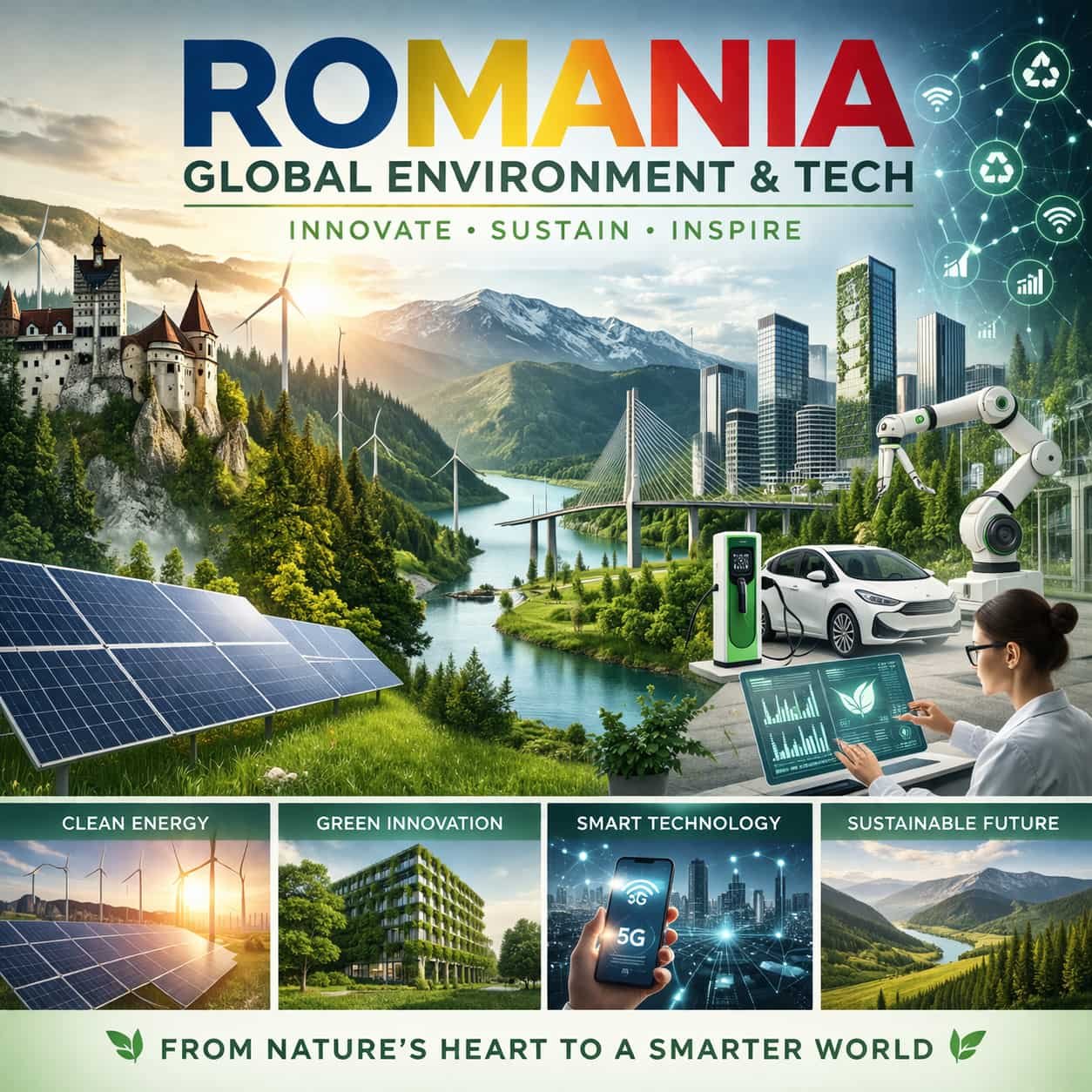
Romania follows EU climate policy (the Green Deal). It targets 42% renewable energy by 2030 in total energy consumption (EU-wide goal) and agreed to a 2022 national plan to reach ~30.7% renewables by 2030. Renewables in Romania are ~25% of electricity (hydro ~30%, wind ~23%, solar ~13% of capacity). Romania has significant potential for biomass and solar, and it recently raised its solar/wind investment plans. It also has a growing electric car market and is rolling out EV charging networks.
International cooperation: Romania ratified the Paris Agreement and participates in COP climate talks as part of the EU bloc. In 2023 it formally joined India’s International Solar Alliance. It is part of EU research on carbon capture and is upgrading its grid for renewables.
Space and tech: Romania’s space agency (ROSA) partners with ESA (joined 2011) and NASA on Earth observation missions (e.g. Cospas-SARSAT satellites). It builds small satellites and space hardware (e.g. Dr. Țurcan’s work on nano-satellites). In AI, Romania is home to a vibrant tech sector (Bucharest known as a tech hub) and participates in EU AI initiatives. It has some partnerships with India: for instance, a MoU on IT in 2019 and joint research projects under Horizon Europe.
Environmentally, Romania also works on the Danube and Carpathians conservation. It is a party to Arctic shipping agreements (due to Danube-Black Sea link) and is keen on protecting its forests.
Table: Top 8 Bilateral Partners
| Partner | Diplomacy | Trade (2024) | Defense | Technology/Science |
|---|---|---|---|---|
| Germany | Close EU ally; hosts largest Romanian diaspora | Largest trading partner (20.5% of exports) | NATO ally; high-tech military equipment and joint projects (tank training, etc.) | Collaborates on automotive tech (Dacia-Renault), research programs (Horizon Europe) |
| Italy | Warm relations; second-largest diaspora | 9.6% of exports; major remittances from emigrants | NATO ally; procurement of helicopters and naval tech | Shared cultural links; joint work in infrastructure (e.g. highways), research |
| France | Strategic EU partner; co-founder of EU | 6.3% of exports; defense contracts (aircraft engines) | NATO ally; major arms supplier (Rafale jets discussions, SAMs) | Nuclear energy (cooperation on Cernavodă nuclear plant); space (ESA membership) |
| United States | Key security partner (NATO ally) | ~2–3% of trade; imports U.S. tech, medical goods | Bilateral defense (Patriot missiles, joint exercises, intelligence sharing) | Technology transfers (IT, biotech); space cooperation (ROSA-NASA data-sharing) |
| China | Pragmatic ties; growing economic dialog | ~0.8% of exports; imports electronics, machinery | No military alliance; limited arms imports in past | Engagement in infrastructure (tentative Belt & Road projects); telecommunications (Huawei) |
| Hungary | Regional neighbor; part of V4 group | ~5.3% of exports; minority rights dialogue | V4/NATO cooperation; cross-border infrastructure | Joint energy projects (gas interconnectors), EU-funded tech initiatives |
| Poland | Friendly V4 partner (Central Europe) | ~4.0% of exports; growing trade ties | NATO ally; coordinated regional defense exercises | Collaboration on IT and agritech via EU programs |
| United Kingdom | Partner through trade/education | ~3.1% of exports; significant diaspora community | Historic NATO ally; joint exercises (in Romania or UK bases) | Academic exchanges; financial and fintech links; space cooperation (ROSA-UK partnerships |
Lesser-Known Anecdotes
- Solar Alliance: In December 2023, Romania officially joined India’s International Solar Alliance (ISA) as a founding member. This reflects an unexpected climate partnership: a NATO/EU country aligning with an India-led initiative.
- Diaspora Politics: Romania’s diaspora is unusually influential. For the 2019 presidential election, over half a million Romanians voted from abroad, helping secure the incumbent’s victory.
- UN Mutual Support: India and Romania often back each other in international forums. For example, India (as G20 president) invited Romania to speak at global conferences, underscoring their 75-year friendship.
- Historic Border Win: Romania’s legal victory at the ICJ (2009) settled a long-running dispute over Black Sea oil rights with Ukraine. About 80% of the contested gas reserves ended up on Romania’s side, a rare clean win in international arbitration.
FAQs
-
What are Romania’s main international alliances?
Romania is a member of NATO (since 2004) and the EU (since 2007). It is also part of the United Nations, the WTO, and regional groups like the Danube Commission. It has bilateral treaties (e.g. with the U.S., France) and engages with both Western and Global South partners. -
Who are Romania’s biggest trading partners?
By far its largest partners are EU countries. In 2024, Germany (20.5%), Italy (9.6%), France (6.3%), Hungary (5.3%) and Bulgaria (4.4%) absorbed over half of Romania’s exports. The United States, China and neighbors like Poland and Turkey also figure, but at lower shares. -
What does Romania export?
Key exports include automobiles and parts (it hosts Dacia/Renault and Ford plants), machinery, electronics, steel products, and agricultural goods (corn, wheat). It also exports textiles and IT services. Romania imports petroleum, machinery, and consumer goods. -
Does Romania have any border disputes?
Romania has no current territorial conflicts with neighbors. A noted case was its 2004 claim against Ukraine in the Black Sea; the ICJ resolved this in 2009 largely in Romania’s favor. Minor issues involve the status of the Serpents’ Island and river borders, but all were settled peacefully. -
How does Romania support global security?
It contributes troops to NATO and UN missions (e.g. in Afghanistan and Mali). It hosts NATO infrastructure (such as the Deveselu base). It participates in regional security (Black Sea naval patrols) and NATO exercises. Romania also works with neighbors on border security and shares counter-terrorism intel with allies. -
What is the size of the Romanian diaspora?
Estimates vary, but around 5–8 million people of Romanian origin live abroad. The largest communities are in Italy (~1.05M), Spain (~0.62M), and Germany (~0.91M). Smaller communities are in the UK, U.S., Canada, and Moldova. Many work in construction, healthcare and IT abroad. -
How does Romania influence culture internationally?
Romania’s cultural exports include folk music, dance ensembles, classical composers (Enescu) and acclaimed filmmakers (e.g. Cristian Mungiu). The country markets itself via tourism (Medieval castles, Carpathian nature) and events (film festivals). Romanian language and literature are studied to some extent abroad, especially in Moldova, and bilingual schools exist in parts of Ukraine and Serbia. -
What is Romania’s environmental policy?
Romania follows EU climate goals. It agreed to a renewable energy target (~43% of final energy by 2030). It invests in wind, solar and biomass, building on large hydroelectric and nuclear capacity. Romania signed the Paris Agreement and often attends COP climate conferences as part of the EU bloc. It joined the India-led International Solar Alliance in 2023. -
How does Romania collaborate on science and technology?
Romania cooperates through EU science programs (Horizon Europe) in areas like AI, biotech, and environment. It has a national space agency (ROSA) partnering with ESA and NASA on satellite projects. In India-Romania ties, they’ve signed an R&D agreement in 2022. Romania’s IT sector and engineers are integrated with European and global tech supply chains. -
Are there any unique Romania-related international stories?
Yes – some interesting tidbits include Romania negotiating an EU quota for refugees in 2015, or its engineers helping build Nigeria’s tallest skyscraper. Romania also exported solar panels to war-torn areas in the Middle East as a humanitarian effort. These underscore Romania’s growing international engagement beyond Europe (Source: various news/NGO reports).