Dongfeng-1 ballistic missile. The DF‑1 was China’s first short‑range ballistic missile, entering development in the late 1950s and first tested in November 1960. It was a single‑stage rocket about 17.7 m long and 1.65 m in diameter, weighing ~20.5 t. The DF‑1 was essentially a licensed Chinese copy of the Soviet R‑2 (SS‑2) missile (itself a V‑2 upgrade). It used a liquid‑oxygen and alcohol propellant (RD‑101 engine) and carried a roughly 500 kg high‑explosive warhead. Guidance was by early inertial navigation (vacuum‑tube gyroscopes) with occasional radio corrections. Its maximum range was on the order of 550–590 km, but accuracy was low (CEP on the order of a kilometer or more). The DF‑1 was never armed with a nuclear warhead (China’s first atomic test occurred in 1964) and saw only limited deployment in the 1960s as a training and deterrence system. It was soon superseded by more advanced DF‑2 and later missiles.
Thank you for reading this post, don't forget to subscribe!History
After the 1950 Sino‑Soviet Treaty, the USSR provided China with rocket technology for its first missiles. Chinese engineers at the Fifth Academy reverse‑engineered the Soviet R‑2 (SS‑2) from 1956 onward. The first Chinese test of this design (called the “1059” project or DF‑1) was on 5 November 1960 at Jiuquan Base. That flight used a dummy warhead to validate the rocket. Production was slow (hampered by political turmoil like the Great Leap Forward), but eventually a handful of DF‑1s were built in the early 1960s. They were deployed in fixed silos and launch pads in northern China. The DF‑1 never saw combat and was more of a testbed for developing China’s missile forces. In 1962–1966 China began fielding the improved DF‑2 missile and tested nuclear warheads on it (DF‑1 itself had no nuclear payload). By the late 1960s China had largely moved beyond the DF‑1 design to liquid‑propellant MRBMs (like DF‑3) and eventually solid‑fuel designs.
Design and Propulsion
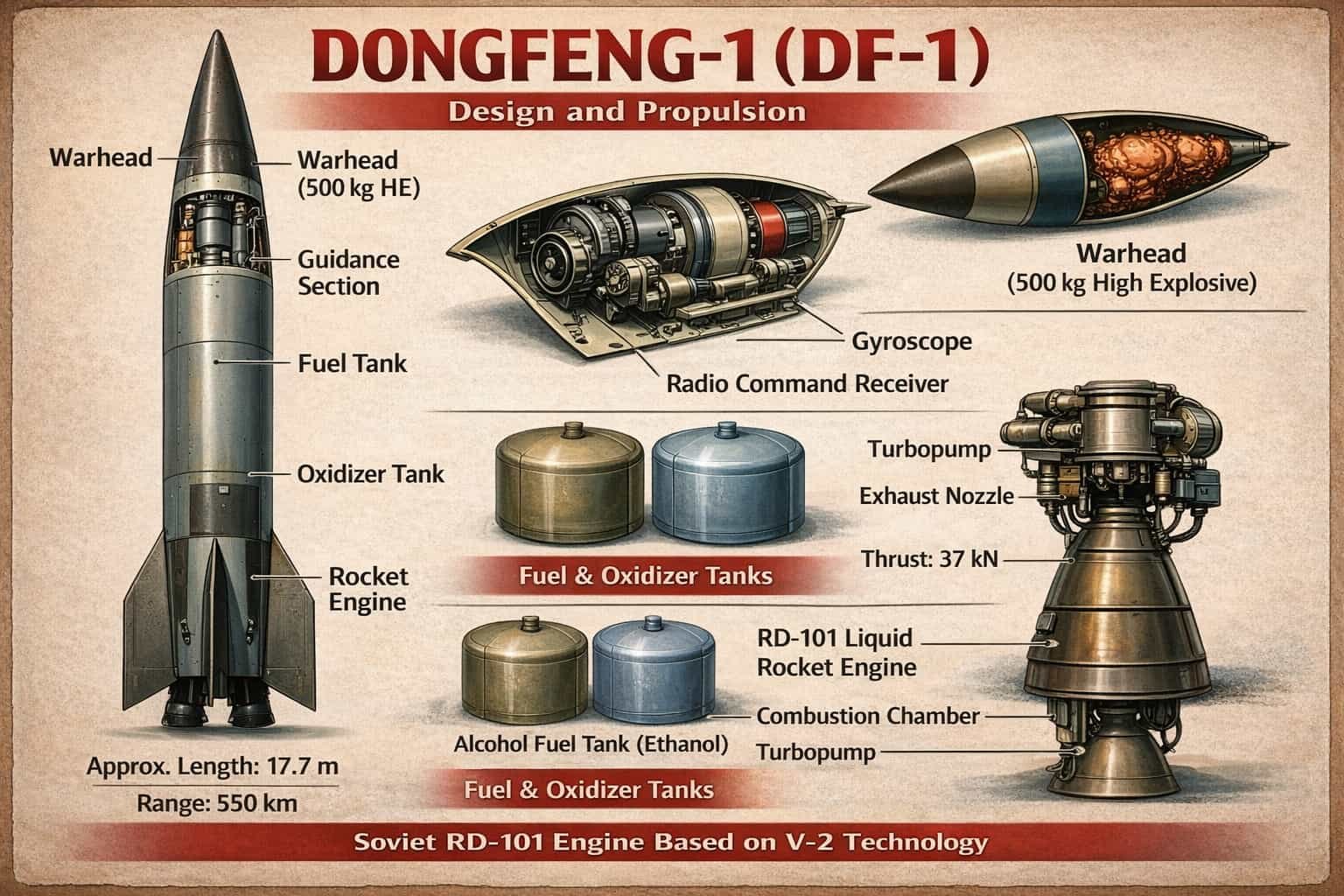
DF‑1 was a single‑stage liquid‑propellant missile (essentially the Chinese R‑2). It was about 17.7 m long, 1.65 m in diameter, and weighed ~20.5 t at launch. The missile had four fixed tail fins and no separable booster. DF‑1’s engine was the Soviet RD‑101 (built in China), which burned liquid oxygen (LOX) and ethanol fuel. At liftoff this produced on the order of 370 kN of thrust (about 37 tonnes-force). The construction was a riveted steel frame (akin to the V‑2 design) that held the fuel tanks and engine, as seen in museum displays. Its overall design was straightforward and strongly based on the R‑2/V‑2 lineage. According to sources, the DF‑1 had a payload capacity of roughly 500 kg (warhead plus fuzing) and a maximum range near 550–590 km. (Heavier payloads reduced range proportionally.) Since it was LOX‑fueled, it could not be held fully fueled indefinitely. Compared to later solid‑fuel missiles, the DF‑1 required extensive preparation (e.g. engine chilldown) before launch.
Guidance and Launch Systems
The DF‑1 used a purely inertial guidance system, with stabilizing gyroscopes steering the missile via vanes in the exhaust. No modern satellite or radar guidance was available, so accuracy was limited. (For context, a comparable Soviet R‑11/“Scud‑A” of the 1950s had a CEP around 3 km.) Some radio ground‑tracking was likely used to correct drift, but overall DF‑1 accuracy remained on the order of kilometers CEP. The missile had to be launched from a fixed ground pad. In practice, DF‑1 was transported to a prepared site, raised on an erector, and then fueled at the base with LOX and alcohol. Because the oxidizer boiled off if left in the missile, launch preparation took hours, similar to other early liquid rockets. A concrete pad or silo was leveled for firing; only after fuel loading (about 15 minutes once fully ready) could the missile be ignited. There were no road‑mobile launchers for DF‑1 (its large launcher vehicles and fuel trailers, like the U.S. Redstone, were bulky and slow).
Warhead Types and Payload
The DF‑1 was designed to carry a conventional warhead. At least one source gives its payload capacity as about 500 kg. This could be a blast‑fragmentation high‑explosive or specialized submunition warhead. Early Chinese strategic plans assumed DF‑1 could eventually carry a nuclear warhead, but China’s first atomic bomb test only occurred in 1964 – well after DF‑1’s introduction. In practice no nuclear warheads were deployed on DF‑1; it served only with inert or high‑explosive warheads.
Range, Accuracy, and Performance
DF‑1’s maximum range was about 550–590 km. This made it a short‑range tactical missile, able to strike targets within China’s region (for example Taiwan or bases in Southeast Asia) but not truly strategic distances. Performance data are limited, but the DF‑1’s use of inertial-only guidance meant its accuracy was poor – likely only on the order of a few kilometers CEP. (By comparison, the Soviet R‑11/“Scud-A” of similar era had CEP ≈3 km.) The missile’s velocity would be a few kilometers per second at burnout, following a roughly parabolic trajectory. Its liquid engine gave moderate thrust (∼37 t), but no staging or clustering (as used in later missiles) meant DF‑1 was relatively simple but had limited range vs. weight.
Deployment and Operational Use
Only limited numbers of DF‑1 missiles were produced and deployed. Deployments began in the early 1960s at China’s northern bases. These missiles were primarily used for training missile crews and establishing operational procedures; they were not combat‑firing missiles in any war. All DF‑1s were ground‑based (no air‑ or sea‑launch versions). By the late 1960s and early 1970s, DF‑1s were gradually phased out as China introduced more capable DF‑2/DF‑3 systems. (Some sources note China had on the order of a few dozen DF‑1s in service, but exact figures are not publicly available.)
Limitations
The DF‑1’s design imposed several limitations. First, its fueling was cumbersome: using liquid oxygen meant long pre‑launch preparation and no quick reaction alert. As noted above, engines needed chill‑down and fueling on site (taking on the order of hours). Second, the missile had poor accuracy by modern standards – effective only against large, soft targets. Third, DF‑1 was immobile except by heavy transport, so it was vulnerable to counterattack if launch sites were revealed. Its single-stage design and fixed pad “soft launch” meant it could not be rapidly redeployed. In short, DF‑1 was a first‑generation system: reliable enough for testing, but soon superseded by storable‑propellant and later solid‑fuel missiles that required far less launch preparation.
Strategic Role
The DF‑1’s strategic role was mainly foundational. It was not a major deterrent on its own, but it jump‑started China’s missile force. By successfully copying the R‑2, China gained experience and training in rocketry. DF‑1 showed China could build and field ballistic missiles, paving the way for more advanced DF‑2/3/4/5 rockets. In a regional sense, DF‑1 gave China a theoretical strike ability against nearby targets, but its limited accuracy and conventional warhead meant it was more a political/technological tool than an effective weapon. In sum, the DF‑1 proved the concept of indigenous ballistic missiles, but its direct impact on strategic balances was modest.
Comparative Table: DF‑1 and Selected Missiles
| Missile (Country) | Era (Deployment) | Range | Payload | Propulsion | Guidance | Accuracy (CEP) | Launch Platform | Mobility | Strategic Role |
|---|---|---|---|---|---|---|---|---|---|
| DF-1 (China) | 1960s | ~550–590 km | ~500 kg | Single-stage LOX/ethanol | Inertial (+radio) | ~km (est.) | Fixed ground pad | Ground (static) | Early SRBM (training, regional deterrent) |
| Redstone (PGM-11) (USA) | Late 1950s – 1960s | ~320 km (200 mi) | ~2,720 kg (6,000 lb) | Single-stage LOX/ethanol | Inertial | ~0.3 km | Ground mobile erector | Ground mobile | Tactical nuclear SRBM / early space launcher |
| R-17 “Scud-B” (USSR) | 1960s – present | ~300 km | ~985 kg warhead | Single-stage kerosene/AK-27I (storable) | Inertial | ~0.45 km | Road-mobile TEL | Highly mobile TEL | SRBM for battlefield/nuclear/chem. strike |
| Agni-I (India) | 2000s–present | 700–1200 km | ~1000 kg | Single-stage solid (HTPB) | Inertial (+THAAD?) | (not publicly known, likely <0.5 km) | Road/rail-mobile TEL | Mobile TEL/Rail | Short‑range IRBM, nuclear deterrent |
Frequently Asked Questions
1. What is the DF‑1 missile?
DF‑1 (Dongfeng‑1) was China’s first domestically built ballistic missile, a copy of the Soviet R‑2 SRBM. It was a single‑stage, liquid‑fuel short‑range missile used in the 1960s.
2. When did DF‑1 first fly and serve?
The DF‑1 had its maiden launch on November 5, 1960. It became operational in the early 1960s and was gradually retired by the early 1970s as newer missiles came online.
3. What propellant does DF‑1 use?
DF‑1 used liquid oxygen (LOX) and ethanol fuel. Its single RD‑101 engine burned LOX (oxidizer) with alcohol (fuel). This required fueling just before launch.
4. How far could DF‑1 fly?
Its maximum range was about 550–590 km. The exact range depended on payload weight.
5. What kind of warheads did DF‑1 carry?
DF‑1 carried up to ~500 kg of warhead. In practice it used conventional high‑explosive warheads. China’s first nuclear test was in 1964, so DF‑1 was never fitted with a nuclear warhead.
6. How accurate was DF‑1?
DF‑1 relied on early inertial guidance. Its accuracy was poor by modern standards – on the order of kilometers CEP. (For example, a similar Soviet R‑11 missile had about 3 km CEP.)
7. How was DF‑1 launched?
It was fired from a fixed ground launcher. DF‑1 had to be transported to a prepared pad, erected, and fueled on-site. Launch preparations (fueling with LOX, etc.) took hours, so it was not a “quick‑reaction” missile.
8. Who operated DF‑1 and where?
DF‑1 was operated by the Chinese Second Artillery Corps (now the Rocket Force). A limited number were deployed at missile bases in northern China during the 1960s.
9. What were DF‑1’s main limitations?
Its liquid‐oxygen fuel required lengthy fueling, it could not be left ready for long, and it was not very accurate. It also had limited range compared to later missiles. These drawbacks (and rapidly advancing tech) meant it was soon replaced by improved designs.
10. How did DF‑1 compare to other countries’ missiles?
DF‑1 was similar to the U.S. Redstone (both were V‑2 descendants, LOX/ethanol fueled, ~200–300 km range) and the Soviet R‑11/Scud series. For example, U.S. Redstone had 320 km range and 300 m CEP, while DF‑1 had longer range but worse accuracy. Later Indian missiles (like Agni-I) are larger, solid-fueled, and much longer range (700+ km). Each reflects its era’s technology and strategic need.
Agni-5 Program, Mission Divyastra
DF – 1