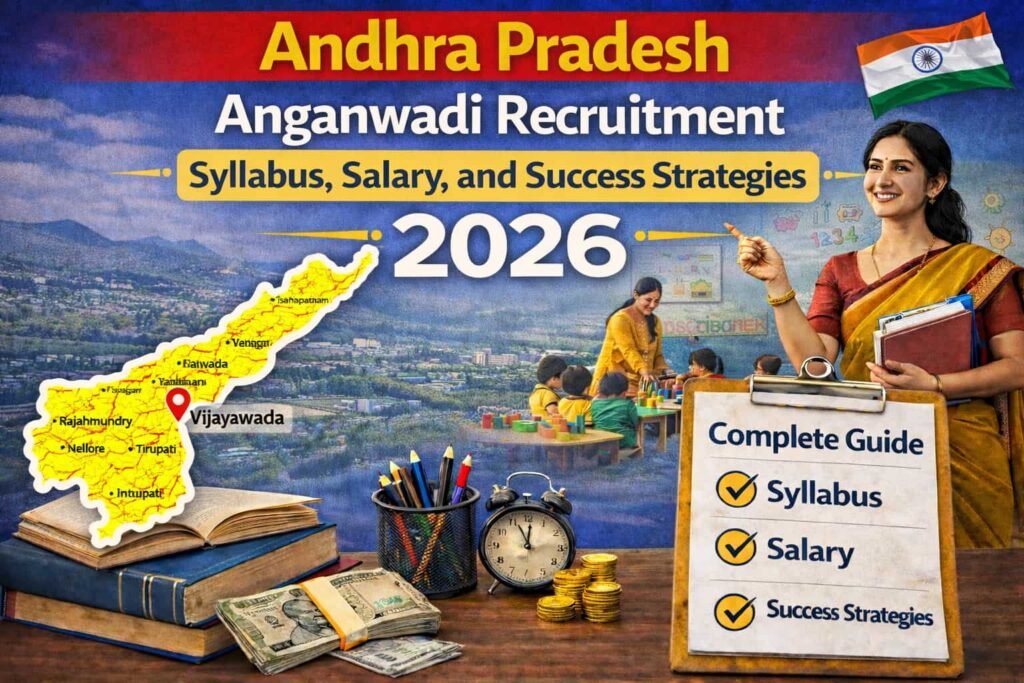
The Integrated Child Development Services (ICDS) scheme is a cornerstone of India’s commitment to early childhood care and maternal health. In Andhra Pradesh, a network of over 55,000 Anganwadi centers serves as the primary delivery mechanism for critical initiatives like the YSR Sampoorna Poshana scheme.
Thank you for reading this post, don't forget to subscribe!The highly anticipated Andhra Pradesh Anganwadi Recruitment 2026 aims to fill an estimated 15,274 vacancies for Anganwadi Workers (AWW) and Helpers (AWH), alongside supervisory roles facilitated by the APPSC. This condensed guide provides a complete overview of the eligibility, exam pattern, syllabus, salary, and preparation strategies for aspirants.
Overview of the 2026 Anganwadi Recruitment
The 2026 recruitment drive offers a monumental opportunity for female candidates seeking stable employment. District Women and Child Development Agencies issue localized notifications to ensure community integration.
| Parameter | Recruitment Details |
|---|---|
| Authority | Department of Women Development & Child Welfare, AP |
| Roles | Anganwadi Worker (AWW), Helper (AWH), Supervisor |
| Vacancies | 15,274 (Workers/Helpers) and 560+ (Supervisors) |
| Application | Offline (CDPO offices) / Online (State portal) |
| Selection | Merit-based (Workers/Helpers); Exam-based (Supervisors) |
| Target | Exclusively female candidates residing locally |
Eligibility Criteria for 2026
The eligibility parameters are designed to ensure the workforce is capable and deeply embedded in the local culture.
- Educational Qualifications: Anganwadi Helpers must pass the 10th standard (8th pass accepted in specific tribal areas). Anganwadi Workers require a strict 10th-class pass. Supervisors (Extension Officer Grade-II) need a Bachelor’s Degree in relevant disciplines like Home Science or Social Work.
- Age Limit: The baseline age for AWWs and AWHs is 21 to 35 years. For APPSC supervisory roles, the entry age is 18 to 35 years. Standard age relaxations apply for reserved categories (SC/ST/BC).
- Residency & Social Priority: Candidates must be permanent residents of the specific ward or village where the vacancy is located. Unmarried women, widows, and divorcees often receive procedural weightage during the merit calculation to foster empowerment.
Selection Process and Exam Pattern
The selection methodology varies strictly based on the administrative level of the post.
For Anganwadi Workers and Helpers: There is no written exam. Selection is entirely merit-based, relying heavily on 10th standard (SSC) marks and absolute locality preference. Shortlisted candidates undergo rigorous document verification at the CDPO office.
For Anganwadi Supervisors (Extension Officers):
- Internal Promotion: Existing AWWs take a 45-mark written test (90 questions) covering ICDS modules, plus a 5-mark spoken English proficiency video assessment.
- Direct Recruitment (APPSC): External candidates face a 300-mark examination divided into two papers. There is a negative marking of 0.33 marks for each incorrect answer.
| Paper | Subject | Questions | Marks | Duration |
|---|---|---|---|---|
| Paper I | General Studies & Mental Ability | 150 | 150 | 150 Mins |
| Paper II | Home Science & Social Work | 150 | 150 | 150 Mins |
In-Depth Syllabus Analysis for Supervisors
Mastering the APPSC syllabus is crucial for aspiring Extension Officers.
- Paper I (General Studies): Focuses on Science & Technology, AP History and Geography, Indian Polity, and the economic implications of the AP bifurcation. The Mental Ability section tests logical reasoning and basic arithmetic.
- Paper II (Home Science & Social Work):
- Food Science: Basic food groups, nutritive values, macronutrients/micronutrients, and therapeutic diets for conditions like Anemia and Malnutrition.
- Child Development: Prenatal care, immunization, child psychology, preschool education frameworks, and national welfare programs (ICDS, POSHAN Abhiyan).
- Social Work: Social reform, casework methodologies, rural community development, and legislation concerning women’s welfare.
Preparation Strategy and Time Management
To succeed in this highly competitive exam, candidates need a scientifically sound preparation strategy and a strict timetable.
Preparation Strategy:
- Deconstruct the Syllabus: Prioritize high-yield technical topics like Child Development and Nutritional frameworks, as they overlap with the actual job profile.
- Mock Tests: The one-third negative marking scheme punishes speculative guessing. Practice with previous APPSC papers to build accuracy.
- Use Primary Sources: Read official government manuals directly, such as the YSR Sampoorna Poshan Pocket Book.
Ideal Daily Time Table:
- 5:00 AM – 7:00 AM: Core conceptual study (Home Science and Social Work). Cognitive fatigue is lowest in the morning.
- 9:00 AM – 4:00 PM: Transit or break-time learning. Use Telugu digital platforms or pocket notes for Current Affairs.
- 6:00 PM – 8:00 PM: Active recall and practice. Solve Mental Ability and General Studies MCQs.
- 8:30 PM – 9:30 PM: Rapid revision of the day’s concepts and a quick look at previous question papers.
Recommended Books (English & Telugu Medium)
Selecting the right study material is critical, especially for regional language candidates.
| Subject | Recommended Book | Author / Publisher |
|---|---|---|
| General Knowledge | Lucent’s General Knowledge | Lucent Publications |
| Reasoning | A Modern Approach to Logical Reasoning | R.S. Aggarwal |
| APPSC Supervisor (Telugu) | Anganwadi Grade-II Supervisors Guide | Major Srinivas |
| Telugu Literature / Culture | Telangana Adhunika Sahitya Charitra | Dr. Sunki Reddy |
| Departmental Policies | YSR Sampoorna Poshan Pocket Book | Dept. of WCD, AP |
Salary Structure and Honorarium
Anganwadi Workers and Helpers are officially classified as “honorary workers.” Their compensation is a fixed monthly honorarium comprising Central and State government shares. Supervisors are regularized government employees.
| Designation | Monthly Salary/Honorarium | Remarks |
|---|---|---|
| Anganwadi Worker | ₹11,500 | Central (₹4,500) + AP State Top-Up (₹7,000) |
| Anganwadi Helper | ₹7,000 | Central (₹2,250) + AP State Top-Up (₹4,750) |
| Supervisor (EO Grade-II) | ₹35,400 – ₹1,12,400 | Regular APPSC Pay Scale + Allowances (DA, HRA) |
Recent strikes in AP resulted in positive changes, including a ₹20 crore budget allocation for gratuity payments, mandatory 1st-of-the-month salary credits, and the provision of 5G smartphones for digital reporting.
Job Profile: Anganwadi vs. ASHA vs. Village Volunteer
Understanding the grassroots administrative web is vital for clarity.
- Anganwadi Worker (WCD Ministry): Operates from a center. Focuses on preschool education, eradicating malnutrition via hot cooked meals (Balamrutham), and maternal counseling. Receives a fixed honorarium.
- ASHA Worker (Health Ministry): Field-based clinical mobilizer. Focuses on universal immunization, escorting women for institutional deliveries, and basic medical aid. Earns largely through task-based incentives.
- Village Volunteer (AP Specific): Handles last-mile doorstep delivery of state welfare schemes and pensions, managing micro-clusters of around 50 households.
Departmental Promotion Hierarchy
The AP government legally codifies administrative mobility, allowing grassroots workers to climb the ladder.
- Helper to Worker: 50% of all vacant AWW posts are reserved for promoting eligible AWHs. Helpers must be under 50, possess a 10th-class pass, and have 5 years of continuous service.
- Worker to Supervisor: 50% of Extension Officer Grade-II vacancies are reserved for existing AWWs. This requires passing the departmental written exam (45 marks) and a spoken English test (5 marks). This promotion elevates a worker from an honorary role to a regularized state employee.
Motivation and Real-World Success
The true motivation for this job lies in the profound social impact. Anganwadi workers are the frontline warriors against severe acute malnutrition (SAM). By tracking child weights and ensuring the consumption of fortified nutrition, they secure the cognitive futures of entire generations.
During the COVID-19 pandemic, this million-strong army pivoted to contact tracing and delivering dry rations door-to-door. To modernize their efforts, the AP government recently distributed over 58,000 5G smartphones to workers, shifting from paper registers to real-time digital monitoring via the Poshan Tracker, pushing center attendance from 70% to 96%. Joining the Anganwadi ranks is an opportunity to be a digitally empowered agent of social transformation.
Top 10 Frequently Asked Questions (FAQs)
Q1: Is there a written exam for the post of Anganwadi Worker or Helper? No. The selection for Workers and Helpers is entirely merit-based, relying primarily on 10th-standard marks and local residency.
Q2: What is the age limit for AP Anganwadi Recruitment 2026? The baseline age limit for Workers and Helpers is 21 to 35 years. For APPSC Supervisor roles, it is 18 to 35 years, with standard category relaxations.
Q3: Can unmarried or widowed women apply? Yes. The state actively encourages applications from unmarried women, widows, and divorcees, often granting them specific procedural weightage.
Q4: What is the current salary of an Anganwadi Worker in AP? An Anganwadi Worker in AP receives a consolidated monthly honorarium of ₹11,500 (Central + State share).
Q5: What does the Anganwadi Supervisor written exam consist of? The APPSC exam comprises two 150-mark papers: Paper I (General Studies & Mental Ability) and Paper II (Home Science & Social Work).
Q6: Is there negative marking in the Supervisor exam? Yes, the APPSC enforces a penalty of one-third (0.33) of a mark for every incorrect answer in the Supervisor exam.
Q7: How can an Anganwadi Helper be promoted to a Worker? 50% of AWW posts are reserved for Helpers under 50 years of age, with a 10th-class pass and a minimum of 5 years of continuous service.
Q8: What is the main difference between an Anganwadi Worker and an ASHA Worker? An AWW focuses on long-term nutrition and preschool education from a center for a fixed honorarium. An ASHA is a mobile health activist focusing on clinical emergencies and immunizations for task-based incentives.
Q9: Which Telugu books are best for the Supervisor exam? The Anganwadi Grade-II Supervisors (Department Test) Guide by Major Srinivas is highly recommended, alongside translated versions of Lucent’s GK.
Q10: What documents are required for application verification? You need your 10th mark sheet, Aadhaar Card, verified Residence Certificate, Caste Certificate (if applicable), and any specialized documentation for widows/divorcees.