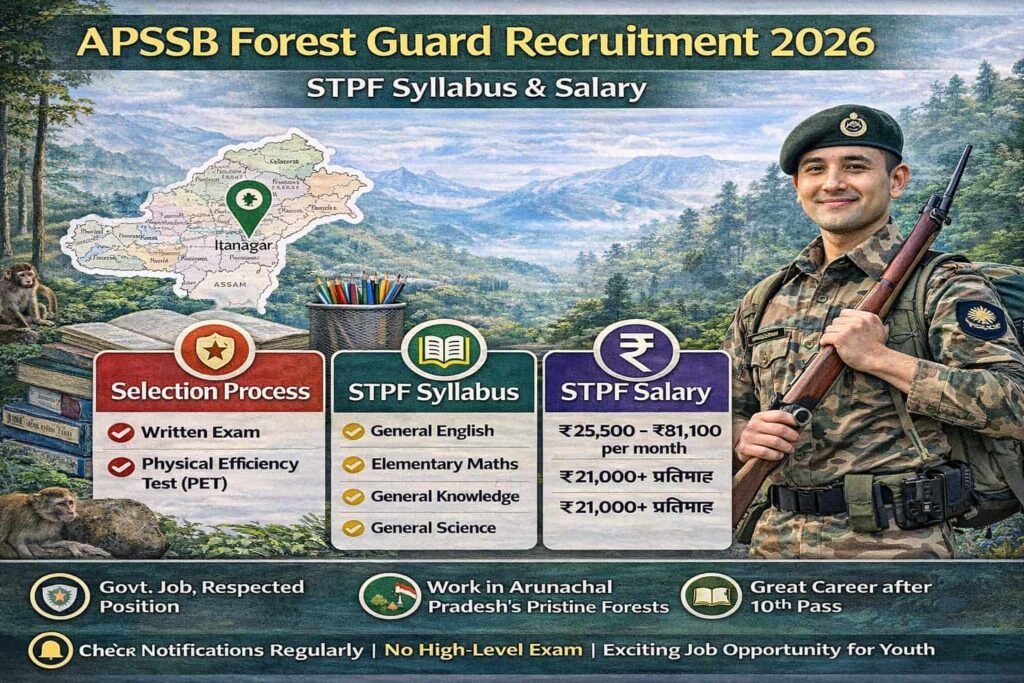
APSSB Forest Guard Recruitment 2026, globally renowned as a biodiversity hotspot and the “Land of the Dawn-Lit Mountains,” is home to some of the most pristine and impenetrable tropical and subtropical forests in India. With over 80% of its geographical area covered by forests, the state acts as a critical carbon sink and a sanctuary for endangered species like the Red Panda, Snow Leopard, and the Royal Bengal Tiger. The immense responsibility of guarding this natural wealth rests on the shoulders of the frontline staff of the Department of Environment, Forest & Climate Change. The ground-level executives, prominently known as Forest Guards and Special Tiger Guards, form the very backbone of wildlife conservation in the state.
Thank you for reading this post, don't forget to subscribe!For the 2026 recruitment cycle, the Arunachal Pradesh Staff Selection Board (APSSB) has launched a massive “Special Recruitment Drive for Uniformed Services.” This includes a combined examination for filling up 984 Group ‘C’ posts across various departments, out of which a highly significant portion is dedicated to the newly formed Special Tiger Protection Force (STPF) and regular Forest Guards. Specifically, 243 vacancies have been allotted for the Special Tiger Guard (STPF).
This exhaustive 2500-word research report provides a deep, analytical, and strategic breakdown of all 14 essential dimensions of the APSSB Combined Secondary Level Examination (CSLE) for Forest Guards. From syllabus micro-analysis and unique physical standards to salary matrix, tough location allowances, and the highly specific 40-year age rule for STPF, this guide is the ultimate blueprint for serious aspirants aiming to secure a position in the 2026 recruitment drive.
1. Comprehensive Syllabus
The written examination for the Forest Guard and Special Tiger Guard is conducted by the APSSB under the Combined Secondary Level Examination (CSLE) framework. The syllabus is designed at the 10th standard (Matriculation) level but requires high accuracy and speed. The syllabus is distinctly divided into four equal sections:
A. General Awareness (50 Marks): This section tests the candidate’s knowledge of their surroundings and current events.
- State-Specific GK: Extreme focus on Arunachal Pradesh’s history, tribes (Nyishi, Galo, Apatani, etc.), culture, festivals (Mopin, Losar), and geography (rivers like Siang, Kameng, and Lohit).
- National Parks & Wildlife: Detailed knowledge of Namdapha, Pakke, Mouling, and Kamlang Tiger Reserves.
- Core Subjects: Indian History, Polity and Constitution, Geography, and Indian Economics.
- Static GK & Science: Everyday Science, Scientific Research, National and International Organizations, Sports, and Art & Culture.
B. General Intelligence & Reasoning Ability (50 Marks): This section assesses logical and spatial thinking, which is crucial for navigating unmapped forest terrains.
- Verbal & Non-Verbal Reasoning: Analogies, similarities and differences, and problem-solving.
- Spatial Reasoning: Space visualization, visual memory, discrimination, and observation.
- Analytical Skills: Relationship concepts, arithmetical reasoning, verbal and figure classification, and arithmetical number series.
C. Arithmetical & Numerical Ability (50 Marks): Mathematical precision is required for measuring timber volumes and plotting GPS coordinates.
- Basic Arithmetic: Number Systems, Simplification, Decimals, Fractions, L.C.M., and H.C.F.
- Commercial Math: Ratio & Proportion, Percentage, Average, Profit & Loss, Discount, Simple & Compound Interest.
- Advanced & Data: Mensuration (calculating areas and volumes), Time & Work, Time & Distance, and Data Interpretation (Tables & Graphs).
D. Test of English Language and Comprehension (50 Marks): Proficiency in English is mandatory for drafting field reports, FIRs against poachers, and maintaining logbooks.
- Grammar & Usage: Spot the error, fill in the blanks, Active/Passive voice, and Direct/Indirect narration.
- Vocabulary: Synonyms, Antonyms, Spellings/detecting misspelled words, Idioms & phrases, and One-word substitution.
- Comprehension: Sentence improvement, shuffling of sentence parts, cloze passage, and reading comprehension passages.
2.APSSB Forest Guard Recruitment 2026 Exam Pattern
The APSSB CSLE exam pattern is highly unique compared to other state public service commissions. The selection process is strictly objective, but it comes with specific qualifying caveats that candidates must deeply understand.
| Subject / Section | Total Questions | Maximum Marks | Duration |
|---|---|---|---|
| General Awareness | 25 | 50 | – |
| General Intelligence & Reasoning | 25 | 50 | 2 Hours |
| Arithmetical & Numerical Ability | 25 | 50 | (120 Mins) |
| English Language & Comprehension | 25 | 50 | – |
| Grand Total | 100 Questions | 200 Marks | 120 Minutes |
Crucial Strategic Rules of the Exam:
- No Negative Marking: A massive advantage for candidates is that APSSB applies absolutely zero negative marking for wrong answers in this exam. Candidates are highly advised to attempt all 100 questions.
- Sectional Qualifying Marks (The 33% Rule): This is the ultimate trap for unprepared students. A candidate must secure a minimum of 33% marks independently in EACH of the four subjects. Even if you score 100% in Maths, English, and Reasoning, but score only 30% in General Awareness, you will be disqualified from the selection process.
- Shortlisting Ratio: Candidates who clear the written exam are shortlisted for the Physical Standard Test (PST) and Physical Efficiency Test (PET) in a ratio of 1:8 (8 candidates called for 1 vacancy).
3. Eligibility Criteria & Physical Standards
Because defending the dense forests of Arunachal Pradesh is a physically demanding task, the eligibility criteria focus heavily on physical robustness, endurance, and state-specific demographic relaxations.
A. Educational Qualification: The candidate must have passed Class X (Matriculation) or its equivalent from a recognized board.
B. Age Limit:
- For regular Constable posts, the age limit is 18 to 22 years. However, for Fireman and Special Tiger Guard (STPF) / Forest Guard, the age limit is much broader: 18 to 32 years.
- Candidates belonging to the Arunachal Pradesh Scheduled Tribe (APST) receive a standard upper age relaxation of 5 years.
C. Physical Standard Test (PST): APSSB provides highly specific height relaxations considering the genetic and geographical demographics of the APST candidates.
| Parameter | Male (General / Non-APST) | Male (APST) | Female (General / Non-APST) | Female (APST) |
|---|---|---|---|---|
| Minimum Height | 163 cm | 152 cm | 150 cm | 145 cm |
| Chest (Normal) | 79 cm | 79 cm | 74 cm | 74 cm |
| Chest (Expanded) | 84 cm | 84 cm | 79 cm | 79 cm |
| (Note: A minimum chest expansion of 5 cm is mandatory for all categories). |
D. Physical Efficiency Test (PET) – The Walking Test: Unlike police constables who must sprint 100 meters or perform high jumps, Forest Guards are tested purely on stamina and endurance.
- Male Candidates: Must complete a rigorous Walk of 25 Kilometers within a maximum time limit of 4 Hours.
- Female Candidates: Must complete a Walk of 14 Kilometers within 4 Hours. This test is qualifying in nature, meaning no extra marks are added to the final merit list for finishing early, but failing to finish within 4 hours leads to immediate disqualification.
4. Salary and Allowances (7th CPC)
A career as a Forest Guard in Arunachal Pradesh provides not just adventure but strong financial stability backed by the Central Pay Commission norms.
| Salary Component | Details / Amount |
|---|---|
| Pay Matrix Level | Level – 3 (As per 7th CPC) |
| Basic Pay Scale | ₹21,700 to ₹69,100 per month |
| Starting Basic Pay | ₹21,700 |
| Dearness Allowance (DA) | ₹10,000 to ₹12,000 (Adjusted bi-annually based on inflation) |
| House Rent Allowance (HRA) | ₹1,500 to ₹3,600 (Depending on posting location) |
| Transport & Uniform Allowance | ₹2,800 to ₹4,800 combined |
| Tough Location Allowance | ₹1,000 to ₹1,200 per month (Paid to employees serving in remote/tribal areas under Part-C/D of government schedules) |
| Gross Monthly Salary | ₹38,000 to ₹45,000 |
| Net In-Hand Salary | ₹28,000 to ₹35,000 (After NPS & Tax deductions) |
Financial Insight: The inclusion of the ‘Tough Location Allowance’ makes this salary package highly attractive. As guards are posted in dense reserves like Namdapha or Pakke, the government compensates them for the harsh living conditions.
5. Recommended Books and Study Material
Since the exam requires a minimum of 33% in every section, balanced preparation using standard books is non-negotiable.
| Subject | Recommended Book | Author / Publisher |
|---|---|---|
| Complete Practice & PYQs | APSSB CSLE 2026 Practice Work Book (Including Previous Year Papers) | Kiran Institute of Career Excellence |
| Arunachal Pradesh Specific GK | Arunachal Pradesh General Knowledge for APSSB Exams | RPH Editorial Board / Kiran Publications |
| General Awareness (Static) | General Knowledge 2025/2026 | Manohar Pandey (Arihant) / Lucent |
| English Language | Objective General English | S.P. Bakshi (Arihant) |
| Numerical Ability (Maths) | SSC Mathematics or Quantitative Aptitude | Rakesh Yadav / R.S. Aggarwal |
6. Strategic Preparation Methodology
The absence of negative marking and the presence of a sectional cut-off completely dictate the strategy for the APSSB CSLE.
- The 33% Sectional Survival Strategy: Do not study just your strong subjects. If you are weak in Maths, you must dedicate 40% of your daily study time to Arithmetic to ensure you easily cross the 16.5 marks (33% of 50) threshold. Failing one section means failing the entire exam.
- The ‘Attempt All’ Rule: Because there is no penalty for wrong answers, you must leave zero blank bubbles on the OMR sheet. Reserve the last 5 minutes of the exam specifically for intelligent guessing on unanswered questions.
- Mastering Local AP GK: A significant chunk of the General Awareness section is dedicated purely to Arunachal Pradesh. You must know the local topography, tribal history, and the state’s flora and fauna intimately.
7. Daily Time Table
To balance written exam preparation with physical stamina building, aspirants should follow a rigorous 10-hour daily routine.
| Time Slot | Activity / Focus Area |
|---|---|
| 05:00 AM – 07:30 AM | Physical Training: Fast-paced walking for 8-10 km carrying a small backpack to build endurance for the 25km PET. |
| 09:00 AM – 11:30 AM | Mathematics: Focus on Arithmetic, Simplification, and Mensuration. |
| 12:00 PM – 01:30 PM | General English: Grammar rules, active/passive voice, and vocabulary building. |
| 03:00 PM – 05:00 PM | General Awareness: National GK, History, and Current Affairs. |
| 05:30 PM – 07:00 PM | Arunachal Pradesh State GK: Deep dive into state geography and tribal culture. |
| 08:00 PM – 09:30 PM | Reasoning & Mock Tests: Solve 25 reasoning questions and review one full APSSB previous year paper. |
8. Preparation Plan (6 Months / 24 Weeks)
A zero-to-hero 6-month roadmap for absolute beginners:
- Month 1-2 (Foundation Phase): Focus strictly on Class 10th NCERTs for Mathematics and Science. Read basic English grammar rules. Start walking 5 km every alternate day.
- Month 3-4 (Intensive State Focus): Memorize the Arunachal Pradesh State Gazetteer. Cover topics like the history of NEFA, state reorganization, and major river systems. Increase walking endurance to 15 km per session.
- Month 5 (Speed & Accuracy): Since there are 100 questions to be solved in 120 minutes, start using a timer. Practice reading comprehension and data interpretation to reduce time per question.
- Month 6 (Mock Tests & Physical Peak): Do not touch new theoretical topics. Solve one full-length APSSB CSLE mock test daily. Perform at least two full 25 km (or 14 km for females) walking trials to ensure you can beat the 4-hour limit comfortably.
9. Time Management in the Exam Hall
You have exactly 120 minutes to solve 100 questions, giving you 1 minute and 12 seconds per question.
- Phase 1 (First 30 Mins): Attack the General Awareness and English sections first. These require no calculations. Attempt all 50 questions rapidly.
- Phase 2 (Next 40 Mins): Move to Reasoning. This section is generally scoring. Secure your 33% minimum easily here.
- Phase 3 (Next 40 Mins): Tackle Arithmetical & Numerical Ability. Use this large block of time for complex calculations (Mensuration, SI/CI).
- Phase 4 (Final 10 Mins): OMR bubbling review and making calculated guesses for any questions you couldn’t solve, utilizing the no negative marking rule.
10. Motivation and Psychological Readiness
Being a Forest Guard in Arunachal Pradesh is not a desk job; it is a calling. You will be defending the majestic Royal Bengal Tigers in Pakke and Namdapha, battling against heavily armed poachers and timber smugglers. You will work in deep, silent forests under the canopy of ancient trees. The job commands immense respect from society and plays a direct role in combating global climate change. Whenever preparation feels exhausting, remember that this uniform gives you the legal authority to protect the “lungs of Northeast India.”
11. Success Tips
- Do Not Fear the 25 KM Walk: Many candidates fail the PET because they underestimate 25 kilometers. Practice walking on inclined surfaces, as the actual test at PTC Banderdewa may involve hilly terrain.
- English is the Tie-Breaker: In APSSB exams, many candidates struggle with English Comprehension. Mastering Active/Passive voice and Direct/Indirect speech will push your rank above the competition.
- Target Safe Scores: Aim for at least 25/50 in your weakest subject to safely cross the 16.5 mark (33%) threshold without relying on luck.
12. Job Profile and Duties in Mountainous Terrain
The life of an Arunachal Pradesh Forest Guard or Special Tiger Guard is challenging, thrilling, and demands 24/7 vigilance.
General Duties of a Forest Guard:
- Sub-Beat Management: A Forest Guard is placed in independent charge of a “Forest Sub-beat,” which typically covers a dense area of around 20 Square Kilometers.
- Patrolling: Conducting daily foot patrols in hilly, rugged terrains to monitor for illegal logging, forest fires, and encroachment.
- Wildlife Monitoring: Recording observations of wildlife, maintaining trails, and clearing firebreaks before the dry season.
The STPF (Special Tiger Protection Force) Profile:
- Elite Conservation: STPF guards are deployed in highly sensitive zones like the Pakke Tiger Reserve and Namdapha.
- Technical Duties: Wading through rivers to install, adjust, and retrieve batteries from Camera Traps used to monitor tiger movements.
- Anti-Poaching Operations: Camping deep inside the jungle for several nights at a stretch to ambush organized poaching gangs.
- The 40-Year Age Rule: Because STPF duties require extreme physical agility to chase poachers and navigate steep mountains, STPF personnel serve in this elite force only until the age of 40. After turning 40, they are honorably transferred out of the STPF to perform normal Forest Guard duties in other territorial divisions, retaining all their seniority and promotional benefits.
13. Promotion Hierarchy and Career Path
The Arunachal Pradesh Forest Department offers a highly structured and transparent career progression ladder through the Subordinate Forest Service.
| Current Rank | Promoted Rank | Required Service & Criteria |
|---|---|---|
| Forest Guard (Level 3) | Forester Grade – II | Must complete a minimum of 5 years of continuous service as a Forest Guard. Promotion is based on seniority-cum-merit. |
| Forester Grade – II | Forester Grade – I | Filled entirely (100%) by promotion based on seniority-cum-merit. |
| Forester Grade – I | Deputy Forest Ranger | Filled exclusively through departmental promotion. Takes charge of a full Forest Beat. |
| Deputy Forest Ranger | Forest Ranger (RFO) | 50% of Forest Ranger posts are filled by promoting Deputy Forest Rangers who have completed 5 years of service. RFO is a Gazetted rank. |
Note: Special Tiger Guards (STPF) maintain their recruitment seniority and are eligible for this exact same promotion ladder even after they are transferred to regular territorial duties post the age of 40.
14. Job vs Preparation
Should you quit your current job to prepare for the APSSB CSLE 2026?
- For Working Professionals: Do not quit your job immediately. The syllabus is based entirely on the 10th standard. If you can extract 4 to 5 hours daily (early mornings for physical walking and nights for study), you can clear this exam. Use Sundays strictly for 15-20 km walks and full-length mock tests.
- For Full-Time Aspirants: If you are nearing the upper age limit of 32 years and are financially secure, dedicating 6 months purely to this exam is highly recommended. The sheer volume of vacancies in 2026 (984 posts including 243 STPF) makes this a golden, once-in-a-decade opportunity.
15. Frequently Asked Questions (FAQs)
Q1: What is the minimum educational qualification to apply for APSSB Forest Guard or STPF? A: Candidates must have passed Class 10 (Matriculation) from any recognized board.
Q2: Is there any negative marking in the APSSB CSLE Written Examination? A: No, there is absolutely zero negative marking in the APSSB CSLE exam. Candidates should attempt all questions.
Q3: What is the 33% qualifying rule in the APSSB exam? A: Candidates must secure a minimum of 33% marks independently in each of the four subjects (General Awareness, English, Maths, and Reasoning) to be considered for selection.
Q4: How much walking is required in the Physical Efficiency Test (PET)? A: Male candidates must walk 25 Kilometers in 4 hours, and female candidates must walk 14 Kilometers in 4 hours.
Q5: What are the height requirements for APST candidates? A: The minimum height for male APST candidates is 152 cm, and for female APST candidates, it is 145 cm.
Q6: What is the age limit for the Special Tiger Guard (STPF) and Forest Guard posts? A: The age limit is generally 18 to 32 years, with a 5-year upper age relaxation for candidates belonging to the APST category.
Q7: What happens to Special Tiger Guards (STPF) after they turn 40? A: Due to the extreme physical demands of tiger protection, STPF guards serve in the force until the age of 40. After that, they are transferred to regular Forest Guard duties in other divisions while keeping their seniority and promotion benefits intact.
Q8: What is the starting salary of an Arunachal Pradesh Forest Guard? A: Forest Guards are placed in the 7th CPC Pay Matrix Level 3 (₹21,700 – ₹69,100). The starting gross salary, including DA, HRA, and Tough Location Allowances, is approximately ₹38,000 to ₹45,000.
Q9: Do Forest Guards receive extra allowances for remote postings? A: Yes, employees posted in remote and difficult terrains in Arunachal Pradesh receive a “Tough Location Allowance” ranging from ₹1,000 to ₹1,200 per month depending on the exact location.
Q10: When is a Forest Guard eligible for their first promotion? A: A Forest Guard becomes eligible for promotion to Forester Grade-II after completing a minimum of 5 years of continuous regular service in the cadre.