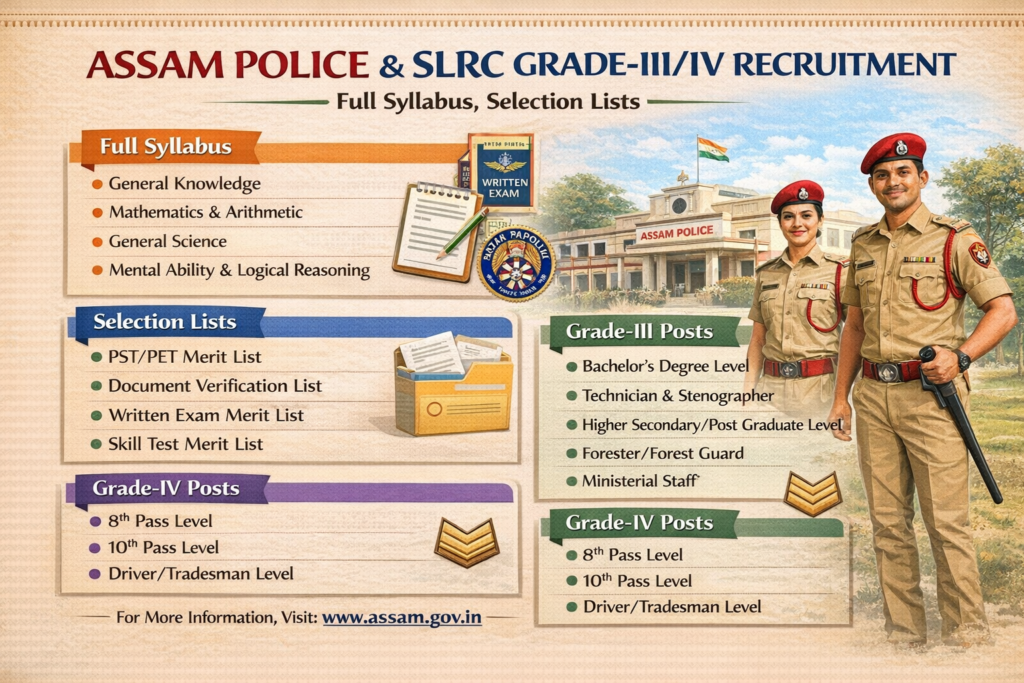
Assam Police administrative landscape of recruitment in Assam has undergone a paradigm shift, transitioning from a decentralized, department-specific model to a rigorous, centralized meritocracy governed by statutory bodies. This transformation was largely operationalized through the Assam Direct Recruitment Commission for Analogous Posts in Class-III and Class-IV Act, 2021, which mandated the creation of the State Level Recruitment Commissions (SLRC). The primary intent of this legislative framework was to eliminate procedural variations across governmental departments and establish a uniform selection mechanism for technical and non-technical personnel. Simultaneously, the State Level Police Recruitment Board (SLPRB) continues to serve as the specialized authority for the uniformed services, maintaining an intricate balance between academic screening and physical standard validation. This report provides an exhaustive, expert-level examination of these recruitment ecosystems, detailing the complex syllabi, multi-stage selection logistics, merit list calculations, and the administrative prerequisites that define the current employment trajectory within the Government of Assam.
Thank you for reading this post, don't forget to subscribe!The Statutory Architecture of Centralized Recruitment
The institutionalization of the SLRC under the Assam Administrative Staff College (AASC) represents a strategic effort to consolidate public sector intake. By grouping analogous posts—those defined by similar minimum educational qualifications and salary pay bands—the commission has simplified the applicant journey while ensuring a common baseline of competency. The commissions are divided into two distinct bodies: the State Level Recruitment Commission for Class III Posts and the State Level Recruitment Commission for Class IV Posts.
This centralization serves a dual purpose. Academically, it allows for a standardized testing environment where candidates are evaluated on a level playing field regardless of the specific department they may eventually join. Logistically, it reduces the overlap of recruitment cycles and mitigates the “appointment fatigue” often associated with multiple departmental applications. The selection process for Grade III and Grade IV typically involves a combination of a preliminary written examination followed by skill tests, computer proficiency tests, or viva-voce interviews, depending on the tier and post category.
Assam Police Grade III (Class III) Recruitment: Multi-Tiered Evaluation
The Grade III recruitment cycle is the most complex within the SLRC ecosystem, as it spans several educational qualification levels, each requiring a tailored assessment strategy. These are generally categorized into the Bachelor’s Degree level, the Higher Secondary School Leaving Certificate (HSSLC) level, and the High School Leaving Certificate (HSLC) level.
The Bachelor’s Degree Category: Analytical and Cognitive Assessment
Candidates applying for posts requiring a Bachelor’s Degree undergo an examination designed to measure higher-order cognitive abilities, linguistic precision, and a deep understanding of social sciences. For positions that involve administrative or clerical duties, a secondary stage involving a computer proficiency test is mandatory.
| Examination Subject Area | Number of Questions | Weightage / Total Marks | Allocated Duration |
| Social Studies | 30 | 30 | 180 Minutes |
| General Knowledge | 35 | 35 | 180 Minutes |
| Logical Reasoning and Mental Ability | 20 | 20 | 180 Minutes |
| General Mathematics (Class 10 Standard) | 30 | 30 | 180 Minutes |
| General English | 10 | 10 | 180 Minutes |
| Reading Comprehension and English Language | 25 | 50 | 180 Minutes |
| Consolidated Total | 150 | 175 | 3 Hours |
The statistical weighting in this tier is notable for its emphasis on “Reading Comprehension and English Language,” where each of the 25 questions carries a value of 2 marks, totaling 50. This reflects the state’s requirement for a graduate-level workforce capable of interpreting complex policy documents and executing high-level official communication. Negative marking is a critical factor in the 2025-2026 cycles, with a penalty of 0.25 marks for standard questions and 0.50 marks for the higher-weighted comprehension questions.
The HSSLC (Class 12) Category: Operational and Foundational Competence
The HSSLC tier serves as the intake for intermediate administrative and technical support roles. The curriculum focuses more heavily on fundamental mathematics and general English compared to the graduate tier.
| Subject Area | Total Questions | Maximum Marks | Exam Duration |
| Social Studies | 30 | 30 | 3 Hours |
| General Knowledge | 30 | 30 | 3 Hours |
| Logical Reasoning and Mental Ability | 20 | 20 | 3 Hours |
| General Mathematics | 35 | 35 | 3 Hours |
| General English | 35 | 35 | 3 Hours |
| Aggregate Total | 150 | 150 | 180 Minutes |
The marking scheme for this level is uniform, with each question carrying 1 mark and a negative marking penalty of 0.25 for every incorrect entry.
The HSLC (Class 10) Category: Specialized and Technical Support
For Grade III roles requiring an HSLC qualification—most notably the post of Driver—the assessment integrates general knowledge with specialized vocational requirements. The “Road Transport” segment is a unique addition to this level, testing the candidate’s knowledge of traffic regulations, vehicle maintenance, and safety protocols.
| Subject Area | Number of Questions | Total Marks | Exam Duration |
| Social Studies | 20 | 20 | 3 Hours |
| General Knowledge | 30 | 30 | 3 Hours |
| Logical Reasoning and Mental Ability | 20 | 20 | 3 Hours |
| General Mathematics | 30 | 30 | 3 Hours |
| General English | 30 | 30 | 3 Hours |
| Road Transport / Specialized Knowledge | 20 | 20 | 3 Hours |
| Total | 150 | 150 | 180 Minutes |
Comprehensive Syllabus Breakdown for Grade III
The depth of the SLRC Grade III syllabus is exhaustive, requiring candidates to possess a multidisciplinary knowledge base. The following narrative details the specific thematic clusters as identified across multiple recruitment cycles.
Linguistic Proficiency: General English
The assessment of English language skills is not merely for basic literacy but for grammatical and structural accuracy. Key thematic areas include transformations of active and passive voice, mastery over direct and indirect speech, and the correct application of prepositions. Candidates are tested on their ability to identify synonyms and antonyms, complete sentence structures through passage completion or substitution, and identify errors in grammar or spelling. The graduate level adds a layer of complexity through Reading Comprehension, where candidates must infer meaning from dense narrative texts.
Scientific and General Awareness: The GK Cluster
The General Knowledge segment is expansive, covering the basic sciences (Botany, Zoology, Chemistry, and Physics) at an observational level. Beyond science, the curriculum includes a rigorous understanding of the Indian Parliament, Indian Politics, and Geography. Cultural literacy is also tested, encompassing world inventions, sports, environmental issues, and a catalog of famous books and authors.
Quantitative Aptitude and Mental Ability
Mathematical evaluation for Grade III is centered on Class 10 standards but requires a high degree of speed and accuracy. Topics include basic number systems (HCF/LCM), percentages, profit and loss, and simple and compound interest. Advanced topics often include linear equations, geometry (triangles, circles, quadrilaterals), and basic trigonometric ratios. Mental ability and logical reasoning tests evaluate the candidate through puzzles, verbal and non-verbal reasoning, data interpretation, and analytical reasoning tasks.
The Grade IV (Class IV) Recruitment Framework
Recruitment for Grade IV positions (including peons, guards, and other support staff) is bifurcated into two categories: those who have “read up to Class VIII” and those who have “passed HSLC or equivalent”. This separation ensures that the testing mechanism remains commensurate with the candidate’s educational exposure.
| Recruitment Parameter | Details of Grade IV Framework |
| Primary Assessment Method | Written Examination (Offline OMR-based) |
| Total Number of Questions | 135 Multiple Choice Questions (MCQs) |
| Total Marks | 135 |
| Penalty for Incorrect Answers | 0.25 Marks deducted per wrong response |
| Total Duration | 2.5 Hours (150 Minutes) |
| Curriculum Basis | SCERT Class 8 or SEBA Class 10 |
The curriculum for Grade IV follows the syllabus prescribed by the State Council of Educational Research and Training (SCERT) for Class 8 or the Board of Secondary Education, Assam (SEBA) for Class 10. The core subjects include English, Social Studies, Mathematics, General Knowledge, and Mental Ability. While the subjects mirror the Grade III tier, the questions are designed to test foundational knowledge rather than advanced analytical reasoning.
The Assam Police Selection Mechanism: A Dual-Focus Approach
Recruitment within the Assam Police, managed by the SLPRB, is an intricate process where physical prowess and academic competence are weighted sequentially. The selection stages generally involve the Physical Standard Test (PST), Physical Efficiency Test (PET), a Written Examination, and a Viva-Voce or Psychometric test.
Sub-Inspector (SI) Selection: Leadership and Tactical Knowledge
The Sub-Inspector recruitment is the elite tier of state law enforcement intake, focusing on graduates. The written exam is the primary eliminator and carries a significant penalty for errors.
| Assessment Stage | Marks Distribution |
| Written Test (OMR-based) | 100 Marks (100 Questions) |
| Physical Efficiency Test (PET) | 40 Marks (Qualifying-based marks) |
| Oral / Viva-Voce Interview | 5 Marks |
| NCC (Level C Certificate) | 5 Marks |
| Cumulative Total | 150 Marks |
The SI written examination is notably lengthy, providing 3 hours for 100 questions. The curriculum is divided into three key areas:
- Logical Reasoning, Aptitude, and Comprehension (35 Marks): Includes figural analysis, verbal and non-verbal reasoning, and problem-solving techniques.
- Culture and History of India and Assam (35 Marks): Focuses heavily on the Ahom Kingdom, the freedom struggle in Assam, and regional geography including the Brahmaputra river system.
- General Knowledge (30 Marks): Covers Indian polity, economy, science, and technology.
Constable Recruitment: Unarmed Branch (UB) and Armed Branch (AB)
Constable recruitment prioritizes physical endurance. Candidates are first screened via the PST/PET. Only those who meet the physical benchmarks proceed to the written test.
| Component for Constables | General Constable Marks | Specialized (Boatman/Bandman) |
| Physical Efficiency Test (PET) | 40 | 60 |
| Written Test | 50 | 50 |
| Viva-Voce / Skill Test | 5 | 5 |
| Extra-Curricular (NCC/Sports) | 5 | 5 |
| Total Marks Potential | 100 | 120 |
The written exam for constables is distinct as it consists of 100 questions worth 0.5 marks each, totaling 50 marks. There is typically no negative marking at this level, encouraging candidates to attempt all questions.
Physical Efficiency and Standard Requirements
The Physical Efficiency Test (PET) is the most critical stage for uniformed service aspirants. Unlike the qualifying-only nature of the PST, the PET awards marks based on performance, which are then integrated into the final merit list.
Physical Standards Test (PST) benchmarks
Candidates must adhere to minimum height and chest specifications based on their demographic category. Failure to meet these criteria results in immediate disqualification.
| Category | Male Height (cm) | Female Height (cm) | Male Chest (Normal/Exp.) |
| General/OBC/MOBC/SC | 162.56 | 154.94 | 80 cm / 85 cm |
| ST(H)/ST(P) | 160.02 | 152.40 | 78 cm / 83 cm |
Physical Efficiency Test (PET) Performance Scaling
The PET for constables evaluates two primary events: the long-distance race and the long jump. These events are monitored via CCTV and recorded using RFID timing chips for absolute transparency.
The Race Event: 20 Marks Potential
For males, the distance is 3200 meters, and for females, it is 1600 meters. The marks decrease as the time taken increases.
| Time Taken (Male – 3200m) | Marks | Time Taken (Female – 1600m) | Marks |
| $\le$ 600 Sec (10 Min) | 20 | $\le$ 330 Sec (5.5 Min) | 20 |
| 601–630 Sec | 17.6 | 331–360 Sec | 17 |
| 631–670 Sec | 15.2 | 361–390 Sec | 14.6 |
| 671–730 Sec | 12.8 | 391–420 Sec | 12.8 |
| 791–840 Sec | 10 | 461–480 Sec | 10 |
| > 840 Sec | DQ | > 480 Sec | DQ |
The Long Jump: 20 Marks Potential
Candidates are granted three attempts, and the longest valid jump is recorded for marks.
| Jump Distance (Male) | Marks | Jump Distance (Female) | Marks |
| Minimum 335 cm | 10 | Minimum 244 cm | 10 |
| 400 cm | 12.6 | 289 cm | 11.8 |
| 450 cm | 15.6 | 319 cm | 13.6 |
| 480 cm | 18 | 349 cm | 16 |
| $\ge$ 500 cm | 20 | $\ge$ 389 cm | 20 |
Selection Lists and Result Logistics
The declaration of results in Assam’s large-scale recruitment drives follows a multi-phase timeline. Provisional results are generally released first, allowing for document verification before the final select lists are published.
Merit List Preparation
Merit lists are prepared district-wise and category-wise, ensuring that state reservation policies for SC, ST, and OBC/MOBC are strictly followed. In the event of tied scores, the primary tie-breaker is the age of the candidate, with preference given to the older applicant. If the age is also the same, academic performance in the qualifying exam (HSLC/HSSLC) is considered.
The Statistical Process of Normalization
Because exams like the ADRE are conducted over multiple shifts and days, question difficulty may vary. To maintain equity, the state employs statistical normalization formulas.
Z-Score / Standard Deviation Normalization
This method adjusts a candidate’s score relative to the performance of all other candidates in their shift and aligns it with a “Base Shift”.
$$Normalized Score (X_n) = \frac{S_2}{S_1} \cdot (X – X_{av}) + Y_{av}$$
Where $S_2$ is the standard deviation of the Base Shift, $S_1$ is the standard deviation of the candidate’s shift, $X$ is the raw score, $X_{av}$ is the average score of that shift, and $Y_{av}$ is the average of the Base Shift.
Percentile-Based Normalization
The percentile score is calculated based on how many candidates performed equal to or below a specific candidate in their specific shift.
$$\text{Percentile} = \frac{\text{No. of candidates in shift with score } \le \text{ candidate}}{\text{Total candidates in shift}} \times 100$$
This percentile is then treated as the final score for merit ranking, effectively removing shift-wise advantages.
Administrative Compliance: Employment Exchange and Documentation
A critical prerequisite for all government applications in Assam is a valid registration with a local Employment Exchange. Failure to maintain a current registration card often leads to the summary rejection of a candidate’s application, regardless of their performance in the written exams.
Registration Guidelines and Rules
Registration is available to Indian citizens who are permanent residents of Assam and above the age of 14.
| Parameter | Employment Exchange Regulation |
| Registration Mode | Aadhaar-based (Online) or Non-Aadhaar-based (Physical) |
| Renewal Period | Every 3 Years (within the due month and 3-month grace period) |
| Mandate | Essential for all Class III and Class IV applications |
| Documentation | Birth Certificate, Residential Proof (Aadhaar/Voter ID), Educational Marksheets |
Candidates choosing the Aadhaar-based route can complete the process online without visiting the office, provided their Aadhaar address is within Assam. Non-Aadhaar applicants must visit the office in person for physical verification of original documents within 15 days of online registration.
Career Progression and Promotion Pathways
Joining the state service in a Grade III or Grade IV capacity offers a stable career path governed by seniority and merit.
Promotion from Grade IV to Grade III
Rules allow for vertical mobility, where 10% of vacancies in the Junior Assistant (Grade III) cadre are reserved for promotion from Grade IV.
| Eligibility Condition | Requirement for Promotion |
| Minimum Continuous Service | 7 Years in Grade IV post |
| Educational Prerequisite | Completion of a Bachelor’s Degree |
| Technical Prerequisite | Proficiency in computer typing and working knowledge |
Progression within Grade III
Junior Assistants are eligible for promotion to Senior Assistant roles after 4 to 5 years of continuous service. Further advancement to roles like Superintendent or Head Assistant typically requires a minimum of 7 years of service in the Senior Assistant cadre.
10 Frequently Asked Questions (FAQ) regarding Assam Recruitment
1. Is the computer proficiency test mandatory for all Grade III candidates?
It is mandatory for roles categorized as “Bachelor’s Degree with Computer Certificate/Diploma.” For other general Grade III roles, the requirement is determined by the specific department’s needs.
2. Can I apply for both Grade III and Grade IV in the same recruitment cycle?
Yes, candidates who meet the eligibility criteria for both levels can apply. The exams are typically held on different days or in different sessions to accommodate multiple applications.
3. What is the minimum qualifying mark for the Assam Police written exam?
While specific cut-offs vary by year and difficulty, candidates are generally expected to score at least 33% to be considered for the merit list, though actual selection usually requires much higher scores due to competition.
4. How long is the Employment Exchange registration card valid?
The registration is valid for three years. Candidates must renew it in the due month or within the three-month grace period to keep their status on the “Live Register”.
5. Is negative marking applied in the Constable written exam?
Typically, there is no negative marking in the written examination for Constable posts (UB/AB), as each question is weighted at only 0.5 marks.
6. What documents are required for the Physical Standard Test (PST)?
Candidates must bring their Admit Card, identity proof (Aadhaar/Voter ID), and all original educational and caste certificates as uploaded during the online application process.
7. What happens if I miss the document verification date?
Missing the scheduled document verification or physical test usually results in the cancellation of candidature. However, the boards sometimes issue notices for special considerations in cases of widespread disruptions.
8. Are private sector employees eligible for these recruitments?
Yes, but they must disclose their employment details. For those already in government service, a “No Objection Certificate” (NOC) from their employer is mandatory at the time of application or interview.
9. How is the “Base Shift” selected for normalization?
The “Base Shift” is typically the shift that has the highest mean (average) marks among all shifts, assuming it was the session where candidates performed optimally.
10. Does having an NCC ‘A’ certificate provide any benefit?
Yes, for police recruitment, an NCC ‘A’ certificate typically awards 2 bonus marks. Greater benefits are reserved for ‘B’ (3 marks) and ‘C’ (5 marks) certificate holders.