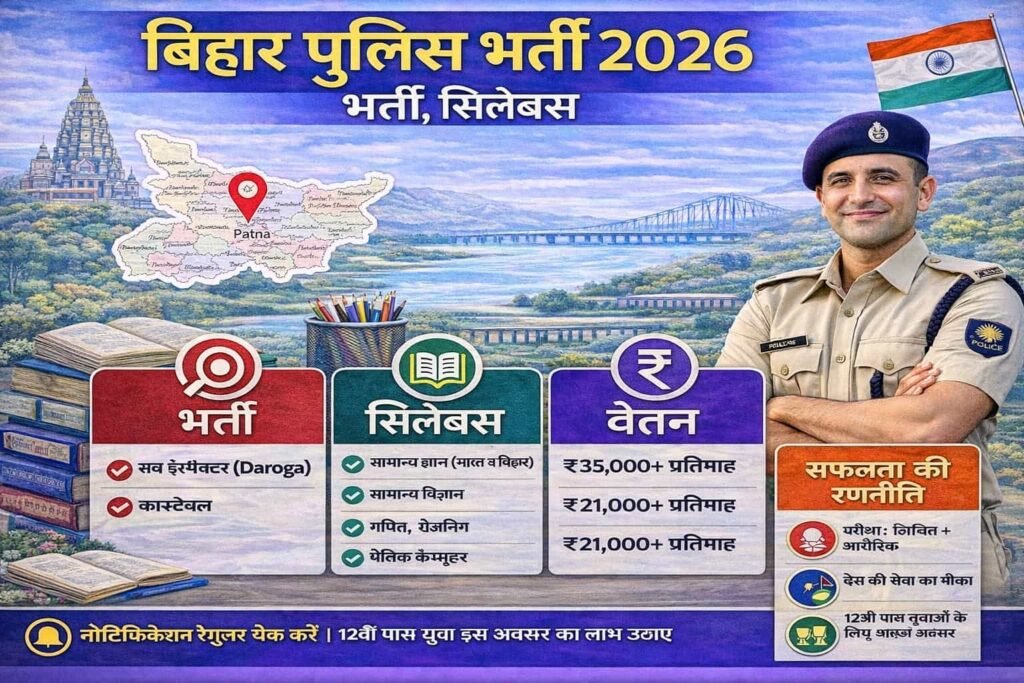
The law enforcement apparatus of any state serves as the ultimate guarantor of civil stability, statutory compliance, and internal security. In the state of Bihar, this apparatus is anchored by the Bihar Police force, an institution whose historical lineage can be traced back to the sophisticated administrative and intensive policing practices of the ancient Magadh empire, where the chief of police was formally designated as the Dandapala. In its modern iteration, established formally in 1935, the Bihar Police has evolved into a massive, multi-tiered governmental agency operating under the jurisdiction of the Bihar Government’s Home Department. With a sanctioned strength of approximately 2,29,000 personnel and an active workforce of roughly 1,10,000 officers and constables, it is a colossal organization.
Thank you for reading this post, don't forget to subscribe!The operational efficacy of this organization rests heavily on its foundational tier: the police constabulary. Recognizing the critical nature of this workforce, the state has continuously refined its recruitment methodologies, training curricula, remuneration structures, and promotion hierarchies.
To make this exhaustive report easier to navigate, the most critical information for aspirants—salary, eligibility, and exam structures—has been placed at the very beginning, followed by career progression, specialized roles, and organizational modernization.
1. Salary Structure & Allowances (Economic Security)
The physical hazards, psychological stress, and demanding operational hours inherent in law enforcement necessitate a highly structured and reliable financial compensation framework. The Bihar government ensures that its constabulary is compensated in strict accordance with the guidelines established by the 7th Pay Commission, providing a robust socio-economic safety net.
The Constabulary Pay Matrix Upon successful completion of basic training and the mandatory probation period, a general duty constable is inducted into Pay Level 3 of the state matrix. The overarching pay band for this level spans from ₹21,700 to a maximum of ₹69,100, carrying an initial Grade Pay of ₹2,000.
The basic pay serves merely as the foundation of the financial package. It is heavily supplemented by a comprehensive suite of allowances:
- Dearness Allowance (DA): Revised twice yearly to counteract inflation. It currently sits at a substantial 53% of the basic pay, effectively adding approximately ₹11,500 to the constable’s monthly gross salary.
- House Rent Allowance (HRA): Provided when government quarters are unavailable. Cities are divided into X, Y, and Z tiers, with the allowance ranging from 8% to 16% of the basic pay (yielding roughly ₹1,700 to ₹5,000 monthly).
- Transport and Travel Allowance (TA): Allocated to offset transit costs, ranging from ₹804 to upward of ₹3,000.
- Ancillary Allowances: Personnel receive fixed Medical Allowances (approx. ₹1,000), Uniform Allowances, and critically, Ration Money. Special Duty or Risk Allowances are also applied for constables operating in volatile sectors, such as Anti-Naxal operations or the Special Task Force (STF).
| Salary Component | Approximate Monthly Calculation (₹) |
|---|---|
| Basic Pay (Initial Level 3) | 21,700 |
| Dearness Allowance (DA – 53%) | 11,500 |
| House Rent Allowance (HRA) | 1,736 – 5,000 (City Tier Dependent) |
| Transport Allowance (TA) | 804 – 3,000 |
| Medical & Risk Allowances | 1,000 – 3,000 |
| Estimated Gross Monthly Salary | 35,000 – 45,000 |
After mandatory statutory deductions (income tax, PF, ESI, pension), a newly inducted constable typically commands a net in-hand salary ranging between ₹25,000 and ₹40,000 per month.
Remuneration Across the Departmental Spectrum
| Rank / Position Designation | Applicable Pay Level | Pay Scale Range (₹) | Estimated In-Hand/Gross Outlook |
|---|---|---|---|
| Mobile Squad Constable | Level 2 / 3 | 19,900 – 63,200 | ~25,000 – 30,000 |
| Jail Warder / Fireman | Level 3 | 21,000 – 69,000 | ~28,000 – 34,000 |
| Constable (GD/BSAP) | Level 3 | 21,700 – 69,100 | ~30,000 – 40,000 |
| Havildar / Head Constable | Level 4 | 25,500 – 81,100 | ~30,000 – 35,000 |
| Assistant Sub-Inspector (ASI) | Level 5 | 29,200 – 92,300 | ~35,000 – 46,200 |
| Sub-Inspector (SI) | Level 6 | 35,400 – 1,12,400 | ~45,000 – 55,000 |
| Inspector | Level 7 | 44,900 – 1,42,400 | ~55,000 – 67,800 |
| Deputy Superintendent (DSP) | Level 10 | 56,100 – 1,77,500 | ~70,000 – 85,000 |
(Note: Data derived from 7th Pay Commission structures; exact in-hand varies by allowances and deductions.)
2. Recruitment Eligibility, Age Limits, & Vacancies
The influx of new personnel is centrally administered by the Central Selection Board of Constables (CSBC), which conducts recruitment drives for the District Police, Bihar Special Armed Police (BSAP), and specialized battalions.
Academic Qualifications
- General Duty: The foundational academic threshold is the successful completion of the Intermediate (10+2) examination from a recognized board. Equivalent qualifications like a Maulvi certificate (Madrasa Board) or Shastri/Acharya certificate (Sanskrit Board) are fully eligible. Over-qualified individuals (graduates/post-graduates) remain eligible.
- Specialized Technical Roles: Constable Operators require a 10+2 specifically within the science stream (Physics, Chemistry, Mathematics) with a minimum aggregate score of 50% (45% for SC/ST).
Demographic Parameters and Age Relaxations The base age limit (calculated via the 10th class certificate) for the general, unreserved category is 18 to 25 years. However, a highly structured system of age relaxations is implemented:
- OBC and EBC (Male): 18 to 27 years (2-year relaxation).
- OBC and EBC (Female): 18 to 28 years (3-year relaxation).
- SC and ST (Male & Female): 18 to 30 years (5-year relaxation).
- Home Guards: A 5-year relaxation appended to the maximum age limit of their respective social category.
Transgender Inclusion: The Bihar government now explicitly invites transgender applications. They are evaluated against the physical and educational standards established for female candidates and benefit from the maximum age relaxations applied to the SC/ST categories (18 to 30 years).
Vacancy Distribution (2025/2026 Cycle Example) The scale of recruitment in Bihar is massive. For instance, the 2025 recruitment cycle aimed to fill 19,838 Constable vacancies:
- General: 7,935 | EWS: 1,983 | SC: 3,174 | ST: 199 | EBC: 3,571 | BC Males: 2,381 | BC Females: 595.
3. Exam Pattern, Syllabus, & Physical Tests
The selection is a protracted, multi-stage process designed to meticulously filter candidates through cognitive, physical, and medical evaluations.
Phase 1: The Written Examination (Cognitive Assessment) This functions primarily as a qualifying threshold. Candidates must secure a minimum of 30% marks to advance; failure results in immediate disqualification.
- Format: Offline, Optical Mark Recognition (OMR). 100 objective-type MCQs.
- Duration/Marks: 2 hours for 100 marks.
- Negative Marking: Explicitly absent. There is no penalty for incorrect responses.
| Subject Domain | Detailed Syllabic Scope |
|---|---|
| Linguistic Proficiency (Hindi/English) | Grammar (nouns, pronouns, adjectives, verbs, gender, tense), synonyms, antonyms, sentence correction, and writing ability. |
| Mathematics & Quantitative Aptitude | Number System, Percentages, Ratio/Proportion, Profit/Loss, Interest, Time/Work, Mensuration, Averages. |
| Social Sciences | History: Ancient Civilizations, 1857 Revolt, Nationalist movements (1918-1947). Geography: Physical/Human Geography, Indian drainage, Economic Geography. Civics/Polity: State Legislature, Judiciary, electoral systems, local self-government in Bihar. Economics: Micro/Macroeconomics, National Income, economic reforms. |
| General Science | Physics: Motion, Force, Light, Sound, Electricity. Chemistry: Molecules, Metals/Non-metals, Acids/Bases. Biology: Zoology, Botany, Environment/Pollution. |
| General Studies & Current Affairs | National/international events, Indian Constitution, historic culture, scientific inventions, awards, financial news. |
Phase 2: Physical Standard Test (PST) & Physical Efficiency Test (PET) Candidates are summoned at a ratio of 5 times the available vacancies.
The PST is qualifying:
- Height: Male Gen/BC/EBC (165 cm), Male SC/ST (160 cm). All Females (155 cm).
- Chest (Males only): Gen/BC/EBC (81-86 cm), SC/ST (79-84 cm).
The PET is the absolute determinant of the final merit list (Maximum 100 marks):
- Running (Max 50 Marks): Males run 1.6 km (under 5 mins = 50 marks; sliding scale up to 6 mins). Females run 1 km (under 4 mins = 50 marks; sliding scale up to 5 mins).
- High Jump (Max 25 Marks): Males (Min 4 ft; over 5 ft = 25 marks). Females (Min 3 ft; over 4 ft = 25 marks).
- Shot Put (Max 25 Marks): Males (16-pound shot, min 16 ft; over 20 ft = 25 marks). Females (12-pound shot, min 12 ft; over 14 ft = 25 marks).
Phase 3: Medical Examination & Antecedent Verification Merit formulation requires candidates to meet categorical minimum PET scores. Following this, a strict medical board evaluates visual acuity (no color blindness), auditory health, and structural fitness (no flat feet, knock knees, or stammering). An exhaustive character verification ensures no history of crimes involving moral turpitude.
4. Career Progression & Promotions
The traditional vertical trajectory ascends through the following ranks: Constable → Havildar / Head Constable → Assistant Sub-Inspector (ASI) → Sub-Inspector (SI) → Inspector.
- Constable to Havildar / Head Constable: Elevates the individual to Pay Level 4. Requires 5 to 8 years of unblemished service (clear Annual Confidential Report) and passing the Promotional Combined Course (PCC) or Head Constables Test.
- Havildar to Assistant Sub-Inspector (ASI): A one-star rank (Pay Level 5). Filled via promotion of Head Constables with 3 to 5 years of service in that rank, based on a “selection-cum-seniority” methodology.
- Assistant Sub-Inspector to Sub-Inspector (SI): A two-star rank (Pay Level 6), serving as the primary Investigating Officer. Vacancies are filled on a 1:1 ratio (50% direct recruitment via BPSSC, 50% departmental promotion for ASIs with 5+ years of service).
- Sub-Inspector to Inspector: A three-star supervisory rank (Pay Level 7). Heavily reliant on the completion of a state-determined “Kalawadhi” and flawless performance records.
Assured Career Progression (ACP) Scheme To mitigate stagnation, if a constable fails to earn a functional promotion due to structural bottlenecks, they receive guaranteed financial upgradations to the next higher pay grade upon completing 10, 20, and 30 years of continuous service. Additionally, the Bihar Police frequently utilizes ad-hoc delegations, granting “superior officer charges” (e.g., constables acting as ASIs) to veteran personnel.
5. Specialized Constabulary Roles
- The Driver Constable Cadre: Requires a valid heavy/light motor vehicle license. The syllabus heavily weights driving proficiency and mechanical knowledge.
- The Prohibition Constable: Tasked exclusively with enforcing the state’s dry laws. Their operational environment frequently involves high-risk raids on illicit liquor units.
- The Special Branch (General Closed Cadre): The intelligence-gathering apparatus. Operating as a “closed cadre” means personnel are not subject to routine transfers back to general police, securing sensitive intelligence networks. Recruitment is highly selective.
- Allied Services: The CSBC also manages recruitment for Firemen (equivalent to Police Constable), Forest Guards, and Jail Warders, each with specialized written examinations tailored to their respective environments.
6. Training Infrastructure & Curricular Modernization
Basic training typically spans six months (up to 44 weeks for specialized units) and takes place across 33 districts and 15 dedicated police training centers, including the state-of-the-art Bihar Police Academy (BPA) in Rajgir and the Constable Training School in Nathnagar.
The Implementation of the New Criminal Justice Framework The academic curriculum has undergone a profound overhaul, replacing colonial-era penal codes with the Bharatiya Nyaya Sanhita (BNS), Bharatiya Nagarik Suraksha Sanhita (BNSS), and Bharatiya Sakshya Adhiniyam (BSA). Constables are now legally literate technicians trained extensively in the preservation of digital evidence, the management of forensic perimeters, and mandatory videography protocols at crime scenes.
7. Operational Modernization and Field Dynamics
Backed by a ₹66 crore modernization budget for 2025-26, the Bihar Police is aggressively pivoting toward digitally integrated law enforcement.
- Dial 112 (ERSS): A consolidated emergency response system fielding 65,000 calls daily. Constables operate 1,833 GPS-tracked Emergency Response Vehicles, maintaining a 15-minute response time. A ₹766.71-crore initiative is expanding this deep into rural jurisdictions.
- Drones & Cyber Integration: A fleet of 50 advanced drones (worth ₹24.50 crore) is being deployed for high-altitude traffic monitoring and STF tactical reconnaissance. Furthermore, a ₹564.02-crore project (BSWAN 3.0) is establishing high-speed intranet connectivity across remote police stations.
Despite these advancements, occupational challenges such as staff shortages, erratic shift work, and psychological stress remain significant factors affecting job satisfaction.
8. The Apex Tier: Gazetted Officers
While the constabulary forms the operational muscle, command rests with Gazetted Officers. The entry-level is the Deputy Superintendent of Police (DSP), recruited via the BPSC. Ranks above DSP are predominantly occupied by officers of the Indian Police Service (IPS), an All India Service recruited centrally through the UPSC. IPS officers follow a time-bound promotion matrix up to the apex rank of Director General of Police (DGP).
9. Conclusion
The Bihar Police Constabulary is the indispensable foundation of the state’s security apparatus. The journey from a civilian applicant to a highly trained law enforcement officer is governed by a rigorous framework designed to ensure physical excellence and legal literacy. With the integration of 7th Pay Commission benefits, progressive inclusion policies (like transgender recruitment), the Assured Career Progression scheme, and massive technological modernizations (Dial 112, BNS training, drone surveillance), the role of the modern Bihar constable is evolving rapidly. For the dedicated recruit, it offers not just a job, but a lifelong, structured career dedicated to the preservation of civil order.
10. Frequently Asked Questions (FAQs): Bihar Police Constable Recruitment & Career
Q1: What is the minimum educational qualification to apply for the Bihar Police Constable Exam 2026? A: The baseline qualification is the successful completion of the Intermediate (10+2) examination from a recognized board. Equivalent qualifications like Maulvi (Madrasa Board) or Shastri/Acharya (Sanskrit Board) are also valid. For specialized posts like Constable Operator, a 10+2 in the Science stream is required.
Q2: What is the age limit and what relaxations are provided for reserved categories? A: For the general category, the age limit is 18 to 25 years. Relaxations apply for reserved categories: OBC/EBC males get a 2-year extension (up to 27 years), OBC/EBC females get 3 years (up to 28 years), and SC/ST categories receive a 5-year extension (up to 30 years). Currently serving Home Guards get a flat 5-year relaxation.
Q3: How are transgender candidates evaluated during recruitment? A: The Bihar government officially invites transgender applicants, evaluating them against the physical standard test (PST) and physical efficiency test (PET) metrics established for female candidates. Additionally, they benefit from the maximum age relaxation (18 to 30 years) normally applied to the SC/ST categories.
Q4: Does the written examination have negative marking, and what is its role in final selection? A: The written exam does not have any negative marking for incorrect answers. It serves strictly as a qualifying stage; candidates must score at least 30% to advance. The final merit list is determined entirely by the marks scored in the Physical Efficiency Test (PET).
Q5: What is the starting salary and in-hand pay for a Bihar Police Constable? A: Constables are placed in Pay Level 3 (Basic Pay ₹21,700). After adding allowances like Dearness Allowance (DA at 53%), House Rent Allowance (HRA), and Transport Allowance, the gross salary ranges from ₹35,000 to ₹45,000. After mandatory deductions, the net in-hand salary typically falls between ₹25,000 and ₹40,000 per month.
Q6: What is the career progression and promotion hierarchy for a Constable? A: The general promotion path ascends through the following ranks: Constable (Level 3) → Head Constable/Havildar (Level 4) → Assistant Sub-Inspector or ASI (Level 5) → Sub-Inspector or SI (Level 6) → Inspector (Level 7).
Q7: How many years of service does it take to get promoted from Constable to Head Constable or ASI? A: Typically, it takes 5 to 8 years of unblemished service to earn a promotion to Head Constable. Promotion to the ASI rank generally takes between 15 to 18 years from the time of joining as a Constable, contingent on vacancies, Seniority-cum-Merit evaluations, and departmental exams.
Q8: What happens if a Constable does not get a timely promotion due to a lack of vacancies? A: To prevent career stagnation, the Assured Career Progression (ACP) Scheme is enforced. If a functional promotion is delayed, constables receive guaranteed financial upgrades to the next higher pay grade upon completing 10, 20, and 30 years of continuous service.
Q9: What are the specialized constable cadres available in Bihar Police? A: Apart from District Police general duty constables, there are specialized roles such as Driver Constables, Prohibition Constables (enforcing the state liquor ban), Special Branch Closed Cadre Constables (intelligence gathering), Constable Operators, and Mobile Squad Constables.
Q10: How has the training curriculum evolved for newly recruited constables in 2026? A: The training curriculum has been radically modernized to align with new legal paradigms. It now mandates the exhaustive study of the new criminal laws enacted in 2024: the Bharatiya Nyaya Sanhita (BNS), Bharatiya Nagarik Suraksha Sanhita (BNSS), and Bharatiya Sakshya Adhiniyam (BSA). Training heavily emphasizes digital evidence preservation and mandatory videography of crime scenes.