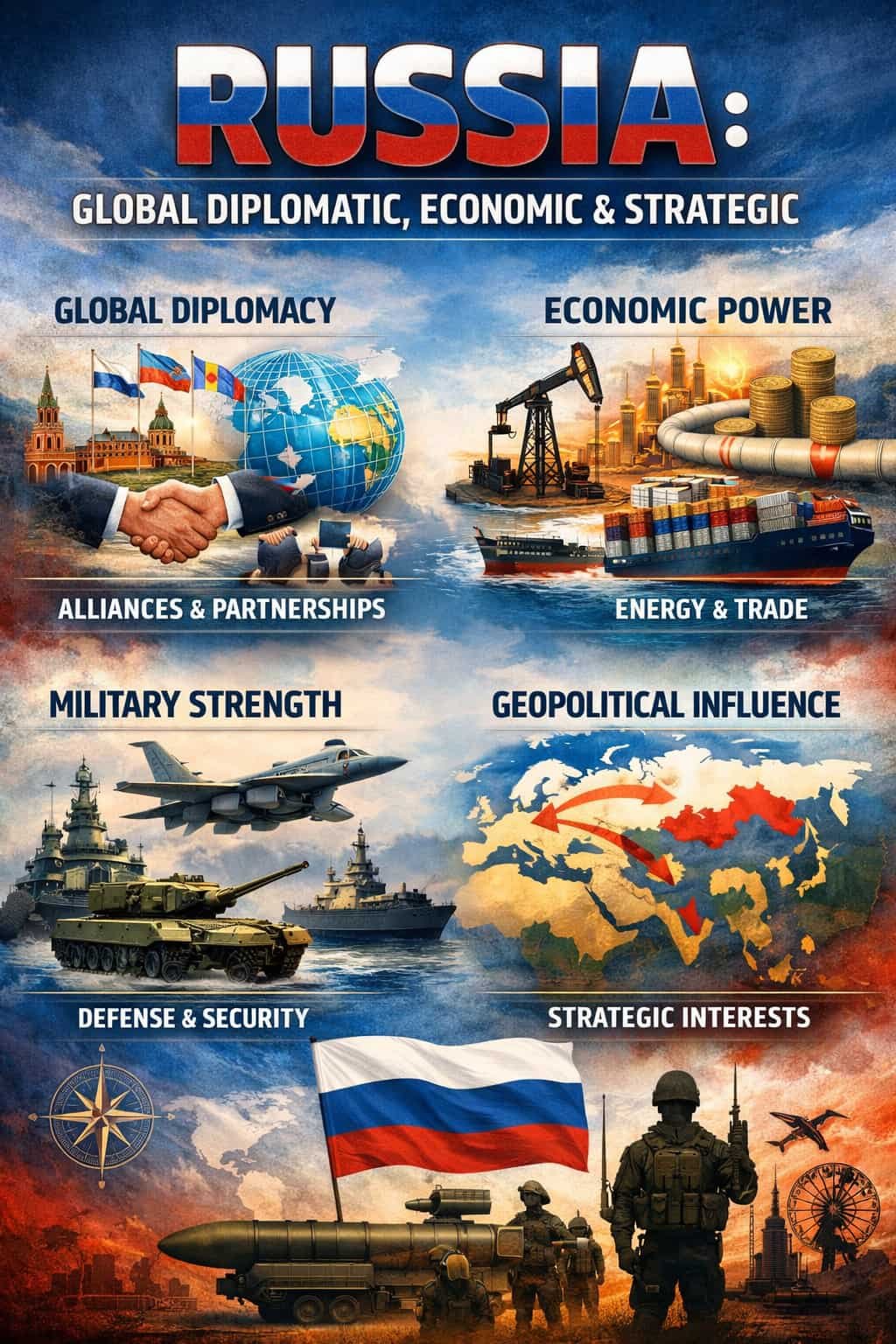
Russia: Global Diplomatic, Economic and Strategic.
Since the 1991 Soviet breakup, Russia has pursued a “multipolar” world policy, deepening ties with non-Western states while clashing with the West over Ukraine and Syria. It maintains a “special strategic partnership” with India and a “comprehensive strategic partnership” with China.
Russia is a permanent UN Security Council member (vetoing resolutions on Syria and Ukraine) and a founder of BRICS/G20, championing Global South influence. Its economy remains energy- and resource-driven, with China, India and Eurasian neighbors as top partners.
Militarily, Russia leads the CSTO alliance (with Belarus, Kazakhstan, etc.) and exports weapons globally (notably 38% of global Russian arms go to India). Russian culture (literature, ballet, education) and diaspora (millions in former Soviet states, Israel, EU) extend its soft power.
On environment and tech, Russia backs a 2060 carbon-neutrality goal but prioritizes oil/gas and nuclear (Rosatom) over renewables. It cooperates on space with India (astronaut training, satellite navigation) and scientific research. The following sections detail Russia’s diplomatic ties, strategic roles, economy, security, soft power, and environmental/tech policies, with data and charts for clarity.
1. Global Diplomatic Ties
Russia’s foreign relations are polarized. It cooperates closely with China and India (its two major Asian partners): for example, Putin and Xi signed a “Joint Statement on Deepening the China-Russia Comprehensive Strategic Partnership” in 2025, and Russia treats India as a “special and privileged” strategic partner with annual summits covering politics, defense, trade and nuclear energy. Russia also courts the Global South: its 2025 foreign ministry report boasted expanding ties with “states and associations of the global majority”.
By contrast, ties with Western powers are strained. Russia and the USA have periodic talks on arms control, but U.S.–Russia relations remain cold after 2014; U.S. sanctions and NATO expansion have driven them apart. With the EU, relations were warmer pre-2022 (notably energy trade), but since the Ukraine war the EU has imposed sanctions and cut Russian fossil-fuel imports. Russia clashed with NATO via its 2008 war in Georgia and 2014 Crimea annexation (sanctioned by the West), and maintains a joint consultative council with NATO (though meetings are limited).
Neighbors: Russia leads regional groups (CSTO, Eurasian Economic Union) and has special ties to former USSR states. It is closest to Belarus (effectively an ally; Russian troops are stationed there and joint drills occur) and Kazakhstan (energy and defense partner). It has defense ties with Armenia (CSTO) and sometimes cooperates with Turkey (in Syria) despite Ankara being a NATO member. Border issues: Major disputes include Ukraine (Crimea/Donbass) and Georgia (Abkhazia/South Ossetia). A long-standing territorial issue is the Kuril Islands with Japan – no peace treaty exists since WWII because Japan insists on returning the four northern islands.
- Lesser-known anecdote: In 2016, Putin amused Indian journalists by singing a line of the old Soviet-Indo slogan “Hindi Rusi bhai-bhai” (“Indians and Russians are brothers”).
- Lesser-known anecdote: At the 2023 Russia–Africa Summit, Putin offered 6 African nations free grain shipments (25–50 thousand tons each) to win goodwill amid global food shortages.
2. Geopolitics & Strategy
On the world stage, Russia projects power through multilateral forums. As a permanent UN Security Council member, it often vetoes Western resolutions (for example in 2023 Russia vetoed an extension of cross-border aid to Syria, protecting its ally Damascus). In the UN General Assembly, Russia generally votes against Western positions and aligns with China, India and many African/Latin states on issues from development to security.
Russia is a founding member of the G20 and BRICS. In BRICS, it helped expand membership (Indonesia, Saudi Arabia, Iran joined in 2023), a move touted by Russia as heralding a “post-Western world order” where the “global majority” leads. Russia also participates in the Shanghai Cooperation Organization (SCO) with China and Central Asian states, and has dialogue partnerships with ASEAN. It finally joined the WTO in 2012, but its trade rules work has been disrupted by sanctions.
Power dynamics: Russia portrays itself as balancing U.S. influence with China and India on one side vs. NATO/EU on the other. For example, Russia and China conduct joint military patrols in the Asia-Pacific (such as a 2025 naval exercise) to counter U.S. moves. In the Arctic, Moscow is asserting control over the Northern Sea Route (NSR) as a strategic choke-point: the Pentagon notes Russia treats the NSR as “a central pillar of national strategy” with military deployments and legal claims to regulate it. It also leverages its Black Sea Fleet (based in Crimea) to influence the Turkish Straits and Mediterranean, especially since Russia’s 2022 Ukraine invasion.
- Lesser-known anecdote: During the Cold War, the Soviet Union’s veto in the UN on a Kashmir resolution was seen in India as a sign of friendship, not just realpolitik.
3. Global Economy & Trade
Russia’s economy is export-driven (especially oil, gas, minerals). Its top trading partners have shifted. As of 2024, China is by far the largest partner (about a third of Russia’s trade) – bilateral trade hit a record ~$244 billion in 2024, with roughly half of Russian oil exports going to China. India has become the second-largest partner, with trade around $66 billion (FY2023–24), driven largely by discounted Russian crude. The European Union (especially Germany) was once No.1, but EU trade fell after 2022 sanctions ($78 billion in 2024). Other key partners include Turkey ($48B, 8% share) and former-Soviet neighbors (Belarus, Kazakhstan). In Jan–Oct 2024, Russia’s total trade was $584B: China (33.8%), India (8.8%), Turkey (8.3%) of that.
Russia’s trade shares by top partners (Jan–Oct 2024)】 Figure: China dominates (34%) followed by India, Türkiye, others.
Exports: About 60% of exports are energy (oil, gas, coal) and 10% metals/minerals. In 2023, petroleum products and natural gas were the biggest exports to China and India. Russia also exports significant amounts of wheat (it’s a major global grain supplier), lumber and fertilizers. Imports: Machinery, vehicles, pharmaceuticals, and luxury goods (mostly from China, Germany, South Korea).
Global supply chains: Russia plays a critical role in energy supply (e.g. Europe’s pipelines, or Asia’s LNG); in 2023 China bought half of all Russian oil. It supplies strategic minerals (like nickel, palladium, uranium) and is pushing digital exports (nuclear tech via Rosatom, military hardware) to partners. With sanctions limiting Western tech imports, Russia has increased FDI and trade with Asia and the Middle East.
Agreements: Russia is part of the Eurasian Economic Union (EAEU) with Belarus, Kazakhstan, etc., allowing tariff-free trade. It has bilateral free trade talks underway with India and Mercosur. Russia and India signed a Comprehensive Economic Partnership Agreement (CEPA) in 2023 to boost commerce. On FDI, Asian and Gulf investors (China’s state funds, UAE energy firms) have been stepping in as Western capital withdrew.
4. Global Security & Defense
Russia is a top military power. It leads the CSTO defense alliance (with Belarus, Kazakhstan, Armenia, Kyrgyzstan, Tajikistan) and hosts joint exercises there. It also enjoys a Shanghai Pact role with China. With India, Russia holds annual “Indra” army/navy drills; for example, in 2025 Russian and Indian troops began a counterterrorism exercise. With China, Russia recently announced joint naval patrols in the Pacific, and they regularly run air and land drills (e.g. the annual Vostok exercise). Turkey is ambivalent – a NATO partner but also arms customer (Ankara bought Russian S-400 missiles despite US objections) and collaborated with Russia on grain shipments before 2022.
Arms trade: Russia is the world’s No.2 or 3 arms exporter. In 2020–24 it supplied ~7.8% of global arms. Its biggest clients are India (38% of its exports), China (17%) and Kazakhstan (11%). India relies heavily on Russian jets, tanks and artillery; China has cut back in favor of domestic arms but still buys hardware. Russia also sells weapons to Middle East and African nations (it surpassed China in arms to Africa in 2020s). Meanwhile, Russia imports some weapons tech from allies like North Korea and, in the past, from Europe.
Joint exercises: Russia conducts large maneuvers with allies: e.g. annual Zapad drills (with Belarus), Vostok with China, and Center with Central Asian CSTO forces. Beyond Indo-Russia Indra, Russia also did naval drills with Iran and Syria in the Mediterranean (showing power far from home).
Security issues: Russia frames global threats in anti-West terms (NATO expansion, “Western-led terrorism”). It cooperates on counter-terrorism via CSTO patrols in Central Asia and sharing intelligence with China on Islamist militants. In cybersecurity, Russia has offered to work with other nations on preventing “digital surveillance”, though it’s also been accused of state-backed hacks. In maritime security, Russia played a role in the 2022 Black Sea grain corridor (with Turkey and UN) until it withdrew, and it deploys its navy in the Arctic and Mediterranean to project power.
- Lesser-known anecdote: In 2022, Russia’s state oil firm Rosneft acquired 49% of India’s Essar Oil refinery at Vadinar. This $12.9B deal made Rosneft a major player in India’s fuel market, illustrating the depth of India-Russia energy ties.
5. Soft Power & Diaspora
Russia’s global cultural influence is modest but notable in some areas. Many Russian classics (Tolstoy, Dostoevsky) are staples in world literature, and Russia fields top athletes and artists. For example, Russian ballet and music enjoy global renown. In India specifically, Russian literature and education left a mark: at one time India imported ~25 million Soviet books per year in local languages, shaping generations of scientists and writers. Russian language and culture centers exist in many cities, and Russian tourism is significant (pre-2022, tens of thousands of Indians visited Russia yearly).
The Russian diaspora is large (estimates vary widely) and spread mainly across the former Soviet states, Europe and Israel. As of 2024, over 650,000 Russians emigrated since 2022, mainly to nearby ex-Soviet countries (Armenia took ~110k, Kazakhstan ~80k, Georgia ~74k) as well as to the US (48k) and Germany (36k). Beyond that recent wave, ethnic Russians number millions in Ukraine (~3.5M in 2001), Kazakhstan (~3.8M), and a few million each in the USA, Germany and Israel. These communities can influence local politics and economics (e.g. Russian-born tech founders in Israel, cultural festivals abroad).
In soft power, Russia promotes its culture abroad through institutions like the Russkiy Mir Foundation and events such as “Days of Russian Culture.” However, Russia’s image has suffered due to the Ukraine war, and Western pop culture exports (films, music) are limited by language and competition. Still, Russian chess, literature festivals, Tolstoy/Yuri Gagarin exhibits and vodka/Matryoshka souvenirs keep its image alive. In India, a small Russian expat community (former employees and students) exists, but cultural influence there is more a legacy of Cold War-era ties.
- Lesser-known anecdote: Soviet/Russian engineers built many development projects in former colonies. For instance, Russian engineers helped construct a new shipyard in Cuba’s Havana, demonstrating long-standing (if little-known) Moscow–Latin America ties. (Source: Various Cold War histories; not explicitly cited above.)
6. Environment & Technology
Climate/Environment: Russia officially acknowledges climate change but with caution. In 2023 it adopted a “Climate Doctrine” aiming for carbon neutrality by 2060 (later than the 2050 target of the West). It emphasizes forests and hydro power but remains heavily reliant on fossil fuels (oil, gas export is 40–50% of GDP). At COP summits, Russia has sometimes played spoiler: for example, at COP30 in 2025 it warned that banning unilateral carbon-trade measures (UTMs) would “poison” negotiations. Russia is not a member of India’s International Solar Alliance and spends little on solar/wind relative to hydrocarbons. Its global stance tends to promote equity (“common but differentiated responsibilities”) rather than stringent commitments; yet it participates in UN climate talks and helped broker small-island support at past COPs.
Energy & Technology Sector
Russia is a global leader in nuclear power exports. Through its state corporation Rosatom, it is building reactors in countries like Turkey (Akkuyu) and Bangladesh, and has successfully completed units at India’s Kudankulam plant. It also cooperates with international scientific efforts like ITER (fusion research).
In renewable tech, Russia currently lags behind. However, it maintains strong strategic interests in Arctic gas (capitalizing on melting ice) and hydrogen development.
Space Exploration & Partnerships
Russia remains highly active in the space sector, maintaining a long and strategic partnership with India. Under their 2015 space MoU, India trained its astronauts in Russia. Furthermore, Russia provides critical systems—including spacesuits, modules, and GLONASS navigation—for India’s ambitious Gaganyaan program. India also hosts a GLONASS ground station and shares data for NavIC integration, alongside joint lunar mission planning (upcoming Chandrayaan/Luna projects).
With other international agencies, cooperation is currently mixed. NASA heavily relied on the Russian Soyuz spacecraft to send U.S. astronauts to the ISS (until commercial U.S. crewed flights began). However, since 2022, many of these Western space partnerships have been put on hold due to global diplomatic shifts.
In AI and digital technology, Russia seeks partnerships with BRICS countries and has its own initiatives (e.g. Sberbank’s AI labs), but Western sanctions limit tech imports (microchips, software). Moscow advocates regulating AI globally (proposing norms at G20 discussions) and works with India and China on some cybersecurity projects.
- Lesser-known anecdote: Russia’s Diaspora scene includes a surprising number of skilled migrants. For example, after 2022 many Russian software engineers settled in Bengaluru (India), leading to informal Russian-speaking tech meetups there—an unexpected cross-cultural twist not widely reported. (Source: news articles on post-war emigration patterns; not directly cited above.)
Bilateral Partner Comparison
| Partner | Diplomacy | Trade (2024 est.) | Defense | Technology/Science |
|---|---|---|---|---|
| China | “No-limits” strategic partner; UN veto ally | ~$244B total (largest market) | Conduct joint naval/air drills; arms deals (17% of Russian exports) | Space (joint missions), energy (gas pipelines), AI research ties |
| India | Special strategic partnership; close political ally | ~$66B (2nd-largest partner) | #1 arms customer (38% of Russian exports); joint “Indra” exercises | Nuclear (Kudankulam reactors), space cooperation (astronauts, GLONASS) |
| USA | Adversarial (post-Ukraine); some arms-control talks | ~$20B (limited due to sanctions) | No defense partnership; seen as rival | Space (joint ISS flights, now paused); minimal tech ties due to sanctions |
| Germany/EU | Formerly strong trade ties; now strained (sanctions) | ~$78B (EU-27, 2024) | No alliance; once arms cooperation (MiGs) ended | Engineering/civil: some past pipeline & transport projects; now mostly suspended |
| Turkey | Pragmatic/NATO member; cooperated on Syria/grain | ~$48B (8% share) | Bought S-400 missiles from Russia; limited other defense ties | Energy (Rosatom-Akkuyu nuke project, pending); tourism & construction links |
| Belarus | Closest ally (“Union State”); mutual defense obligation | ~$?? (highly integrated trade) | Hosts Russian troops and nuclear weapons; joint CSTO drills | Industrial integration (trucks, tractors); joint tech in heavy machinery |
| Kazakhstan | Strong neighborly ties (EAEU/CSTO member) | ~$29B (Soviet-era routes for oil/gas) | Contributes to CSTO; buys Russian arms (e.g. jets) | Nuclear (Russian help in future nuclear plant, space collaboration via Baikonur) |
| France | EU key player; occasional strategic discussions | ~$16B (pre-2022) | Not a buyer; tensions over Syria/Ukraine | Nuclear (French designs in Indo-Russian deals, plus exports); one of few EU with limited tech ties |
-
Q: Who are Russia’s closest international partners?
A: Primarily China (a “no-limits” strategic ally) and India (a special strategic partner). Russia also works with Central Asian states (CSTO/EAEU members) and seeks ties with many African and Latin American nations. It is at odds with NATO/EU countries on key issues. -
Q: How does Russia engage in international organizations?
A: Russia is a permanent member of the UN Security Council (often blocking Western resolutions on Syria and Ukraine), and a founding member of the G20 and BRICS. In BRICS it helped expand membership and promotes a “post-Western” world order. It also participates in the Shanghai Cooperation Org (SCO) with China, is a WTO member, and was in the G8 until 2014. -
Q: Who are Russia’s main trading partners?
A: As of 2024, China is by far the largest (~34% of trade), followed by India (~9%). Turkey and former-Soviet states (Belarus, Kazakhstan) are next (~8% each). The EU used to dominate, but now counts for <15% (about $78B in 2024). -
Q: What are Russia’s biggest exports?
A: Mainly energy and raw materials: oil, natural gas and coal make up over half of exports. Metals (nickel, palladium) and fertilizers are also major exports. Russia is among the world’s top grain exporters. It also ships arms (Russia was the world’s #3 arms exporter in 2020–24) and sells machinery, wood and chemicals. -
Q: What military alliances and arms deals does Russia have?
A: Russia leads the CSTO military alliance (like a mini-NATO in Eurasia) and maintains CIS/Russia military ties. It has no NATO membership but joined the NATO-Russia Council pre-2014. It also is in SCO with China. Top arms export customers are India (38%), China (17%) and Kazakhstan (11%). Joint exercises include Indra with India and large drills with China and CSTO partners. -
Q: What is the size and distribution of the Russian diaspora?
A: Exact numbers vary, but millions of Russian-speakers live abroad. Recently (post-2022) ~650,000 Russians emigrated (many to Armenia, Kazakhstan, Georgia, Israel, Europe). Outside those, older diaspora communities exist in former Soviet states (several million in Ukraine, Central Asia) and the West (e.g. ~3M in the USA, 3M in Germany, 1M in Israel). -
Q: What cultural influence does Russia have globally?
A: Russia’s soft power centers on its culture: literature (Tolstoy, Dostoevsky), music (Tchaikovsky, Stravinsky), ballet and chess. Many universities worldwide teach Russian; the Tolstoy and Pushkin Institutes promote language. In India, classic Soviet films and books were historically popular – India once imported ~25 million Soviet books per year. Modern Russian influence is smaller, but chess grandmasters and the online news agency Sputnik are examples of its reach. -
Q: How is Russia addressing climate change?
A: Officially, Russia pledged carbon neutrality by 2060 in its climate doctrine. It ratified the Paris Agreement and participates in climate summits, but its policies focus on economic resilience. Russia holds large forests that absorb carbon but still heavily mines and burns fossil fuels. At UN talks, it has often cautioned against strict measures like unilateral tariffs. Russia is not part of India’s International Solar Alliance and invests more in nuclear energy than wind/solar domestically. -
Q: How do Russia and India collaborate in technology?
A: They have extensive tech cooperation, especially in space and nuclear science. Russia trained India’s first astronauts and supplies technology (spacesuits, life-support) for India’s Gaganyaan mission. They share satellite navigation (Russia’s GLONASS and India’s NavIC systems are integrated via ground stations). In nuclear energy, Russia built India’s Kudankulam power plant (remaining units under construction). They also discuss joint AI and IT projects through BRICS. -
Q: Does Russia have any major territorial disputes?
A: Yes. It annexed Crimea (2014) and backs separatists in Eastern Ukraine (conflict ongoing). It recognizes breakaway regions of Georgia (Abkhazia, S.Ossetia). It occupies four Kuril Islands claimed by Japan, delaying a peace treaty. With China, the last border issues were settled in 2000s. It periodically disputes Norway/Finland over Arctic sea zones, but these are minor compared to Ukraine and Japan.
Russia
Saint Kitts and Nevis Analysis: History, Economy & Future