Agni 6 Missile India represents the most ambitious aerospace defense project currently under development by India’s Defence Research and Development Organisation (DRDO). Designed as a highly advanced Intercontinental Ballistic Missile (ICBM), this system initiates a profound paradigm shift in strategic military capability. While previous iterations of the Agni family were engineered primarily to address regional security dynamics concerning immediate continental adversaries, the newest platform is built specifically for global reach. By integrating Multiple Independently Targetable Re-entry Vehicle (MIRV) payloads and Maneuverable Re-entry Vehicle (MaRV) technology, the missile ensures unparalleled survivability against modern multi-layered anti-ballistic missile defense systems. Featuring an estimated operational reach of 10,000 to 12,000 kilometers, it permanently alters the geopolitical calculus, expanding India’s deterrence envelope to cover deep continental targets worldwide. Consequently, this formidable delivery system moves the nation into an exclusive tier of global powers possessing transcontinental nuclear strike proficiency, fundamentally securing its second-strike guarantees under a strict No First Use (NFU) nuclear doctrine.
Thank you for reading this post, don't forget to subscribe!Agni 6 Missile India Historical Background
The genesis of India’s long-range strategic deterrent traces back to 1983 with the inception of the Integrated Guided Missile Development Programme (IGMDP) under the stewardship of Dr. A.P.J. Abdul Kalam. Initially conceived as a technology demonstrator, the Agni program was intended to establish domestic competence in re-entry technology, propulsion, and guidance systems. Following the successful test flight of the Agni-I in 1989, defense planners recognized the platform’s vast strategic potential. Consequently, the Agni portfolio was separated from the broader IGMDP to receive dedicated funding and classified operational status as India’s primary nuclear delivery vehicle.
Over three decades, the missile series evolved methodically. The Agni-I (700 km) and Agni-II (2,000 km) provided foundational medium-range deterrence against immediate border threats. The Agni-III (3,000 km) and Agni-IV (4,000 km) introduced intermediate-range capabilities, bringing a broader operational theater into focus. In 2012, the paradigm shifted dramatically with the maiden flight of the Agni-V, a 5,000+ kilometer system that firmly established an indigenous ICBM infrastructure capable of reaching deep into the Asian continent.
However, the rapid proliferation of advanced ballistic missile defense (BMD) networks across Asia, combined with the geopolitical necessity to ensure absolute second-strike survivability, necessitated a technological leap beyond the Agni-V. Initial defense debates in 2011 suggested skepticism regarding the requirement for ranges exceeding 10,000 kilometers, as primary threats were geographically adjacent. Yet, by 2013, the DRDO officially confirmed that the Agni-VI project was in the hardware realization phase. This transition from regional to intercontinental focus reflects a broader recognition that a credible nuclear deterrent must remain immune to technological obsolescence and adversary interception capabilities, guaranteeing retaliation from deep within domestic sanctuary zones.
Technical Overview
The structural and propulsive architecture of the Agni-VI reflects the absolute pinnacle of domestic aerospace engineering. Moving beyond the three-stage configuration of its predecessor, this ICBM utilizes a highly sophisticated four-stage solid-fueled rocket motor system. The reliance on solid propellants is a critical operational decision; unlike liquid fuels, which require volatile handling and prolonged pre-launch preparation, solid fuels allow the missile to be stored in a state of near-instant readiness. This significantly compresses the launch window, a vital characteristic for ensuring rapid retaliation capabilities during a crisis scenario.
To counteract the massive launch weight—estimated between 55,000 and 70,000 kilograms—engineers have aggressively utilized advanced carbon composite materials. These lightweight composites replace traditional steel and aluminum alloys in the motor casings, drastically reducing the dead weight of the rocket framework. This reduction in structural mass translates directly into increased payload capacity and an extended operational range, allowing the system to house complex multi-warhead buses without degrading its transcontinental reach.
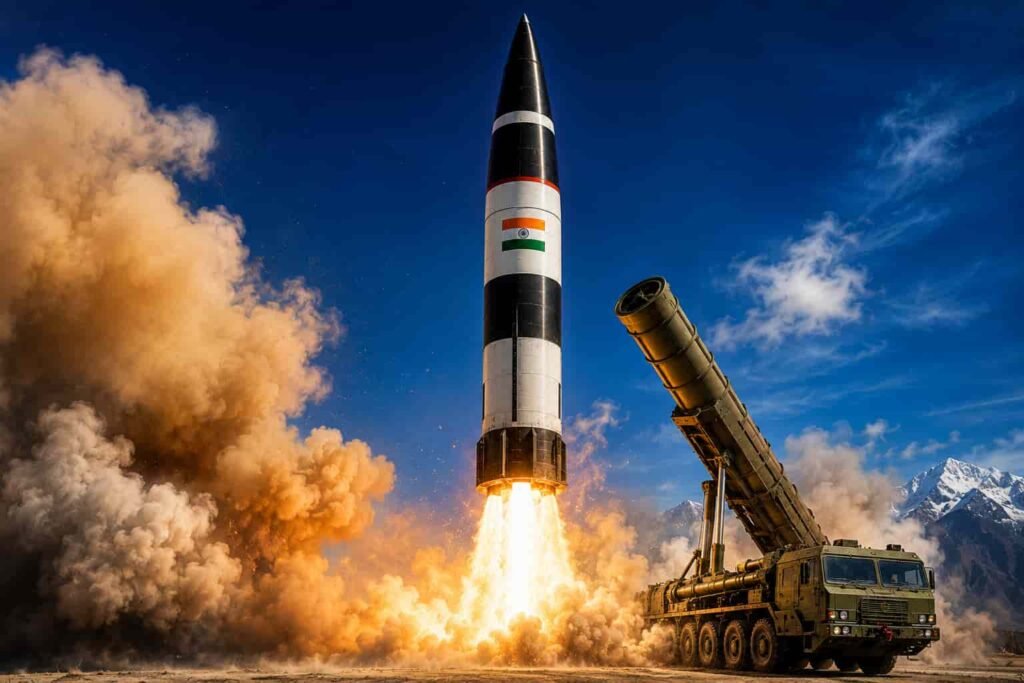
Furthermore, the system employs a heavily modified canisterized cold-launch mechanism. Housed within a hermetically sealed canister mounted on a heavy multi-axle Transporter Erector Launcher (TEL), the missile is ejected using a high-pressure gas generator. The primary rocket engine ignites only after the missile has safely cleared the launch tube. This method protects the launcher from extreme exhaust heat, allowing the TEL to be reused, and enabling the missile to be transported inconspicuously across civilian highway infrastructure. This road-mobility vastly complicates adversary targeting efforts by dispersing the deterrent force across unpredictable geographic nodes.
Main Features
The defining characteristic distinguishing the newest system from legacy platforms is the complete integration of MIRV technology combined with MaRV capabilities. Traditional ballistic systems employ a single unitary warhead that follows a predictable parabolic trajectory, making them susceptible to interceptor missiles. The MIRV architecture disrupts this dynamic completely. A single payload bus can carry up to 11 independent nuclear warheads, alongside lightweight decoys and electronic countermeasures. During the exoatmospheric mid-course phase, the post-boost vehicle dispenses these warheads on highly varied trajectories, allowing one launch to devastate multiple distinct targets spread hundreds of kilometers apart.
| Payload Feature | Operational Benefit | Strategic Capability |
| MIRV Integration | Deploys 10–11 independent warheads. | Overwhelms missile defense networks through sheer saturation. |
| MaRV Technology | High-G terminal evasive maneuvers. | Renders flight paths completely unpredictable to interceptor radars. |
| RAM Coating | Reduces radar cross-section (RCS). | Evades advanced early warning systems like S-500 and THAAD. |
| Lightweight Decoys | Dispenses chaff and fake thermal signatures. | Exhausts enemy interceptors before genuine warheads arrive. |
Complementing the MIRV payload is the implementation of Maneuverable Re-entry Vehicles (MaRV). Rather than passively descending through the atmosphere, MaRV-equipped warheads utilize aerodynamic control surfaces and internal thrusters to execute sharp, unpredictable zig-zag maneuvers at hypersonic velocities. This renders the warhead’s terminal flight path inherently erratic.
Additionally, the system incorporates advanced stealth features. To further degrade the tracking efficiency of systems like China’s HQ-19, the United States’ THAAD, and Russia’s S-500, the re-entry vehicles are coated with proprietary radar-absorbent materials (RAM). This multi-layered approach—saturation via MIRVs, unpredictability via MaRVs, and signature reduction via RAM—ensures an almost guaranteed penetration of heavily defended airspace.
Detailed Specifications
The quantitative metrics of this ICBM underline its status as a heavy-class strategic weapon. It measures approximately 20 to 40 meters in length with a consistent diameter of 2.0 meters, creating the massive internal volume required for the solid-propellant grains and the complex MIRV dispensing bus.
Technical Data and Metrics
| Specification Category | Operational Details |
| System Classification | Intercontinental Ballistic Missile (ICBM) |
| Total Mass | 55,000 kg – 70,000 kg |
| Physical Dimensions | Length: 20–40 m; Diameter: 2.0 m |
| Propulsion System | Four-stage composite solid-fuel rocket |
| Maximum Range | 10,000 km – 12,000 km |
| Terminal Speed | Mach 24 (Approx. 29,400 km/h or 8.17 km/s) |
| Warhead Configuration | 10–11 MIRVs + MaRV capability |
| Total Payload Capacity | ~3,000 kg (3 Tonnes) |
To contextualize this capability within the broader domestic arsenal, it is necessary to examine the progressive evolution of the missile family. The generational leap in both reach and velocity is stark when compared against earlier platforms.
| Missile Variant | Operational Range | Terminal Speed | Launch Platform |
| Agni-I | 700–1,200 km | Mach 7.5 | Road/Rail Mobile |
| Agni-III | 3,000–5,000 km | Mach 15 | Rail Mobile |
| Agni-V | 7,000–8,000 km | Mach 24 | Canisterized TEL |
| Agni-VI | 10,000–12,000 km | Mach 24+ | Canisterized TEL |
Navigation Architecture
Navigational precision is absolutely critical for delivering multiple warheads across intercontinental distances. The missile relies on a highly redundant, jam-resistant suite of avionics to achieve a low Circular Error Probable (CEP), ensuring precision strikes against hardened military installations.
| Navigational Component | Function and Technical Role |
| Ring Laser Gyroscope (RLG-INS) | Provides highly accurate, optical interference-based inertial navigation without moving mechanical parts using the Sagnac effect. |
| Micro-INS Backups | Redundant Micro-Electro-Mechanical Systems (MEMS) ensure continuous spatial tracking if primary optical sensors fail. |
| Satellite Navigation (GNSS) | Integration with NavIC (India’s regional satellite network) and GPS for real-time mid-course trajectory correction. |
| Terminal Guidance Sensors | Utilizes imaging infrared homing and radar scene correlation to accurately strike targets in the final seconds. |
Working Mechanism
The flight profile of the missile operates as a highly synchronized sequence of mechanical, propulsive, and computational events spanning three distinct operational phases.
The launch initiates the Boost Phase, wherein high-pressure gas ejects the missile from its mobile canister. Milliseconds after clearing the launch tube, the first-stage solid rocket motor ignites, generating massive thrust to propel the 70-ton vehicle through the dense lower atmosphere. As each stage depletes its fuel, explosive bolts sever the empty casing to shed dead weight, allowing the subsequent stages to push the payload faster and higher until the missile exits Earth’s atmosphere entirely.
Once in the vacuum of space, the Mid-Course Phase begins. Here, the post-boost vehicle (often referred to as the “bus”) takes exclusive control. Utilizing the Ring Laser Gyroscope and satellite navigation inputs, the bus aligns itself along specific orbital vectors. Small attitude-control thrusters maneuver the bus as it systematically releases individual MIRV warheads and radar decoys at precisely calculated intervals, establishing entirely distinct ballistic trajectories for each independent target.
Finally, the gravitational pull brings the warheads back toward Earth, initiating the Terminal Phase. Re-entering the atmosphere at speeds approaching Mach 24 (roughly 8.17 kilometers per second), the warheads endure extreme thermal friction. Carbon composite heat shields prevent incineration. Concurrently, MaRV-enabled warheads execute pre-programmed aerodynamic deviations, pulling high-G maneuvers to evade interceptor missiles right before detonating over their respective targets via impact or proximity airburst.
Strategic Importance
The introduction of the Agni 6 missile India alters the fundamental balance of power far beyond the South Asian subcontinent. Historically, the nation’s nuclear posture was calibrated to achieve “credible minimum deterrence” specifically focused on mitigating threats from neighboring Pakistan and China. With the Agni-V, the entire Chinese mainland was brought within strike range, effectively establishing a stable regional deterrence equilibrium.
However, the pursuit of an ICBM with a 12,000-kilometer range signals a transition toward transcontinental strategic hegemony. This expanded reach means that targets across Europe, the Middle East, the deep Pacific, and parts of the Americas now fall under the operational envelope of the Strategic Forces Command. While India maintains a strict No First Use policy, ensuring that its nuclear arsenal is entirely retaliatory, possessing a weapon of this magnitude guarantees that no adversary—regardless of their geographic distance or technological superiority—can launch a preemptive strike without facing guaranteed and unacceptable devastation.
Furthermore, the geopolitical messaging attached to this development is profound. By mastering MIRV technology and long-range solid-propellant systems, India explicitly demonstrates that it belongs to the elite upper echelon of global military powers. Strategic scholars observing this behavior through the lens of Mearsheimer’s offensive realism note that states seek survival through dominance, not equilibrium. This capability serves as a vital instrument of statecraft, providing New Delhi with significant diplomatic leverage in international arms control negotiations and shifting geopolitical alignments. It forces global superpowers to recognize India not merely as a regional balancer, but as an independent, offensive-ready pole in the multi-polar world order.
Advantages
The operational advantages of this ICBM architecture act as a profound force multiplier for defense forces. Foremost is its remarkable survivability. Because it is housed in a climate-controlled canister and transported on road-mobile TELs, the system can be continuously relocated across vast, rugged domestic terrains. This mobility ensures that enemy surveillance satellites cannot easily pinpoint and neutralize the launchers in a preemptive first strike.
Additionally, the MIRV payload allows the military to threaten up to 11 distinct targets using only a single delivery vehicle. This creates immense economic and tactical efficiency, forcing adversaries to exponentially increase their spending on interceptor missiles, which are inherently more expensive and complex than offensive warheads. Furthermore, the extreme Agni 6 speed of Mach 24 during terminal descent drastically compresses the reaction window for enemy radar operators and automated defense networks, meaning that even if the incoming warhead is detected, there is simply not enough time to calculate an interception vector.
Limitations
Despite its devastating potential, the development and deployment of an ICBM of this class face formidable engineering and logistical challenges. The physical dimensions and the estimated 70,000-kilogram mass severely restrict its mobility. Transporting a 40-meter heavy missile across civilian bridges, mountain passes, and unreinforced rural infrastructure requires highly specialized logistical planning, making deployment routes somewhat predictable compared to lighter, shorter-range variants.
Testing also poses a significant geopolitical hurdle. Conducting full-range validations for a 12,000-kilometer missile requires securing vast stretches of international waters—typically deep into the Indian Ocean or the Pacific. Such tests inevitably trigger alarm and intense surveillance from global naval powers. Chinese research vessels equipped with telemetry-gathering arrays, such as the Xiang Yang Hong 01 and 03, frequently lurk near NOTAM (Notice to Airmen) zones attempting to harvest sensitive electronic data during launch windows. Lastly, the financial burden of continuously modernizing guidance avionics to stay ahead of rapidly evolving interceptor technologies demands massive, sustained defense expenditures.
Latest Developments
The trajectory of the DRDO Agni 6 program accelerated dramatically between 2024 and 2026, transitioning from theoretical design to active hardware validation. The foundational leap occurred on March 11, 2024, with “Mission Divyastra,” which marked India’s maiden test of a MIRV payload aboard the Agni-V platform. This success proved that domestic scientists had successfully mastered the complex physics of sequential warhead release in exoatmospheric conditions.
The most critical milestone occurred in May 2026. In a concentrated three-day span, the DRDO successfully validated several strategic technologies, culminating in the test of an advanced MIRV-equipped Agni variant from the Integrated Test Range off the Odisha coast on May 8. Strategic analysts widely identified this advanced variant as a technological validation platform for the Agni-VI. To avoid alarming international observers regarding the system’s true range, the missile was flown on a depressed trajectory over a restricted span of approximately 3,500 kilometers.
Despite the artificially shortened distance, the test confirmed the operational maturity of the multiple payload delivery mechanism, proving the system could strike widely dispersed targets with absolute precision. According to DRDO Chairman Samir V Kamat, the organization is now fully prepared to initiate the full-scale development and production phase, awaiting only final executive clearance.
| Feature Matrix | Agni-V (Current Fleet) | Agni-VI (Next-Generation) |
| Operational Range | 5,000 km – 8,000+ km | 10,000 km – 12,000 km |
| Warhead Technology | Single Warhead / Early MIRV | Fully integrated 10–11 MIRVs + MaRV |
| Payload Capacity | ~1,500 kg | ~3,000 kg (3 Tonnes) |
| Overall Mass | 50,000 kg | 55,000 kg – 70,000 kg |
| Rocket Stages | Three-stage solid fuel | Four-stage solid fuel |
| Evasion Tactics | Basic decoys | Radar-absorbent coatings, high-G MaRV |
Future Scope
The technological maturation of this ICBM directly informs the future architecture of India’s nuclear triad, specifically its sea-based deterrent. Defense analysts note immense cross-pollination between the land-based program and the highly classified K-Family of Submarine-Launched Ballistic Missiles (SLBMs). The composite propellant formulations and MIRV dispensing buses engineered for the Agni-VI are expected to be heavily integrated into the upcoming K-5 (5,000 km) and K-6 (8,000 km) SLBMs. These naval variants will eventually arm the advanced S5-class ballistic missile submarines, offering a virtually undetectable second-strike platform from the ocean depths.
Looking further ahead, the payload module itself will evolve. While traditional MIRVs represent the current state-of-the-art, the DRDO’s ongoing success with scramjet combustors and Hypersonic Glide Vehicles (HGVs)—as validated in parallel tests during May 2026—suggests that future variants of the ICBM may replace standard ballistic warheads with HGVs. Because HGVs glide along the upper atmosphere rather than entering deep space, they remain entirely beneath the radar horizons of traditional early-warning networks, representing the ultimate evolution in strategic penetration.
Expert Analysis
The unveiling of transcontinental capabilities has prompted intense debate among geopolitical and defense scholars regarding India’s evolving strategic posture. Traditionally, New Delhi’s nuclear doctrine has been strictly defensive, focused on “credible minimum deterrence” and a posture of pure retaliation. However, experts from institutes like the Observer Research Foundation (ORF) and the Manohar Parrikar Institute for Defence Studies and Analyses (IDSA) suggest that the sheer capability of an extremely accurate, heavy-payload, MIRV-enabled ICBM edges India closer to a counter-force posture.
A counter-force strategy implies the ability to preemptively destroy an enemy’s nuclear silos and command centers, a feat requiring the exact high-precision, multi-target capabilities that the Agni-VI provides. Observers point out that framing the development purely around Chinese regional deterrence is a strategic convenience that masks a broader ambition to possess global striking capabilities. The May 2026 depressed-trajectory test specifically showcased a mastery of deterrence messaging; by visibly launching a highly advanced system while intentionally withholding the true apex range, India fostered an environment of strategic ambiguity. This ambiguity forces adversaries to plan against worst-case scenarios, thereby magnifying the psychological impact of the deterrence without technically violating international stability norms.
Frequently Asked Questions
What is the operational Agni 6 range?
The operational Agni 6 range is estimated to fall between 10,000 and 12,000 kilometers. This transcontinental reach allows the missile to strike targets across Asia, Europe, the Middle East, and significant portions of North America, firmly establishing it as a top-tier Intercontinental Ballistic Missile (ICBM).
What is the maximum Agni 6 speed during re-entry?
The Agni 6 speed reaches an extreme hypersonic velocity of approximately Mach 24 (roughly 29,400 km/h or 8.17 kilometers per second) during its terminal descent phase. At this velocity, combined with unpredictable Maneuverable Re-entry Vehicle (MaRV) flight paths, interception by traditional anti-ballistic missile systems is nearly impossible.
Is the DRDO Agni 6 equipped with MIRV technology?
Yes, the DRDO Agni 6 is designed to be fully MIRV (Multiple Independently Targetable Re-entry Vehicle) capable. A single launch can carry a payload bus equipped with 10 to 11 independent nuclear warheads. The missile releases these warheads in space, directing each one toward a different geographic target, effectively acting as a massive force multiplier.
What is the difference between MIRV and MaRV technology in the Agni-6?
While MIRV allows a single missile to carry multiple warheads that are deployed along different trajectories using a post-boost vehicle bus , MaRV (Maneuverable Re-entry Vehicle) allows individual warheads to actively change their flight path during terminal descent. MaRVs can perform zig-zag maneuvers to evade anti-ballistic missile interception and increase targeting precision.
Will there be a submarine-launched variant of the Agni-VI?
Yes, the technologies engineered for the Agni-VI are directly informing the development of the K-6 Submarine-Launched Ballistic Missile (SLBM). The K-6 will be a solid-fueled, MIRV-capable missile with an estimated range of 8,000 to 12,000 kilometers, designed specifically to arm the Indian Navy’s next-generation S5-class ballistic missile submarines.
How does the missile survive the extreme heat of hypersonic re-entry?
To survive intense atmospheric friction where external temperatures can exceed 4,000 degrees Celsius, the missile’s re-entry vehicles utilize an indigenously designed carbon-carbon composite heat shield. This advanced material burns sacrificially to protect the payload, maintaining internal temperatures safely below 50 degrees Celsius.
What guidance systems ensure the Agni-6 hits its targets?
The missile relies on a highly sophisticated, redundant navigation architecture. It primarily uses a Ring Laser Gyroscope-based Inertial Navigation System (RLG-INS) combined with multi-GNSS satellite navigation and redundant micro-inertial backups. This multi-layered approach ensures precise targeting even over intercontinental trajectories.
What is the Agni 6 latest update regarding testing?
The Agni 6 latest update involves a critical technology validation test conducted by the DRDO on May 8, 2026. An advanced MIRV-capable Agni variant was tested from the Odisha coast. To validate the technology without revealing its maximum capabilities to international observers, the missile was flown on a depressed trajectory over a reduced range of 3,500 kilometers, successfully delivering multiple payloads in the Indian Ocean. DRDO officials have stated they are ready for full-scale development pending final government approval.
How does the Agni 6 missile India alter global deterrence?
By possessing an ICBM capable of reaching the world’s major superpowers, the Agni 6 missile India shifts the nation’s nuclear strategy from a regional focus (deterring Pakistan and China) to an absolute global deterrence model. It guarantees a devastating second-strike capability that prevents any nation globally from attempting nuclear coercion against New Delhi.
| Missile System | Operator Country | Maximum Range | Warhead Configuration | Mobility/Basing |
| Agni-VI | India | 10,000–12,000 km | 10–11 MIRVs + MaRV | Road-Mobile TEL |
| LGM-30G Minuteman III | United States | Up to 14,000 km (8,700 miles) | 1–3 MIRVs | Underground Silo |
| RS-28 Sarmat | Russia | 18,000 km | Up to 15 MIRVs / HGV | Underground Silo |
| DF-41 | China | 12,000–15,000 km | Up to 10 MIRVs | Road-Mobile TEL |
| M51 | France | 8,000–10,000 km | 6–10 MIRVs | Submarine (SLBM) |