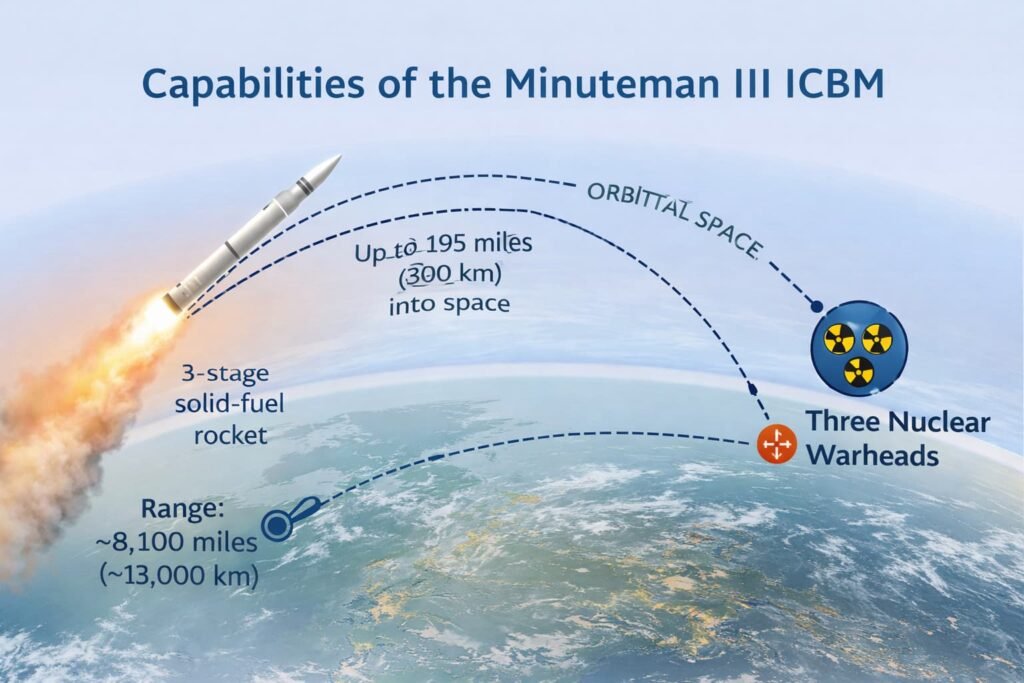
The Minuteman III rocket is often called one of Earth’s fastest machines. In a test launch (as shown above), it blasts out of its underground silo with three powerful solid-fuel stages firing in sequence. In just a few minutes it can travel thousands of kilometers: official data show it can strike targets over about 6,000 miles away, and it reaches speeds around 15,000 mph (about Mach 23) by burnout. After the engines cut off, the warhead(s) coast and re-enter the atmosphere at roughly 13,000–18,000 mph. The rest of this article explains, in simple terms, how its rocket stages, guidance system, and reentry physics make this possible.
What is the Minuteman III?
The Minuteman III is a U.S. intercontinental ballistic missile (ICBM) – a nuclear-capable long-range rocket. It was developed during the Cold War and became operational around 1970. According to official sources, Minuteman III was the first U.S. ICBM to use solid rocket fuel. Solid fuel acts like a huge frozen firework inside the rocket: it can sit loaded in its silo for years and ignite instantly, allowing the missile to launch on very short notice. The missile is nearly 60 feet (18.3 meters) long and weighs about 36,000 kilograms (79,000 pounds), roughly the size and mass of a large bus. This simple, solid-fuel design (unlike older liquid-fuel rockets) made the Minuteman fast to launch and reliable. Today the Minuteman III is the only land-based ICBM in the U.S. nuclear deterrent, kept on alert in hardened silos across several bases.
Rocket Stages and Launch Sequence
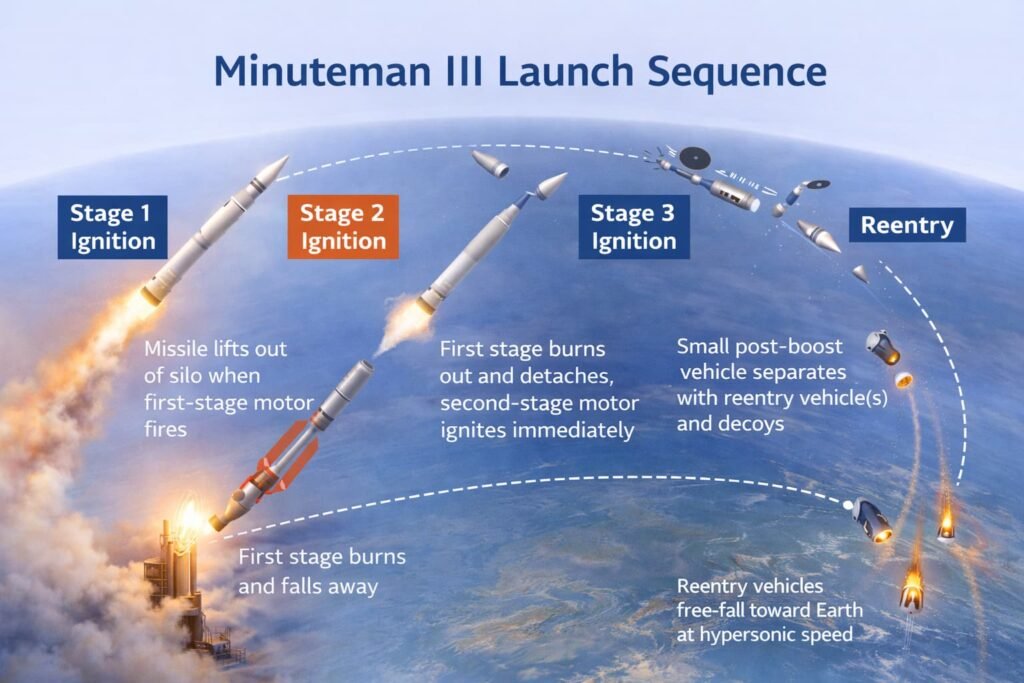
The Minuteman III uses three solid-fuel rocket stages stacked end-to-end. Each stage burns for a short time, then drops away to lighten the load. Official descriptions outline its launch steps as follows:
- Stage 1 ignition – The missile lifts out of its silo when the first-stage motor fires. Just before launch, explosive gas cartridges open the heavy silo door (and drop the launch-plug) so the rocket is free. The first stage then burns for roughly 60 seconds, sending the missile rapidly upward.
- Stage 2 ignition – About 1 minute after liftoff, the first stage burns out and detaches. The second-stage motor ignites immediately. At the same time, the nose cone (shroud) on the rocket is jettisoned. The second stage continues to push the missile higher at hypersonic speed.
- Stage 3 ignition – Around 2 minutes into flight, the second stage also burns out and drops away. The third-stage rocket then fires for about another minute, giving the final boost into space.
- Post-boost and release – Roughly 3 minutes after launch, the third stage cuts off. A small liquid-fuel post-boost vehicle (the “warhead bus”) separates from the spent rocket. This bus has its own tiny rocket engine that can maneuver slightly in space. It uses that to reach a precise release point, then ejects the reentry vehicle(s) (warhead) along with decoys and chaff.
- Reentry – Finally, the released reentry vehicle(s) free-fall toward Earth along a steep, ballistic path. These warheads re-enter the atmosphere at hypersonic speed (tens of thousands of km/h) and descend onto the target.
Each stage separation and ignition happens automatically in sequence. By discarding empty stages, the missile sheds thousands of pounds of dead weight, allowing the remaining engines to accelerate the payload even faster. The overall result is a rocket that climbs rapidly to high altitude and high speed before coasting.
Guidance and Control
Throughout the flight, Minuteman III is steered by an onboard inertial guidance system. Before launch, a target trajectory is loaded into its flight computer. Once airborne, internal gyroscopes and accelerometers keep track of how the missile is moving. The onboard computer uses this data to stay on the correct course without any outside signals (hence “inertial” navigation).
To adjust direction, each rocket stage has movable gimballed nozzles. Tiny piston or hydraulic actuators tilt the nozzle while the engine burns, nudging the thrust vector. This keeps the missile pointed in the right direction. In other words, if the missile begins to drift, it simply pivots the exhaust slightly to steer. After the third stage, the small liquid thruster on the post-boost bus makes fine adjustments before release. An independent source describes it as a kind of “4th stage” – a tiny bipropellant rocket engine that can place up to 3 warheads on separate targets if needed. All these systems together ensure the Minuteman follows its planned trajectory with high accuracy.
Re-entry and Speed
Once the warhead is released, it ballistically coasts and then re-enters the atmosphere at extremely high speed. According to ballistic missile physics, Minuteman warheads hit the air at about 6–8 kilometers per second – roughly 13,000–18,000 miles per hour. (The USAF fact sheet notes a burnout speed near 15,000 mph, about Mach 23.) At these hypersonic speeds, air friction heats the reentry vehicle’s surface to thousands of degrees. To survive this, the warhead is housed in a heavy heat shield. The shield is made of ablative material that gradually chars and erodes away, carrying heat out with the material. In NASA/AFC terms, the reentry vehicle “protects the warhead through intense atmospheric re-entry”. In short, the ablative shield takes the heat so the inner warhead stays cool.
Because of this careful engineering, the Minuteman’s reentry vehicle remains intact despite re-entering at velocities well beyond any airplane’s speed. For a moment it becomes one of the fastest human-made objects moving through the atmosphere, which is why the system is often billed as “Earth’s fastest machine.”