The Ramayana is much more than an ancient tale; it is a foundational text that has shaped societies across Asia. To truly understand its global impact, we must explore various Ramayana Cultural Perspectives. From its earliest textual origins to its diverse modern interpretations, this epic provides a fascinating window into the evolution of duty, morality, and shared human heritage.
Scholars have shown that Valmiki’s Ramayana exists in many versions with different readings. The critical edition compiled at the Oriental Institute, Baroda, collated hundreds of manuscripts (from Nepal, India, Southeast Asia) to recover a core text. This work identified two major traditions: a Northern recension (manuscripts from north and east India, Nepal, etc.) and a Southern recension (from south India, Southeast Asia). Editors also noted that older scholars thought the original epic had only five books (kāṇḍas), with Bala Kanda and Uttara Kanda added later.
- Manuscript variation: The Baroda team gathered over 2,000 manuscripts (dating from ~1020 CE to 1860 CE) and noted that even core passages often differ between sources. They marked verses unique to one tradition.
- Recensions: Northern and Southern recensions have significant differences. For example, many verses in the northern manuscripts of Bala Kanda (21 of 37 selected mss) have no parallel in the southern ones (16 mss). These textual splits point to separate lines of transmission.
- Interpolations: Critics agree some episodes were probably later insertions. The Uttara Kāṇḍa (book 7, dealing with Sita’s exile) is widely seen as a late addition. Scholars describe its style as inferior and “vastly inferior” in poetry, even calling it “completely interpolated”. Other suspected interpolations include: the phalashruti (colophon) at the end of Yuddha Kanda, the story of Shambuka, the Lava-Kuṣa episode in Uttara, and Sita’s Agni Parikṣā (trial by fire). These may not have been in Valmiki’s original.
The language and style also reflect layers. The Ramayana is written in Epic Sanskrit – derived from but distinct from the older Vedic Sanskrit. Its grammar and vocabulary show both archaic forms and later innovations. In sum, philologists treat the Ramayana like any great epic: by comparing manuscripts and linguistic clues they tease out the earliest recoverable text while noting that the tradition is “pluriform” (having many variants).
Hermeneutics: Multiple Interpretations and Ramayana Cultural Perspectives
In literary terms, hermeneutics is the art of interpretation. A single narrative can carry multiple meanings – literal, moral, symbolic, or allegorical. The Ramayana is read in many ways across cultures and eras. For instance, one study notes that the Ramayana has 300+ regional versions: it “differs from place to place due to local culture, environment and traditions”. This means the same story can be reshaped by communities (just as the Mahabharata and Jesus story have many tellings).
-
Hero vs. villain: Traditionally Rama is the virtuous hero and Ravana the demon-king. But interpreters sometimes flip these roles. Some see Ravana not just as a villain but as a learned ruler – he was “a devout follower of Shiva, a great scholar, [and] a capable ruler” in the epic’s own description. Indeed, Ravana is portrayed as Shiva’s devotee and an accomplished veena-player. Others view Ravana symbolically – as the personification of ego and desire. Hindu tradition even teaches that Ravana’s ten heads represent ten emotions including kaam (lust), krodh (anger) and ahamkāra (ego). In this light, Rama’s victory can be read as the triumph of spiritual discipline over ego (a classic allegory).
-
Rama’s character: Similarly, readers find different sides of Rama. He is admired as Maryada Purushottama (the ideal man) – noble, obedient, compassionate. At the same time, some modern critics ask whether he was a pragmatic king making tough choices. For example, was exiling his pregnant wife Sita truly just, or politically forced by public expectations? Such questions show the depth: Rama can be a model ruler or a complex human bound by dharma and realpolitik.
-
Levels of meaning: In one approach, one finds a moral lesson (e.g. Rama’s sacrifice of power to honor his father’s word teaches filial piety). In another, one sees psychological symbols (Ravana as id or ego, Rama as the superego or higher self). There is also allegorical reading: Ravana might stand for spiritual ignorance, while Sita represents bhakti (devotion) or the soul. The Ramayana has even been viewed through philosophic lenses (e.g. Vedanta, where Rama is the supreme reality). In any case, the “science of interpretation” tells us to look beyond the surface story. As one cultural analysis sums up, “mythology is neither mere fantasy nor simple allegory; it is a multivalent mirror” (meaning it can reflect many truths).
⚖️ Dharma Theory and Ethics
When examining these texts, Ramayana Cultural Perspectives reveal how the story adapts to local traditions and ethics
The concept of dharma (duty/ethics) is central to the Ramayana. Importantly, dharma is contextual and relative. There are different spheres of duty: the king’s duty, the wife’s duty, duties during crisis, etc. Traditional Hindu categories include rāja-dharma (duty of a king), stri-dharma (duty of a woman/wife), and apad-dharma (duty in emergencies). The epic illustrates all of these.
-
Raja-dharma vs. other duties: Rama repeatedly embodies rāja-dharma. He willingly gives up the throne to honor his father’s promise, demonstrating a king’s duty to truth and justice above personal gain. For example, when Dasharatha’s word obliges him to exile, Rama obeys without bitterness, showing inner discipline. One scholar notes that this is not a conflict of right vs wrong, but “between two competing rights”: on one side Raja-dharma (upholding the king’s promise and justice) and on the other side personal love (Rama’s affection for his father and brother). This highlights a core lesson: even a virtuous king must sometimes sacrifice personal happiness for the greater dharma of his office.
-
Stri-dharma (Duties of a wife): The Ramayana also shows ideals of a devoted wife. Sita is held up as the epitome of wifely dharma – loyal, pure, and supportive of her husband. For instance, when Rama is banished, Sita insists on sharing his fate, expressing that life without Rama is meaningless. The text itself comments that her reply is “one of the clearest and most nuanced articulations of Strī-dharma”. In other words, Sita knowingly chooses her duty as Rama’s wife over her own comfort. (This act illustrates śaraṇāgamana, her total surrender to Rama’s path.)
-
Apad-dharma (Dharma in crisis): There are crisis moments – wars and personal tragedies – where usual rules may bend. The ethics in those scenes is often debated. For example, Rama’s killing of the demon Shambuka (a Brahmin ascetic) raises questions about religious law vs. compassion. Scholars point out that episodes like Sita’s banishment or Shambuka’s death show an “innate dichotomy of ethics” – what is right for society vs. mercy for an individual. In short, characters are forced to make hard choices, and sometimes duty to dharma clashes with personal feelings or fairness.
-
Modern parallels: Today we compare these ideas to modern ethics (like duty vs. consequence). For instance, Sita’s trial by fire (Agni Pariksha) or exile can be scrutinized by modern readers: was it just or unfair? Such questions form a living debate. Overall, the Ramayana teaches that dharma depends on role and context – the king’s rules differ from a wife’s or a hermit’s. No action is black-and-white, and characters aim to act according to the dharma most relevant at the moment (whether as rāja, putra, svami, etc.).
🏛️ Political Theory – “Ram Rajya” as Ideal
Ram Rajya means “Rama’s rule” and is often invoked as an ideal state. The epic implies a society guided by dharma, justice and welfare under a righteous king. Valmiki portrays Rama as the model monarch: he is just, humble and caring, ensuring prosperity and morality in the kingdom. Many later writers and leaders (especially Gandhi) idealized this as the perfect state.
-
Just and moral governance: One analysis notes that Ramarajya is seen as ethical governance “built on the values of morality, peace, justice and prosperity”. In other words, it’s like a welfare state where people live harmoniously. Rama’s administration (as described in lore) supposedly had no crime, no poverty, and the king was fully accountable to dharma. Though the Ramayana itself doesn’t spell out a constitution, its vision resembles a model polity where social and cosmic order coincide.
-
Guidelines for rulers and citizens: The text’s lessons were meant for all: future kings (following rāja-dharma) and people alike. It is said the Ramayana educated even illiterate folk about values of governance. Gandhiji famously adopted Ram Rajya as a metaphor for independent India – literally a return to India’s ancient ideal of dharma. Plato’s Republic can be compared, as both imagine a wise ruler caring for the state; but Ram Rajya emphasizes divine duty (Rama is divine) over abstract theory. Modern constitutions instead distribute power and rights, yet the ideal of justice remains common.
-
Welfare and accountability: In Ram Rajya, the king’s primary duty is the welfare of subjects. Rama is depicted listening to citizens’ grievances and punishing even his own son (in Uttara Kanda) for wrongdoing, symbolizing accountability. This idealized image goes beyond many historical monarchies. However, scholars question how literal to take it: did Valmiki intend a literal “ideal state”, or was this more a mythic example of virtuous rule? Debates continue, but the phrase Ram Rajya lives on in Indian political culture as shorthand for righteous and people-centered government.
🧠 Comparative Mythology
Comparing Rama with Western heroes (like Achilles or Odysseus) highlights what is universal in hero myths and what is uniquely Indian. Both Rama and Odysseus, for example, are kings on long journeys home, facing trials to reclaim their wives. As one overview notes: “both epics depict one man’s journey, ultimately, to their respective wives; Rama to Sita and Odysseus to Penelope”.
-
Similarities: Like Achilles, Odysseus or Gilgamesh, Rama has divine ancestry and a grand purpose. All these heroes undertake epic battles (e.g. Rama fights Ravana, Achilles fights Trojans) and endure separation from family. They embody cultural ideals of heroism and duty. For instance, both Rama and Odysseus obey their kingship duties: Rama obeys his father’s orders, and Odysseus re-takes Ithaca from traitors.
-
Differences (cultural values): However, the nature of their heroism differs. Rama is often portrayed as an almost perfect man of principle, strictly adhering to dharma; Odysseus is cunning and improvisational, relying on wit as much as honor. Achilles is driven by personal honor and emotion (he sulks and nearly kills Agamemnon), whereas Rama is measured and self-controlled. Rama’s goals are familial and moral (rescue wife, uphold promise), while Odysseus’s are more survivalist and cunning (outsmart enemies and return home). In short, Western epics often celebrate individual cleverness or heroic rage, while the Ramayana emphasizes duty, righteousness, and cosmic order.
-
Unique Indian elements: Divine intervention is common to all these stories, but in the Ramayana Rama himself is God (Vishnu’s avatar), which is a different conception than the human Achilles or Odysseus. Rama’s story also includes complex notions of karma and rebirth absent in the Iliad/Odyssey. Understanding these parallels and contrasts helps us see what values each culture prizes in their heroes, and what moral lessons each epic imparts.
🔬 Anthropology & Sociology of Ramayana Festivals
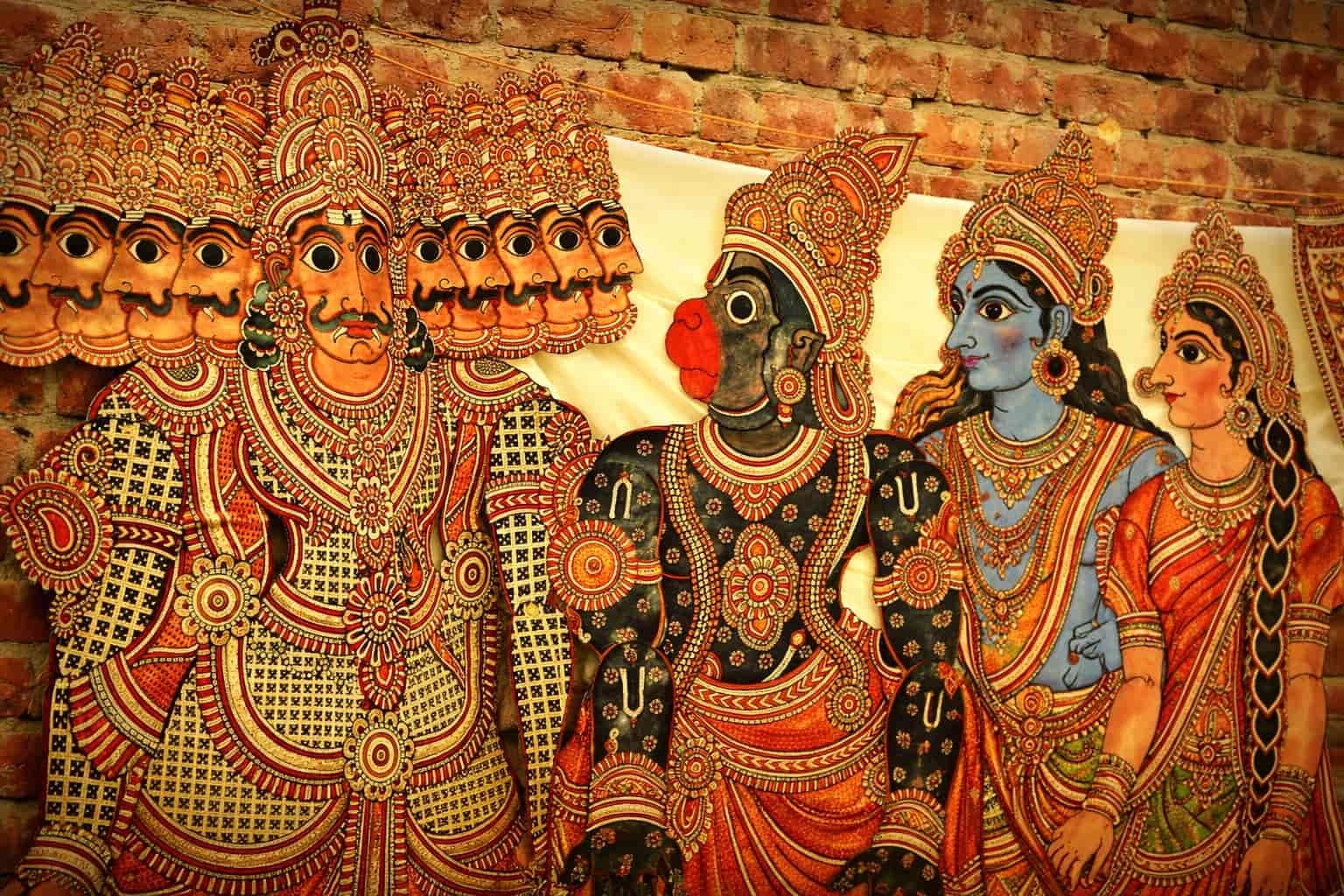
The Ramayana is not just a text; it lives in society through rituals and festivals like Ramlīlā and Rāma Navamī. These events play social roles: they reinforce community identity and shared values. Celebrations of Rama’s birth (Rāma Navamī) often involve devotional singing, processions, and dramas. They bring people together across social strata and reaffirm a common heritage. For rural and urban Hindus alike, retelling the Ramayana (through folk theatre, street plays, or puppet shows) keeps tradition alive.
For example, traditional shadow-puppet theatre in Andhra Pradesh (Tholu Bommalata) portrays scenes from the epic for village audiences. The image above shows a Hanuman puppet facing Ravana (ten-headed) with Sita by the side, a tableau common in such performances. These communal art forms (like Ramlīlā stages) help pass moral lessons from Rama’s story down generations, fostering unity.
At the same time, the organization of the festival can reflect power structures. Historically, celebrations were local and devotional. In recent times some political groups have staged shobha-yatras (processions) on Ram Navami to mobilize supporters. Scholars note, for instance, that large Ram Navami marches have been used by Hindu nationalist organizations to assert dominance. This shows how a religious narrative can be “weaponized” in modern politics – highlighting underlying tensions. Overall, anthropologists observe that festivals function as “social glue” (à la Durkheim), but also can become arenas for social power play.
🏺 Archaeology & the Historicity Debate
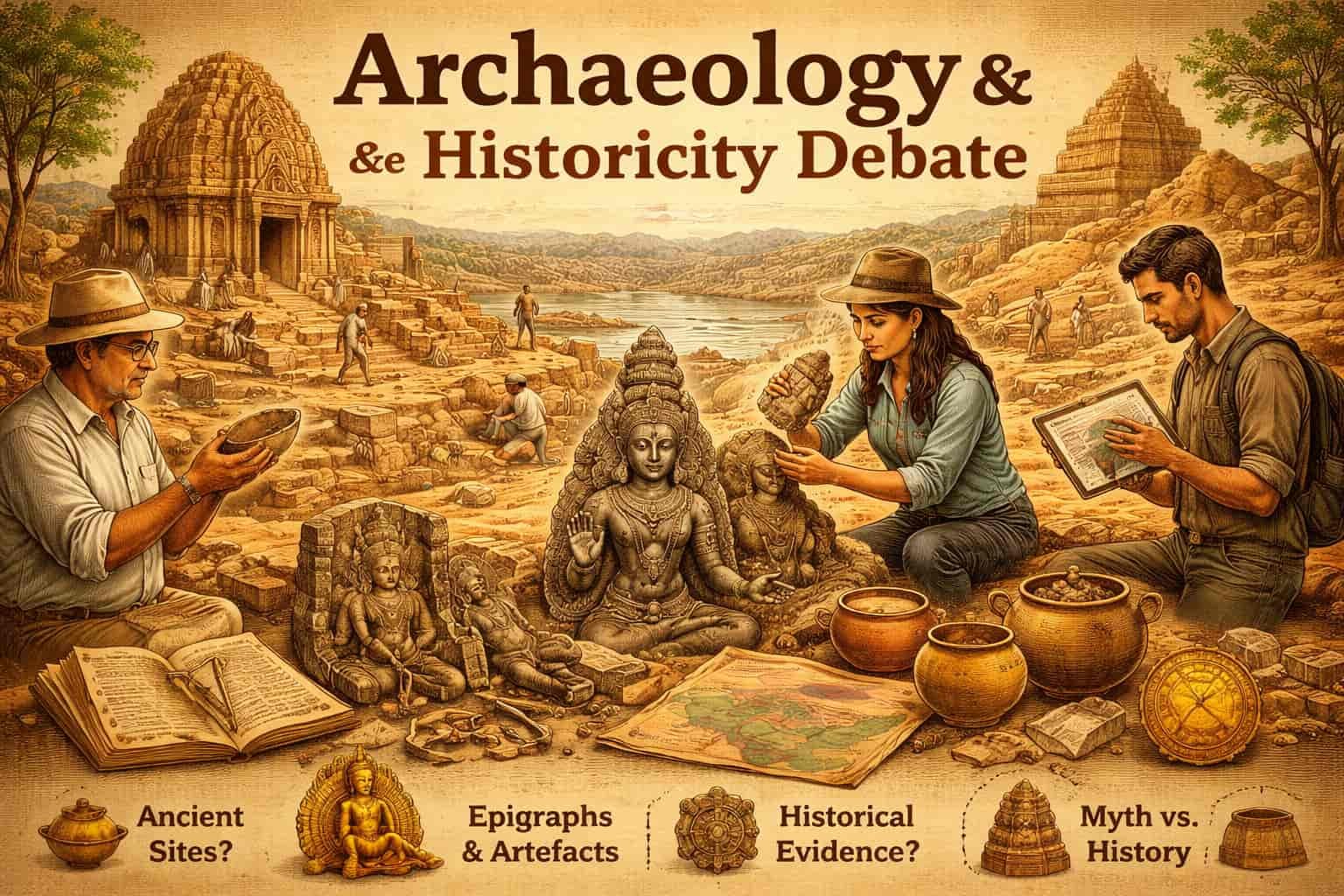
Is Ayodhyā (Rama’s capital) a real ancient city? Have we found Rama’s palace? These questions bridge myth and history. Archaeologists have dug at Ayodhya. In 1975-77, B.B. Lal reported no evidence of a palace or temple at the Babri Masjid site. Yet in later excavations (1989–90), his team claimed to find pillar bases and temple remains at the same spot. These shifting reports are hotly contested. Mainstream historians remain cautious: there is still no direct inscription or datable relic proving Rama was a historical king.
In the scholarly community, opinions vary. Some historicists suggest Rama’s story grew out of memories of ancient rulers (as happened with Gilgamesh or Romulus). Others say Rama is purely mythic – a legendary incarnation meant to teach values, not a factual biography. For example, one overview notes there is “no evidence that Rāmā was a historical person,” though belief in him is culturally widespread. (This view holds that dating mythic epics is beyond reliable archaeology or astronomy.)
The Ayodhya excavation controversy illustrates the divide. One line of thought (often aligning with Hindu nationalist narratives) accepts Lal’s later claims of temple pillars, suggesting a temple once stood there. Critics counter that Lal’s findings were never published in peer-reviewed journals and argue they don’t conclusively date to Rama’s era. In 2003, the ASI (Archaeological Survey of India) again claimed evidence of a temple under the mosque, leading to more debate. To be fair, evidence has been mixed and ambiguous. Most academic experts conclude: Rama’s historicity is uncertain. The epic has mythic depth but lacks solid archaeological proof, so most scholars treat it as a legendary epic embellished over centuries, even while respecting its cultural history.
📚 Impact of the Bhakti Movement
The Bhakti (devotional) movement transformed how Rama was worshiped and understood. Tulsidas, a 16th-century saint, wrote the Rāmcharitmānas in Awadhi (a northern Hindi dialect), making the story of Rama accessible to the masses. In contrast to the Sanskrit Valmiki Rāmāyaṇa (which only the educated could read), Tulsidas’s vernacular epic could be recited and sung in village squares. Britannica notes that “Ramcharitmanas… remains the most popular version of the story of Rama”. Its simplicity and emotional appeal spread Rama-bhakti far beyond the upper classes.
The result was a cultural shift: Rama became a beloved deity for all layers of society. Tulsidas’s work “rallied wide support for the worship of Rama in northern India,” and in many regions Rama overtook even Krishna as the favorite god. In effect, the Ramcharitmanas democratized the Ramayana, because it replaced Sanskrit with a folk language. People who had never heard a Sanskrit verse learned Rama’s story, leading to grand folk performances and songs. The Bhakti movement thus turned Rama from a legendary king into a personal object of devotion for millions. (In social terms, this is like how the King James Bible made Christian stories real to laypeople in Europe – it shifted religious focus from elite scripture to vernacular community practice.)
🧘 Consciousness & Spiritual Psychology
Ultimately, studying Ramayana Cultural Perspectives allows us to see how a single story can unite diverse populations across the world.
Beyond history and ritual, Rama’s story has been read as a model of inner life. Some spiritual interpreters view Lord Rama as symbolic of the higher self (our supreme conscience or ātman), while Ravana embodies our ego and lower instincts. This mirrors ideas in modern psychology: for Freud, Ravana’s lust and anger would correspond to the id (primal drives) and ego (pride), whereas Rama’s calm virtue resembles the superego or ideal self. Indeed, Hindu teachings traditionally say Ravana’s ten heads are tainted by the “nine emotions” plus ego (lust, anger, envy, etc.), suggesting his personality is overwhelmed by desires. Rama, on the other hand, is often seen as the archetype of self-control and duty (akin to Jung’s Wise Old Man or Hero archetype).
-
Id, Ego, Superego: Ravana’s story illustrates the dangers of unchecked ego/id. As one modern commentary puts it, Ravana is associated with Ahamkāra (ego) and other passions. Rama’s victory can be read as the mind (ego) enlightened by dharma (superego). In this lens, the epic is an inner allegory: Hanuman’s journey to find Sita is like the mind (Hanuman) searching for purity (Sita) through dedication (bhakti).
-
Jungian archetypes: Rama can represent the Self – the ideal, whole personality. Ravana might symbolize the Shadow – the repressed parts of our psyche (pride, ignorance). The battles in the epic, then, are like psychological battles within us. Scholars of depth psychology sometimes cite these parallels (for example, likening Lakshmana’s supportive loyalty to an aspect of the ego, or seeing Sita as anima). Though this is a modern interpretive layer, it shows how Ramayana resonates with universal human themes of inner conflict. (As the Hindu American Foundation notes, Ravana is a “great scholar” but his ego led to his fall – a story of knowledge corrupted by pride.)
In short, many modern readers find the Ramayana helpful as a psychospiritual tale. Rama’s calm determination under pressure, and Ravana’s eventual self-destruction from unrestrained desires, echo ideas in Freudian and Jungian psychology about ego and soul. These connections – id/ego vs. higher consciousness – are often used to draw spiritual lessons (Rama as our highest self to be followed, Ravana as our ego to be subdued).
🔍 Critical Debates and Questions
Finally, deep study involves asking tough questions about the narrative and its uses. Scholars and thinkers today debate was Rama truly an ideal ruler, or was he constrained by politics? Was Sita’s trial by fire a fair test? How is the memory of Ram Navami used in modern times? These questions push beyond storytelling into ethics and society.
-
Rama’s rulership: Some argue Rama is perfect (divine, just, beyond reproach). Others note he was still a human king facing dilemmas. For example, when ordered by public opinion to punish Shambuka or to take back Sita, Rama seems torn between compassion and duty. Was he politically savvy or just dharmic? Experts note episodes like his choice to punish his son (Uttara Kanda) or to banish Sita have a disturbing side; others find deeper dharmic reasons in the text. The debate itself is instructive.
-
Sita’s Agni Pariksha (Fire Test): A controversial moment is when Sita must prove her purity by fire. Critics today ask: was this ethical? In the epic, Sita voluntarily enters the flames to demonstrate her chastity, and she emerges unharmed (thus symbolizing her truth). It can be seen as an unjust trial of a faithful wife, or as a mythical gesture fulfilling social expectations. Tulsidas’s Ramcharitmanas and later retellings often drop this test or interpret it differently, showing that even within tradition this scene is reinterpreted. Thus scholars question whether Sita’s ordeal was meant to uphold honor in a male-dominated code, or to illustrate her devotion under any circumstance.
-
Ram Navami in politics: A very modern debate is how Ram Navami is used politically. In recent years, as reported in The Diplomat, processions on Ram Navami have sometimes been used to create religious polarization. These events (especially when they pass through minority neighborhoods with militant slogans) have sparked controversy. Some say this is a misuse of a spiritual festival for sectarian ends. It raises the question: What did Rama’s story intend about religious identity and tolerance? Is modern communal politics aligned with the ancient tale? This is a “critical hermeneutic” question – re-examining a sacred story in the light of today’s social context.
In all of these debates, the goal is insight, not dogma. The Ramayana can teach people to be good rulers or good citizens, depending on interpretation. Its value lies partly in sparking discussion about right action, not just giving easy answers. Advanced study means engaging with these tough questions, comparing views, and forming one’s own understanding of what the epic’s lessons mean today.
Sources: Authoritative research on the Ramayana has informed this discussion. Each cited work provides evidence for the points above, from textual editions to scholarly analyses.
The Ultimate 2026 Guide to Bodh Gaya: India’s Most Sacred Pilgrimage