Shaheen drones are locally built unmanned aerial vehicles (UAVs) used by Syrian rebels (HTS) for reconnaissance and attacks. Emerging around 2019, these “Shaheen” drones – named after HTS’s Al-Shaheen (Falcon) Brigade – have fiber-reinforced frames, onboard cameras, and can carry explosives. They have given the rebel forces a tactical edge by scouting enemy positions and striking high-value targets such as tanks and commanders with claimed precision (<5% error). Key events include early attacks on Russian bases in 2019, a large military academy strike in Homs (Oct 2023) and helping capture Damascus (Dec 2024). The rise of Shaheen drones marks a new era in insurgent warfare, prompting strategic concerns, legal debates, and counter-drone measures.
Background and Development History
Shaheen drones were developed by Hayat Tahrir al-Sham (HTS), primarily through its specialized Al-Shaheen Brigade. HTS began producing UAVs around 2019, after capturing and reverse-engineering failed Russian and Iranian drones. Small workshops (house garages, converted schools) in northwest Syria built these drones using 3D printers and black-market parts. HTS even runs a “drone academy” to train pilots.
-
Timeline of Key Events:
- 2019: HTS launches its first drones, targeting Russia’s Khmeimim airbase.
- Oct 2023: Deadliest strike – Shaheen drones hit a Homs military academy (100+ killed).
- May 2023: Russian airstrike destroys an HTS drone factory in Idlib.
- Feb 2024: New HTS drone factory uncovered in Ain al-Beida.
- Dec 2024: Rebel offensive (named Operation Deter Aggression/Dawn of Freedom) captures Damascus; Shaheen drones used in combined arms assaults.
-
Manufacturers and Origin: There is no formal manufacturer; Shaheen drones are non-state, produced by HTS. Components often come from civilian markets (e.g. China) or are scavenged from other drones. This local development parallels earlier insurgent drone use (like ISIS 2014–18), but HTS’s designs and payloads are more advanced.
Technical Specifications and Capabilities
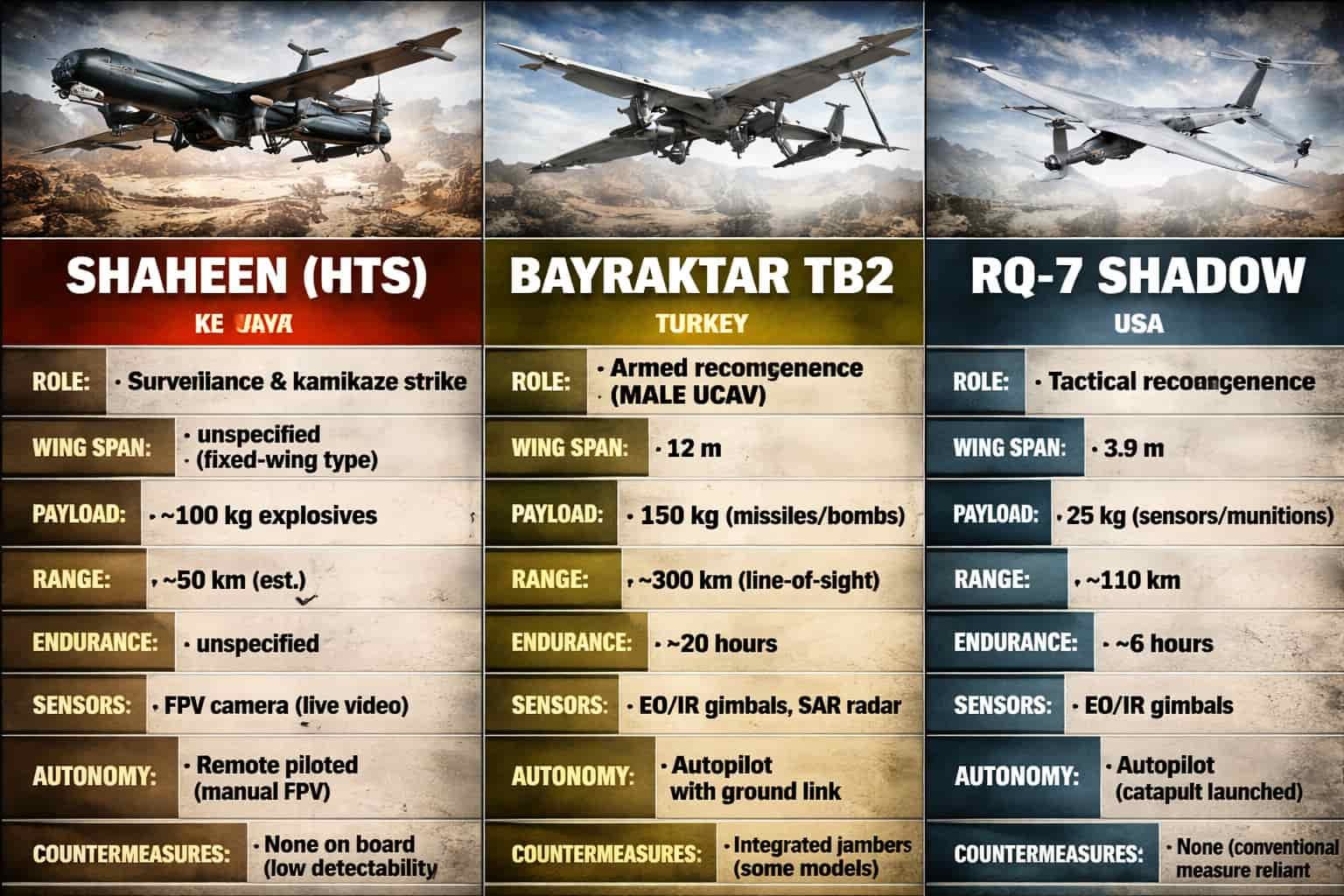
Shaheen drones come in two main types: small multirotor (quadcopter) bombers and fixed-wing strike UAVs. Both use first-person-view (FPV) video, sending live camera feeds to operators for remote piloting. Below are their key attributes (unknown values are marked unspecified):
- Airframe: Shaheen UAVs use lightweight fiber-reinforced frames. Quadcopter variants carry and drop bombs; larger fixed-wing types act as loitering munitions that crash into targets. Some Shaheen drones are rocket-assisted for extended range.
- Sensors: All have a front-facing optical camera for FPV guidance. Infrared or night-vision sensors are unspecified, but primary targeting is via the video feed.
- Endurance: Not publicly known. These drones likely have limited endurance (a few hours at most), suitable for near-frontline or mid-range missions.
- Range: Estimated up to 50 km for the larger long-range models. (Communication is probably line-of-sight radio; no evidence of satellite links.)
- Payload: Up to ~100 kg of explosives on the biggest fixed-wing versions. (Quadcopters carry smaller munitions/grenades.)
- Autonomy: Primarily piloted remotely. They are FPV drones, so operators manually guide them to targets. Any autopilot features are unspecified.
- Communications: Uses a radio data link to transmit video to a ground station, similar to other tactical UAVs. Advanced encryption or anti-jam systems are unspecified.
- Countermeasures: These drones lack built-in countermeasures. However, HTS’s newer rocket-propelled types are “harder to intercept” due to speed and stealth. In general, they rely on speed, surprise, and dispersal of factories to avoid anti-air strikes.
Operational Use and Documented Deployments
Shaheen drones have been used for surveillance (ISR) and precision strikes by rebel forces.
-
Surveillance/ISR: Before major offensives in Aleppo and Hama, Shaheen units flew reconnaissance missions over cities to map enemy positions and find high-value targets. They helped locate senior officers and sites for subsequent strikes. Footage and data from these drones were also used in rebel propaganda videos.
-
Strikes/Attacks: Many documented attacks exist:
- Hama Province: Shaheen drones attacked a Syrian Republican Guards meeting in Masyaf and later shot down a government helicopter from Hama Airport. They also killed Brigadier General Uday Ghasa in Souran (Hama).
- Aleppo and Homs: During late 2023, Shaheen drones struck Syrian Army tanks, artillery, and barracks in Aleppo. In Oct 2023, they attacked the Homs military academy (100+ killed).
- Damascus: In Dec 2024, drones supported the siege of Damascus by targeting checkpoints and armored vehicles. (Rebel media claims Assad’s fall owed partly to Shaheen strikes.)
- Other: HTS also targeted other regime facilities (e.g. logistics, radars) with Shaheen drones.
-
Border Security/Law Enforcement: No evidence of Shaheen use outside military conflict. These drones have not been reported in border patrol or police operations – they are warfighting tools. (Turkey and Iraq worry about stray drones from Syria, but Shaheen as described are in rebel hands.)
In summary, Shaheen drones have been employed against military/government targets in NW Syria from at least 2019 through 2025, with dozens of strikes and two major offensives (late 2024) where they played key roles.
Strategic and Regional Security Implications
The proliferation of Shaheen drones marks a strategic shift: it demonstrates that insurgent groups can field near-peer UAV capabilities. HTS’s success has alarmed both allies and adversaries in the region.
- Impact on Conflict: Shaheen drones have directly affected the Syrian civil war’s dynamics by forcing government and Russian forces to divert air defenses (like Pantsir and jets) to counter low-cost UAVs. The ability to strike behind front lines has amplified HTS’s power, contributing to rapid rebel advances in late 2024.
- Regional Threat: Other militant groups (e.g. Hezbollah, Iranian proxies, ISIS remnants) are likely watching Shahin’s success. In fact, reports suggest Ukraine provided HTS with dozens of FPV drones and operators to challenge Russia’s influence. If Shaheen tech spreads, neighboring countries (Turkey, Israel, Iran) must guard against more UAV strikes on their borders or forces.
- Global Terror Trends: Experts note loitering munitions are a fixture of modern conflict. Shaheen-type drones lower the barrier for “airpower” in conflicts from Ukraine to Yemen. Governments are increasingly concerned about drones “falling into the wrong hands” around the world.
Ethical, Legal, and Privacy Concerns
Shaheen drones raise several issues:
- Legality: These are lethal weapons used by a non-state group labeled as “terrorist” by many governments. Under international law, using suicide drones may be considered part of armed conflict, but accountability is murky. Civilian casualties (if any) would violate laws of war. There is no transparent chain of command or oversight, which complicates legal responsibility.
- Ethics: The use of remotely piloted suicide drones lowers the risk for operators, potentially making violence easier to employ. Humanitarian observers worry this encourages more indiscriminate attacks if targets are misidentified, although HTS claims “<5% error”. The secretive nature of the program means we lack independent casualty verification.
- Privacy: In the Syrian war context, privacy concerns are less highlighted (there is active combat). However, by analogy, widespread UAV surveillance by militias hints at future privacy issues in less warlike settings. Globally, the spread of militarized drones raises questions about surveillance regulation and citizen rights if such tech is misused.
Counter-Drone and Mitigation Measures
To counter Shaheen-like threats, militaries employ a mix of detection and neutralization:
- Electronic Warfare (EW): Jamming radio links or GPS can disable drones. Russia and Syria reportedly use EW systems to disrupt rebel UAVs.
- Anti-Aircraft Systems: Short-range air defenses (e.g. Russia’s Pantsir, ZU-23 guns) can shoot down small drones, though effectiveness varies. For instance, HTS captured a Pantsir and even used it against government targets.
- Directed-Energy/Countermeasures: Some militaries are testing lasers or high-power microwaves to fry drone electronics. The US and Israel have “drone killer” guns and jam systems. Ground troops may use rifle calibers or machine guns if drones come into range.
- Tactical Adaptations: Changing flight patterns, using decoys, and hardening key sites (like burying troops, camouflage) can mitigate drone advantage. On the rebel side, dispersing factories and operating in civilian areas (as HTS did) complicate targeting.
Overall, defeating swarm or FPV drones is challenging, requiring layered defenses and constant vigilance. The Shaheen case underscores the need for armies and police to innovate.
Future Trends and Developments
Looking ahead, Shaheen drones hint at broader trends:
- Increased Autonomy and Swarms: Future Shaheen variants may incorporate more autonomous flight (target recognition) or multiple drones acting in coordination (swarms) as tech advances.
- Larger Payloads and Range: HTS’s rocket-assisted models suggest even heavier drones are possible. Insurgents may keep pushing payload and range limits if they source powerful engines or fuel.
- Broader Adoption: Other insurgent or criminal groups worldwide may copy Shaheen-like designs. We have already seen small attack drones in conflicts from Ukraine to Africa. As components (motors, batteries, sensors) become cheaper, more actors will deploy armed UAVs.
- Policy and Defense Response: Nations will likely tighten export controls on drone tech and improve counter-UAV rules of engagement. Ethical/legal debates may spur new international norms on non-state drone usage.
Shaheen vs. Other Tactical UAVs (Comparison Table)