The Taj Mahal is a vast white-marble tomb in Agra, India, famous around the world as a symbol of love and architectural beauty. It was built by Mughal Emperor Shah Jahan (r. 1628–1658) to honor his beloved wife Mumtaz Mahal after she died in 1631. Construction began about 1632 and took roughly 22 years. Thousands of artisans and laborers worked on it, using white marble from Rajasthan and precious stones from across Asia. The complex includes a central domed mausoleum, four corner towers (minarets), a mosque and guest house in red sandstone, and formal gardens with reflecting pools. Over time, the Taj has come to represent the peak of Mughal art and a “universal masterpiece of the world’s heritage”. This report tells the full story of the Taj – its history, design, and meaning – and also covers lesser-known facts, myths and modern conservation challenges.
Thank you for reading this post, don't forget to subscribe!History and Construction
Shah Jahan was the fifth Mughal emperor, grandson of Akbar the Great. He came to power in 1628 and was deeply in love with his third wife, Arjumand Banu Begum (known as Mumtaz Mahal, or Chosen One of the Palace). Mumtaz died at age 38 in June 1631 while giving birth to their fourteenth child. Grief-stricken, Shah Jahan decided to build a great tomb for her. According to his court chroniclers, he moved Mumtaz’s body from Burhanpur to Agra, and soon after (around 1632) he began work on the new mausoleum.
The site chosen was on the north bank of the Yamuna River in Agra. It was a Mughal-style charbagh garden – a four-part Persian-style garden – and the land was acquired from a local Rajput clan by royal decree. According to the Archaeological Survey of India (ASI), the Taj’s foundations were supported by a network of wells and platforms near the riverbank. Over the years until about 1653, Shah Jahan spent immense wealth on this project, drawing materials and workers from across India and abroad.
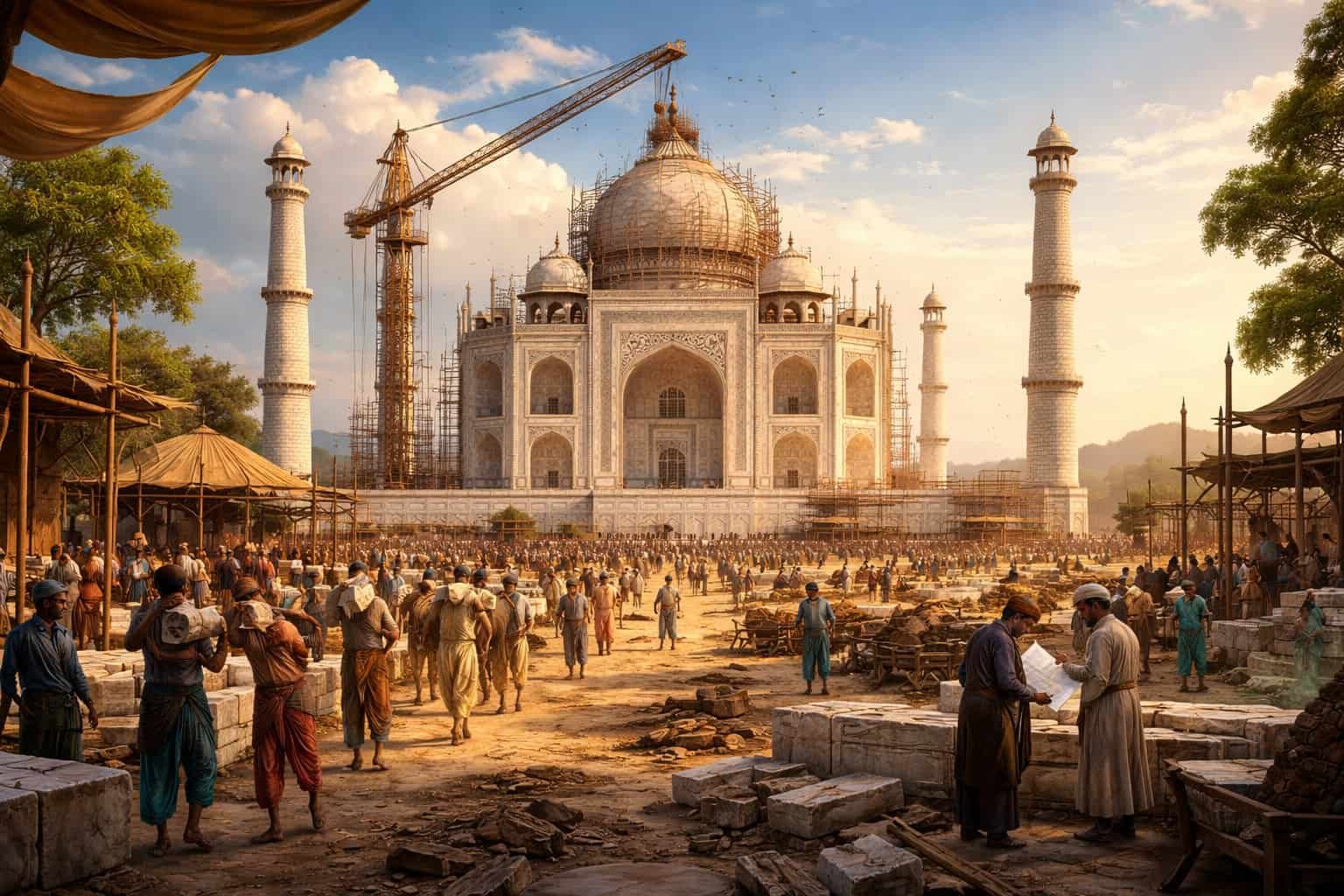
In total, more than 20,000 artisans – masons, stone-cutters, carvers, painters, calligraphers and other craftsmen – worked under a team of master architects. They were brought in from all over the Mughal Empire and even from distant lands like Persia, Turkey, and Central Asia. Local records say bricks for inner structure were made on-site, while the iconic outer casing used high-quality white marble from Makrana, Rajasthan. Semi-precious stones (lapis lazuli, jade, agate, coral, and others) came from far-off places like Ceylon (Sri Lanka) and Afghanistan. Red sandstone (in shades ranging from pink to deep red) was quarried in nearby areas like Fatehpur Sikri and Dholpur.
The chief architect is traditionally believed to be Ustad Ahmad Lahori, a leading Mughal court architect of Persian descent. Other architects and designers – including Mir Abd al-Karim – also took key roles, and one historian notes that Abdul Haqq was the calligrapher and Lahori served as project supervisor. By combining many experts, Shah Jahan ensured that the highest standards of Mughal architecture were met. The work was difficult: contemporaries wrote that Shah Jahan often paced the unfinished tomb at night and wept for his late wife. Construction of the main mausoleum and its adjacent structures was essentially finished by 1648, with finishing touches (the great gateway, outer walls and cloisters) completed around 1653. Altogether, building the Taj took about 17 to 22 years.
Mughal Empire and Context
The Taj Mahal was built at the height of the Mughal Empire’s power and wealth. Shah Jahan was known as the “King of the World” and presided over an empire rich in art, culture and global trade. India was then the world’s leading source of many precious materials, and Mughal patrons were famous for grand monuments: Shah Jahan himself oversaw construction of the Red Fort in Delhi (also designed by Lahori) and other red-sandstone palaces. The Mughal style blended Persian (Timurid), Indian and Islamic influences, featuring domes, arches, intricate ornamentation and gardens.
Shah Jahan’s choice to build a white-marble mausoleum (instead of the more common red sandstone) reflected his ambition. In earlier Mughal tombs (like Humayun’s Tomb or Jahangir’s Itimad-ud-Daulah), white marble was often reserved for decorative inlays or interiors. The Taj Mahal, by contrast, is almost entirely white marble, making it unique in scale and appearance. Its name “Taj Mahal” itself means “Crown of the Palace” – signifying its intended splendor. In Mughal court records (the Padshahnama), the tomb was referred to as the Luminous Tomb (since it was covered in marble that gleamed in sun and moonlight).
Today historians see the Taj as part of a long tradition of Mughal garden-tombs, but one that pushes every element to the extreme. Shah Jahan ordered the charbagh garden to be larger and the tomb raised on a massive plinth, creating a dramatic perspective. One clever innovation (noted by scholars) was to place the mausoleum at the far end of the garden, not the center, so that it seems to recede into the distance – a design giving it greater visual impact. The architects achieved perfect bilateral symmetry: the layout along the central axis (north-south) is exactly balanced. Everything – from the four flanking minarets to the matching buildings on each side – echoes this mirror symmetry.
Architecture and Design
The layout of the Taj complex follows classic Mughal design but on a grand scale. As UNESCO notes, the site covers about 17 hectares (over 40 acres). Visitors first enter through a grand red-sandstone gate at the south end. A broad pathway and long rectangular reflecting pool (with water channels and fountains) lead straight toward the tomb. The central garden is divided by water channels into four main quadrants (a charbagh). Against normal practice, the tomb is placed at the north end (near the river) rather than the geometric center of the garden. From the far gate it appears at the end of the garden, but if one views it from outside the river (in the nearby Moonlight Garden), the river is included in the vista and the Taj aligns with the garden’s center. The garden was originally planted with cypress trees (symbolizing eternity) and fruit or flowering trees (symbolizing life), laid out in formal beds (their exact original plantings are now lost).
The mausoleum itself sits on a huge square plinth. It is essentially a cube with its corners cut off (an octagon plan) that rises three stories high. The central chamber is a perfect octagon topped by a bulbous white marble dome (reaching about 240 feet/73 meters high). Four smaller domes surround it, and four slender, pencil-like minarets stand at each plinth corner. These minarets are slightly tilted outward on purpose – a safety measure so that if they ever fell (in an earthquake, say) they would lean away from the main tomb. Each minaret is adorned with gallery balconies and topped by a small chhatri (a dome-shaped pavilion). The main dome’s bulbous shape and finial on top give the Taj its iconic silhouette, while decorative lotus motifs at the dome’s base echo natural themes.
Flanking the tomb chamber on the same plinth are two identical red-sandstone buildings. One, to the west of the tomb, is a functioning mosque (so worshippers can pray toward Mecca). The other, on the east side, is not used for worship; it is a jawab or “guesthouse” – built simply to maintain symmetry. Both buildings have facades of red sandstone with white marble inlay and many arched openings, but their interiors remain empty halls. By building these twin structures, the architects emphasized the mausoleum’s white marble in the center through color contrast (red vs. white).
The elegance of detail is most visible on and inside the marble mausoleum. The exterior walls are covered in fine carvings and pietra dura inlay: floral patterns, arabesques and calligraphic verses from the Qur’an, all done in black marble and semi-precious stones. For example, white marble panels hold inlaid patterns of lotus blossoms and vines made with lapis lazuli (blue), jade (green), agate, carnelian (red), onyx and other stones. The calligraphy was done by Abdul Haqq and others; Quranic passages (mostly of paradise and light) are inscribed in black marble around the arched entrances. Due to the high skill of the artisans, the letters in the calligraphy appear proportional when viewed from below. This technique of marble inlay (also called parchin kari) is a hallmark of Mughal art, and the artisans here are considered among the finest ever.
Inside, visitors enter through a massive central arch into an inner chamber. This octagonal hall follows the Mughal “hasht-bisht” plan (eight halls around a central space). The main focus inside is the two marble cenotaphs (false tombs) which rest at the center of this chamber on a raised platform. Mumtaz Mahal’s cenotaph is at the heart of the octagon (west of the main chamber’s central axis), and Shah Jahan’s cenotaph (larger but placed slightly off-center to the west) was added by his son later. Each cenotaph is surrounded by a beautifully carved marble jali screen (lattice) of white marble, richly inlaid with flowers and tendrils. The interior walls again show pietra dura decoration, with more floral and geometric motifs, and marble-thin columns of the eight halls arching into a dome overhead. The real graves (coffins) of Mumtaz and Shah Jahan lie directly beneath these cenotaphs in an inaccessible lower chamber, as was the custom in imperial Mughal tombs.
Overall, the Taj is a study in balance and symmetry. From the four minarets at the corners to the matching mosque and jawab, everything is mirrored along the central north–south axis. The effect of light and shadow on its surfaces, and the contrast of red walls against white marble, create constantly changing appearances by time of day. UNESCO calls this “the finest architectural and artistic achievement” of Indo-Islamic design. A colorful detail is that the white marble can take on different hues: at sunrise it can look rosy, under bright sun a dazzling white, and at moonlight a soft golden glow. These visual effects, along with the lush green gardens and reflecting pools, symbolize the idea of paradise on earth – a common theme in Islamic funerary monuments.
Gardens and Surroundings
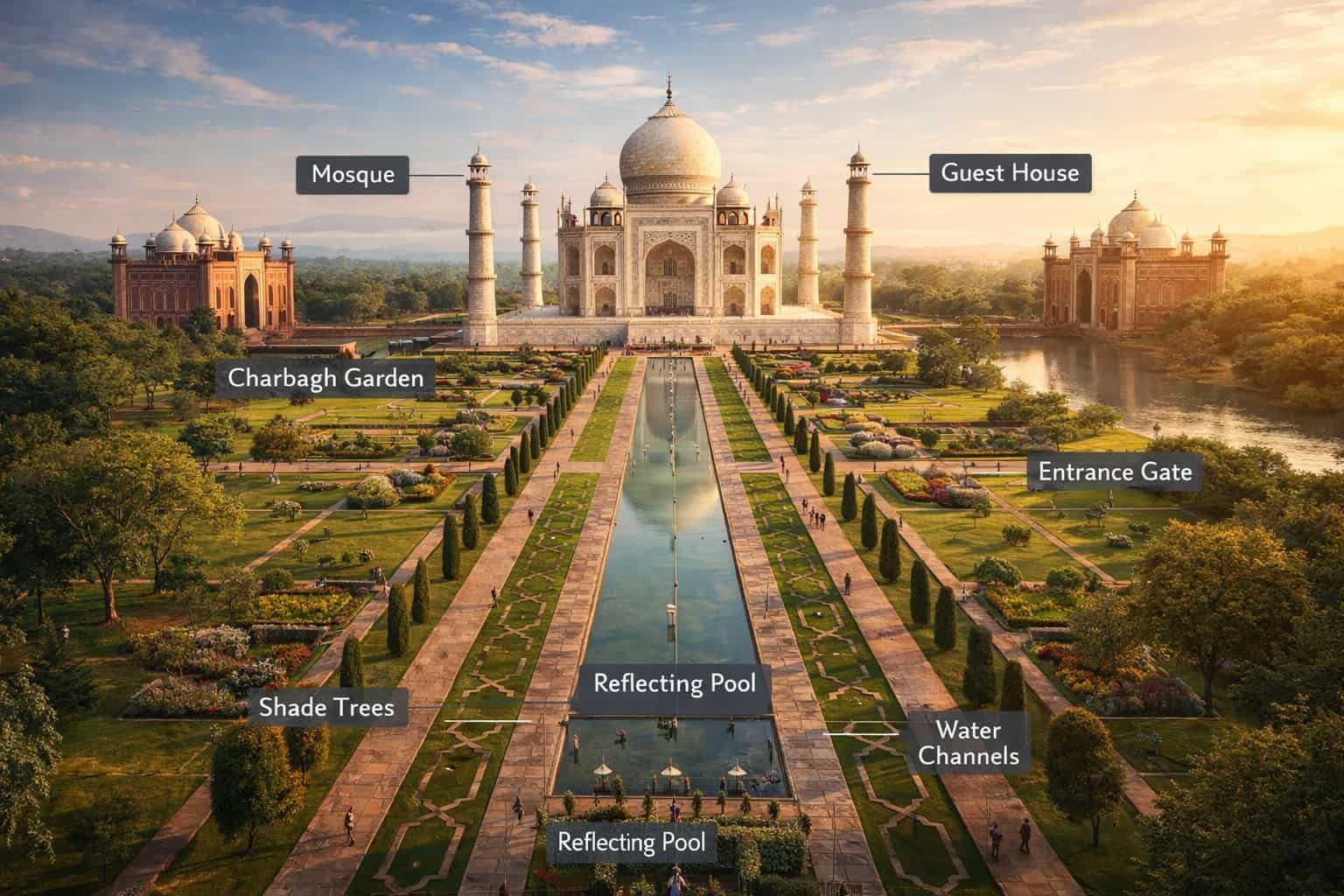
The charbagh garden in front of the mausoleum is an integral part of the design. Stretching to the south, it is divided by perpendicular walkways and watercourses into four main quadrants. This layout represents the traditional Islamic four-part garden (often linked to the four rivers of Paradise). Unusually, Shah Jahan’s architects placed the tomb at the far (north) end of the garden near the river, instead of in the geometric center. As Begley (1979) notes, this deviation makes the garden’s perspective deeper and allows the tomb to dominate the view as one walks toward it.
Long pools in the center reflect the mausoleum’s image, doubling its impact. Originally, the gardeners planted white flowering trees, cypresses and fruit trees in the beds (to follow Mughal ideas of paradise as a garden of abundance). Today, wide lawns, pathways and fountains (fed by the Yamuna via a still-standing irrigation system) fill the garden. On either side of the garden court (near the gateway) are pavilions and the Saheli Burj towers, where some royal ladies, including wives of Shah Jahan, were later buried.
Behind the tomb, across the Yamuna river, lies the Mehtab Bagh or Moonlight Garden. This was built at the same time and aligns with the Taj, framing a backward view of the mausoleum across water. From there, at night under moonlight, the Taj appears ghostly and symmetrical with its reflection – an effect praised by poets. The river at that time was also a beautiful, alive component of the scene. Today, a long causeway above the river and strong embankments protect the Taj’s foundation. Modern conservationists monitor the river’s health because the Taj’s foundations rest on riverine soil; studies have shown falling water levels can slightly shift the structure.
Conservation and Threats
Over the centuries, the Taj Mahal has needed upkeep and repair. The Mughal successors and later the British Raj undertook several renovations. In particular, by the late 19th century the monument had suffered some decay (and even bullet damage during the 1857 rebellion), so Lord Curzon, the British Viceroy of India, ordered a major restoration around 1908. Curzon’s team repaired the marble screens, cleared vegetation, and rebuilt much of the sandstone walling (ironically using new red sandstone from Fatehpur Sikri, the old Mughal capital). They also moved two of the black marble urns on the cenotaph platform to the Victoria Memorial in Calcutta; these ended up in the Indian Museum in Kolkata.
In modern India, the Archaeological Survey of India (ASI) oversees the site. The Taj was declared a UNESCO World Heritage site in 1983, which helped attract international attention and funds. Since the 1980s, conservation has meant cleaning the marble, monitoring structural safety, and controlling nearby development. For example, in 1996 India’s Supreme Court created a Taj Trapezium Zone (TTZ) of about 10,400 square kilometers around Agra, banning coal-burning industries inside it. In 1998, the Court specifically ordered polluting factories to shut or switch to cleaner fuels and banned vehicular traffic in the immediate Taj area. Air-monitoring stations were set up on site to detect sulphur and particulate pollution. These measures have had some effect: many foundries have switched from coal to natural gas, reducing smoke emissions.
Despite controls, air pollution remains a threat. Agra now has over 800,000 vehicles and many small industries in the city, contributing dust and soot. Periodic ‘White Taj’ cleanings (using mud packs to draw out dirt) are carried out by ASI on the marble. Studies published in the 2010s found microscopic gypsum and sulfur compounds on the surface, evidence of acid rain damage. Engineers also watch the Taj for cracks. Some activists have claimed to see tiny fissures or minaret tilts (especially when the Yamuna is low), but UNESCO reports and ASI maintain the structure is fundamentally sound.
Another concern is tourism impact. The Taj Mahal attracts about 2–4 million visitors per year (around 45,000 people per day at peak season). This heavy traffic can wear walkways and cause local pollution from vehicles and tourist shops. The ASI has responded by creating pedestrian zones near the site (including a trolley/shuttle system), and by proposing higher entry fees or tourist caps to limit crowding. The buffer zone around the monument, legally protected since 1958, also helps control nearby building and development.
In recent years (2020–2025), the government launched a Taj Saving Project, a large conservation campaign including marble repairs and garden restoration. A notable threat in 2020–21 was the outbreak of black fungus (a type of biodeterioration) on some marble areas, which ASI has been treating. The World Heritage Committee continues to call for new management plans to deal with modern pressures like tourism and urbanization. In summary, constant effort by ASI, Supreme Court, and UNESCO oversight is focused on keeping the Taj’s “physical fabric” intact and its setting unspoiled.
Myths, Legends, and Controversies
The Taj Mahal’s beauty has inspired many legends and myths, some based in local storytelling and some in modern conspiracy theories. A popular romantic legend holds that Mumtaz Mahal, on her deathbed, made Shah Jahan promise to build “the most beautiful tomb ever known” for her. While charming, this story is not confirmed by contemporary records and is treated as folklore. What is clear is that Shah Jahan did channel vast resources into the mausoleum after her death.
One famous myth is that Shah Jahan punished the builders to keep the design secret. Guides and local lore often say that the architect and craftsmen had their hands (or eyes) cut off so they could never copy the Taj. In reality, there is no historical evidence of any mutilation. On the contrary, records suggest the artisans were well-paid. (One theory is that as a reward Shah Jahan gave them lifelong pensions, which may have spawned tales of “losing their hands”.) Likewise, the tale that Shah Jahan planned a black marble replica of the Taj across the river is likely a later legend. Historians note no evidence in Mughal documents of a Black Taj; this story seems to have arisen long after Shah Jahan’s time (it was mentioned by a 17th-century French traveler but is now discounted).
A major controversy in recent decades has been political: some fringe groups in India claim the Taj Mahal was originally a Hindu temple (called “Tejo Mahalaya”) built long before the Mughals. This theory – first popularized in a 1989 book – is rejected by mainstream historians and archaeologists. For example, Indian court testimony by government archaeologists has labeled those claims “concocted” and pointed out that architectural features (the onion dome, minarets, calligraphy, and inscriptions in Persian) all match Mughal-era design. The Supreme Court of India reviewed such a petition and dismissed it as without basis. In short, the accepted scholarly view is that Shah Jahan did commission the Taj Mahal as a Muslim mausoleum in the 17th century, while the temple theory is widely criticized as unfounded.
Another set of lesser-known facts: the Taj Mahal complex also includes two smaller tombs near the main gate, of two of Shah Jahan’s other wives (Akbarabadi Begum and Fatehpuri Begum). These are often missed by tourists. The British also added one of the ornamental fountains from Fatehpur Sikri when preserving the site. A modern curiosity: in 2010 the Paris Mint struck a diamond-studded Taj Mahal coin, highlighting the monument’s status as a cultural icon.
Throughout, the UNESCO and ASI sources emphasize that the Taj’s authenticity and design “have been maintained” despite repairs. But debates continue over how best to preserve it against new threats. Archaeologists study its foundations and the river’s level; chemists analyze the marble’s chemistry. In 2019–2025, new scientific monitoring (air sensors, marble health tests) and even digital modeling have become part of Taj conservation efforts. These recent studies sometimes uncover surprising details – for instance, a 2019 report suggested that hydrogen sulfide (from the polluted Yamuna) might darken the marble more than previously thought.
In summary, while myths abound, the mainstream facts about the Taj are clear: it was built mid-17th century by Shah Jahan and his court craftsmen as an exquisite mausoleum for Mumtaz. All claims to the contrary are unsupported by evidence. (For example, an Indian court hearing in 2017 concluded that “the Taj Mahal is a Muslim mausoleum built by a Mughal emperor” and rejected the temple claim as insubstantial.)
| Aspect | Mainstream Fact | Disputed Claim |
|---|---|---|
| Patron/Purpose | Commissioned in 1631–1632 by Mughal emperor Shah Jahan as a mausoleum for Mumtaz Mahal. | Some claim it was an older Hindu temple (Tejo Mahalaya) dedicated to Shiva. |
| Architect | Attributed to court architect Ustad Ahmad Lahori (with other Mughal architects). | Legends say a mysterious Pandit or unknown architect built it (no evidence). |
| Construction timeline | Built 1632–1648 (complex finished by 1653) under Mughal rule. | Some say it predates the Mughals by centuries (not supported by archaeology). |
| Workforce | An estimated 20,000 laborers and artisans (from India and beyond) worked on the Taj. | Myth: Workers were mutilated (hands/eyes) after completion (no historical proof). |
| Black Taj Legend | No historical records support a “Black Taj” plan. | Legends say Shah Jahan planned a mirror-image black marble tomb (apocryphal). |
Cultural Impact and Legacy
Beyond its stones and gardens, the Taj Mahal has a vast cultural legacy. It is often called “the jewel of Muslim art in India” and one of the world’s most admired monuments. Poets and writers over centuries have evoked its beauty and its story of love. (In Urdu literature, Shah Jahan’s grief and the image of the Taj appear frequently as symbols of ideal love.) It has influenced many later buildings: for example, the Mughal-inspired Bibi Ka Maqbara in Aurangabad (built by Shah Jahan’s son Aurangzeb in memory of his mother) clearly mimics the Taj’s design on a smaller scale.
Nationally, the Taj Mahal is a pride of India and appears on Indian currency (notably the old 500-rupee note) and postage stamps. It draws dignitaries and millions of tourists each year (often more than 3 million annually). Local artisans in the Taj Ganj area of Agra continue traditional crafts (stone inlay, carving, printwork) that were originally developed for monuments like the Taj. The site also features in popular culture worldwide: it is a frequent subject in travel films, documentaries, and art. The story of the emperor’s devotion to Mumtaz has become globally known, sometimes oversimplified as “a love story carved in marble.”
Among local communities, many folk stories circulate. Some Agra guides and villagers share legends of hidden tunnels (no evidence), or of seeing Mumtaz’s ghost on the anniversary of her death. During festivals, the Taj is lit and celebrated as a place of unity and peace. Its gardens are even considered a sacred space by some, earning the nickname Jannat Ma’abad (paradise house) among local Muslims. Despite the mughal and imperial context, for many today the Taj’s message transcends religion: it is often described simply as a monument built for “love and hope.”
Economically, the Taj dominates Agra’s identity. The city’s tourism, crafts, and services revolve around it. Thousands of people work in hotels, guides, and transport related to the monument. It also inspires art and education: for example, UNESCO’s Tagore Centre in Kolkata hosted events discussing the Taj’s meaning, and universities around the world study it as an example of cross-cultural architecture.
Finally, the Taj Mahal’s oral histories and legends (even if not factual) reflect how deeply it lives in the public imagination. Visitors today might hear the story of Shah Jahan’s vows or the myth of worker mutilation in the same breath as archaeologists and historians explain the real history. These tales, passed down by guides and elders, show how the site has merged fact and folklore. They also reveal cultural perspectives: reverence for the site blends with creative storytelling, whether to entertain tourists or to assert historical narratives.
Timeline of Key Events
In the above timeline, mainstream history is contrasted with the disputed claims. The table below summarizes some of the contested aspects:
Fact vs. Fiction:
| Aspect | Mainstream Fact | Disputed Claim |
|---|---|---|
| Patron/Purpose | Mughal Emperor Shah Jahan built it (1632–1653) as a mausoleum for his wife Mumtaz Mahal. | Some claim it was originally a Hindu temple (Tejo Mahalaya) dedicated to Shiva. |
| Architect | Designed by Ustad Ahmad Lahori and other royal Mughal architects. | Legends speak of an anonymous Pandit or denounce Lahori (no evidence). |
| Date of construction | Built 1631–1653, during Shah Jahan’s reign. | Some say it is much older (pre-16th century) (archaeologists disagree) |
| Labor and Salary | ~20,000 skilled workers from across Asia were employed and paid. | Myth that workers were mutilated after building (no records support it). |
| “Black Taj” story | No reliable evidence in Mughal records for a black-marble tomb plan. | Urban legend says Shah Jahan planned a mirrored black marble mausoleum (apocryphal). |
These comparisons show that scholarly sources (archaeologists, historians, UNESCO) agree on the core facts of the Taj Mahal, while the disputed claims lack credible support. Experts emphasize that the Taj as we see it is the result of 17th-century Mughal patronage, and that later myths should not obscure its true heritage.