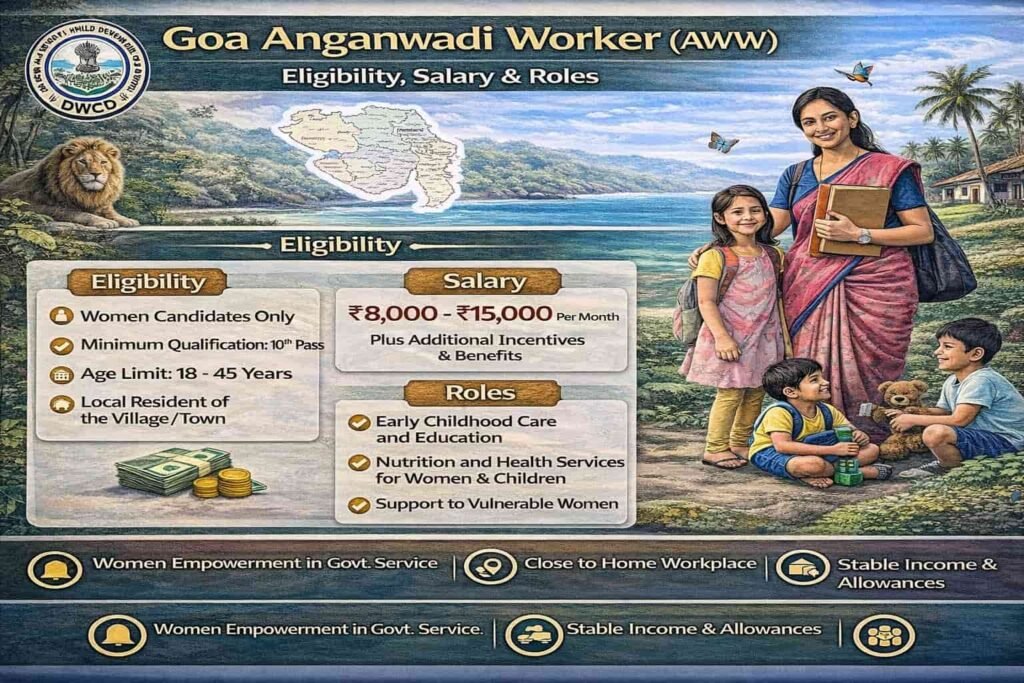
Goa Anganwadi Worker AWW . The State of Goa, globally recognized for its vibrant tourism ecosystem and high human development indices, places an unparalleled administrative emphasis on the socio-economic empowerment of its rural and urban demographics. At the very core of this state-sponsored welfare machinery operates the Directorate of Women & Child Development (DWCD). The DWCD acts as the primary nodal agency responsible for the flawless execution of the Integrated Child Development Services (ICDS) scheme—a monumental, centrally sponsored program structurally designed to eradicate child malnutrition, dramatically lower infant and maternal mortality rates, and provide universal early childhood care and education (ECCE).
Thank you for reading this post, don't forget to subscribe!To successfully penetrate the grassroots level, the Government of Goa operates a vast and intricate network of 1,262 sanctioned and operational Anganwadi Centres (AWCs) distributed meticulously across various Talukas and Village Panchayats. The immense and critical responsibility of guarding the nutritional, cognitive, and educational wealth of Goa’s future generations rests entirely on the shoulders of the frontline staff of the DWCD. These ground-level executives, officially designated as Anganwadi Helpers (AWH) and Anganwadi Workers (AWW), form the absolute operational backbone of child and maternal conservation in the state.
This exhaustive, in-depth research report provides a highly analytical, strategic, and dimensional breakdown of the AWH and AWW posts within the Government of Goa. From micro-analyzing the unique state-sponsored salary matrices and stringent residential eligibility criteria to exploring the robust 26-day training curriculums, massive ₹5 Lakh retirement benefits, and the highly structured 50% promotion hierarchy, this guide serves as the ultimate administrative blueprint for serious aspirants aiming to secure and understand a position in Goa’s ICDS network.
Goa Anganwadi Worker AWW: Roles and Responsibilities
The Anganwadi Helper AWH is the foundational and logistical pillar of the ICDS scheme at the micro-community level. Operating as an honorary community worker, the AWH is tasked with the physical administration of the Anganwadi Centre (AWC) and provides indispensable support to the Anganwadi Worker.
1.1 Comprehensive Eligibility and Demographic Criteria
Because managing an Anganwadi Centre involves active community engagement, hygiene maintenance, and physical tasks, the eligibility criteria focus heavily on hyper-local residency and basic educational foundations.
| Parameter | Official Eligibility Requirement for Anganwadi Helper (AWH) |
|---|---|
| Educational Qualification | The candidate must have successfully passed a minimum of Class VIII (8th Standard) from a recognized school or educational board. |
| Age Limit | The applicant must not be less than 18 years and not more than 44 years of age at the time of submitting the application. |
| Geographical Residency | The candidate must be a permanent, documented resident of the exact local area (Village Panchayat or Municipality ward) where the specific Anganwadi Centre is geographically located. |
| Undertaking for Unmarried Women | Unmarried applicants selected for the post must provide a formal written legal undertaking stating that, post-marriage, they will continue to reside within the local jurisdiction of the AWC or make independent arrangements to commute without affecting their daily administrative duties. |
1.2 Financial Remuneration and Honorarium Matrix (AWH)
Unlike regular state government employees who draw a standardized salary from the 7th Pay Commission matrix, Anganwadi Helpers are paid a monthly “Honorarium.” This honorarium is a unique combination of a fixed Central Government share and a massive State-sponsored top-up, making Goa one of the highest-paying regions for Anganwadi staff in the country.
| Service Experience Slab | Central Govt. Share (Base) | State Govt. Share (Base) | Goa State Additional Top-Up | Total Monthly Honorarium (INR) |
|---|---|---|---|---|
| 0 to 5 Years | ₹ 1,350 | ₹ 900 | ₹ 3,750 | ₹ 6,000/- |
| 5 to 10 Years | ₹ 1,350 | ₹ 900 | ₹ 4,250 | ₹ 6,500/- |
| 10 to 15 Years | ₹ 1,350 | ₹ 900 | ₹ 4,750 | ₹ 7,000/- |
| 15 to 20 Years | ₹ 1,350 | ₹ 900 | ₹ 5,250 | ₹ 7,500/- |
| 20 to 25 Years | ₹ 1,350 | ₹ 900 | ₹ 6,000 | ₹ 8,250/- |
| 25 Years & Above | ₹ 1,350 | ₹ 900 | ₹ 6,750 | ₹ 9,000/- |
Strategic Note: In addition to the above matrix, a performance-linked incentive (PLI) of ₹ 250/- per month is provided for maintaining excellent hygiene and assisting in Poshan Abhiyaan targets. Furthermore, a provision of ₹ 600/- per annum is allocated for the purchase of uniforms, along with ₹ 25/- for an official name badge.
1.3 Micro-Level Job Profile and Daily Duties (AWH)
The daily life of an Anganwadi Helper requires a high degree of empathy, community connection, and physical stamina. Her core duties encompass:
- Facility Management: Sweeping, cleaning, and ensuring the absolute sanitation of the Anganwadi Centre premises every morning prior to the arrival of the beneficiaries.
- Child Escort Services: Safely escorting small children (aged 3 to 6 years) from their respective community homes to the AWC and ensuring their safe return in the afternoon.
- Culinary and Nutritional Duties: Cooking and serving supplementary nutrition meals (hot cooked meals) to children, pregnant women, and lactating mothers under the strict hygienic supervision of the AWW.
- Medical Camp Assistance: Providing crowd-control and logistical support to Auxiliary Nurse Midwives (ANMs) during critical village immunization drives and Pulse Polio Immunization (PPI) campaigns.
Part 2: The Anganwadi Worker AWW – The Frontline Community Commander
The Anganwadi Worker (AWW) is the primary executive and administrative face of the ICDS at the grassroots level. She is the crucial bridge connecting the Government of Goa’s welfare schemes to the rural and urban beneficiaries. Her role is highly multifaceted, requiring administrative capability, digital literacy, nutritional expertise, and immense community leadership.
2.1 Advanced Eligibility and Merit-Based Selection Methodology
Given the administrative complexities of the role, the recruitment criteria for an AWW strictly demand a higher educational standard compared to the Helper, alongside rigid residency rules.
| Parameter | Official Eligibility Requirement for Anganwadi Worker (AWW) |
|---|---|
| Educational Qualification | The candidate must have successfully passed a minimum of Class X (10th Standard / Matriculation / SSCE) from a recognized educational board. |
| Age Limit | The applicant’s age must fall strictly between 18 years and 44 years as of the official cut-off date mentioned in the recruitment advertisement. |
| Geographical Residency | The applicant must be a permanent resident of the specific local area—meaning the exact Village Panchayat or Municipal ward—within which the Anganwadi Centre is located. |
Selection Methodology & Assessment: It is critical to note that there is no written examination for the post of Anganwadi Worker. The recruitment is strictly an objective, merit-based evaluation conducted by a selection committee, which is generally headed by the Child Development Project Officer (CDPO).
- Candidates must submit applications on plain paper detailing their name, address, age, education, and experience.
- The application must be accompanied by heavily scrutinized documentation, including a 15-year residence certificate (or Election Card/Ration Card), birth certificate, and educational mark sheets.
- The selection matrix awards weightage based on the percentage of marks obtained in the 10th standard.
2.2 Comprehensive Salary and Honorarium Matrix (AWW)
The Government of Goa recognizes the extensive workload of the AWWs and consequently provides an exceptionally high financial top-up to the base Central Government honorarium. This multi-tiered pay structure rewards longevity and continuous service.
| Service Experience Slab | Central Govt. Share (Base) | State Govt. Share (Base) | Goa State Additional Top-Up | Total Monthly Honorarium (INR) |
|---|---|---|---|---|
| 0 to 5 Years | ₹ 2,700 | ₹ 1,800 | ₹ 5,500 | ₹ 10,000/- |
| 5 to 10 Years | ₹ 2,700 | ₹ 1,800 | ₹ 6,500 | ₹ 11,000/- |
| 10 to 15 Years | ₹ 2,700 | ₹ 1,800 | ₹ 7,500 | ₹ 12,000/- |
| 15 to 20 Years | ₹ 2,700 | ₹ 1,800 | ₹ 9,500 | ₹ 14,000/- |
| 20 to 25 Years | ₹ 2,700 | ₹ 1,800 | ₹ 11,500 | ₹ 16,000/- |
| 25 Years & Above | ₹ 2,700 | ₹ 1,800 | ₹ 13,500 | ₹ 18,000/- |
Additional Allowances & Digital Incentives: To promote the digitization of health records, AWWs receive an additional Performance-Linked Incentive (PLI) of ₹ 500/- per month for accurately updating real-time demographic and nutritional data on the digital ‘Poshan Tracker’ smartphone application. The government also provides internet connectivity charges at the rate of ₹ 2,000/- per annum per AWW to ensure seamless data upload. Furthermore, they receive ₹ 150/- after the successful payment of each beneficiary under the Pradhan Mantri Matru Vandana Yojana (PMMVY).
2.3 Scientific Training Curriculum and Capacity Building
Upon successful selection, an Anganwadi Worker is not immediately deployed to the field. She must undergo a rigorous, scientifically designed training curriculum mandated by the Ministry of Women and Child Development, executed at recognized Anganwadi Workers Training Centres (AWTCs),:
- Induction Training: A rapid 5-working-day orientation program designed to introduce the worker to the immediate basics of child care, community hygiene, and center administration before she officially assumes her post.
- Job Training Course (JTC): A highly comprehensive 26-working-day intensive syllabus. The syllabus is divided into critical modules:
- Child Development & ECCE: Principles of early childhood development (0-6 years) and play-based learning methodologies.
- Nutrition & Health: Understanding balanced diets, managing Infant and Young Child Feeding (IYCF) practices, and the prevention of Severe Acute Malnutrition (SAM) and Moderate Acute Malnutrition (MAM).
- Community Mobilization: Strategies for conducting mothers’ meetings, advocacy, and mobilizing community participation in ICDS programs.
- Poshan Bhi Padhai Bhi (PBPB): An advanced training initiative launched under Mission Poshan 2.0 and aligned with the National Education Policy (NEP) 2020. This module focuses exclusively on transforming AWCs into vibrant pre-schools, emphasizing early cognitive stimulation for children aged 0-3 years and formal ECCE for children aged 3-6 years.
2.4 Core Daily Operations, Health, and Technical Duties (AWW)
The AWW functions as the ultimate micro-level administrator, health coordinator, and educator. Her vast array of responsibilities includes:
- Growth Monitoring & Nutritional Charting: The AWW is required to weigh every child in her jurisdiction every month. She must plot this data graphically on the standardized Growth Card, identify developmental anomalies, and immediately refer malnourished cases to the nearest Primary Health Centre (PHC).
- Pre-School Education (ECCE): Organizing and conducting daily non-formal, play-way pre-school activities for children aged 3 to 6 years, following the day-wise activity schedule outlined in the state-prescribed ‘Ankur’ syllabus book.
- Healthcare & Immunization Coordination: Acting as a primary liaison for health staff. The AWW assists visiting Medical Officers, ANMs, and ASHA workers in the administration of Iron and Folic Acid (IFA) tablets, Vitamin A drops, and routine immunization schedules (BCG, DPT, Polio, Measles, Hepatitis-B),.
- Demographic Surveys: Conducting a comprehensive “quick survey” of all families within her designated operational area—with a special focus on mothers and children—at least once a year to maintain an accurate and updated beneficiary registry.
- Digital Database Management: Operating the government-issued smartphone to digitally record daily attendance, manage the logistics of Take-Home Rations (THR), and upload nutritional metrics to the central ‘Poshan Tracker’ portal.
2.5 Execution and Facilitation of Goa-Specific Flagship Schemes
Beyond central ICDS duties, Anganwadi Workers in Goa hold the unique and critical responsibility of being the grassroots verifiers and facilitators for the State Government’s premier welfare schemes:
A. The MAMTA Scheme (Financial Incentives to Mothers) The Mamta Scheme is a strategic intervention aimed at improving the female child sex ratio in Goa. It provides a substantial financial incentive of ₹ 25,000/- (disbursed in 5 distinct stages of ₹ 5,000 each) or a one-time incentive of ₹ 10,000/- (under specific amended guidelines) to mothers who deliver a live girl child in a registered medical institution,.
- The AWW’s Critical Role: The eligible mother cannot apply directly; she must apply through the local Anganwadi Worker. The AWW verifies the birth certificate, ensures the application is submitted within the strict 45-day window post-delivery, and forwards the heavily scrutinized file to the CDPO. The funds are then processed for direct bank transfer via ECS/NEFT/APBS,.
B. Laadli Laxmi Scheme Designed to eradicate the financial burden associated with a girl’s education and marriage, this flagship scheme provides ₹ 1,00,000/- (One Lakh Rupees) to eligible Goan girls upon attaining the age of 18 or at the time of their civil marriage.
- The AWW’s Role: The AWW assists rural and urban families in compiling the complex documentation required—such as the mandatory 15-year residence proof, Aadhaar seeding, and income certificates demonstrating parental income below ₹ 3.00 Lakhs per annum—ensuring the application is flawless before it reaches the Directorate.
2.6 Career Progression and The Promotion Hierarchy
The DWCD has fundamentally restructured the career path for Anganwadi staff to ensure that this is not a stagnant, dead-end role, but rather a dynamic career with clear upward mobility into regular government service.
| Feeder Grade (Current Rank) | Promoted Rank / Destination Grade | Official Service Requirements & Promotion Criteria |
|---|---|---|
| Anganwadi Helper (AWH) | Anganwadi Worker (AWW) | Under the Mission Saksham Anganwadi guidelines, 50% of all AWW vacancies are strictly reserved to be filled by promoting existing AWHs. The Helper must have completed a minimum of 5 years of continuous experience and must possess the requisite Class 10 (Matriculation) educational qualification,. |
| Anganwadi Worker (AWW) | Supervisor / Mukhya Sevika | A massive paradigm shift in policy now mandates that 50% of all Supervisor vacancies (which are regular, full-time Government Group ‘C’ posts) are to be filled by promoting Anganwadi Workers. To be eligible for this elevation, the AWW must have completed 5 years of exemplary service and must possess a recognized University Graduate Degree,,. |
2.7 The 2024 Retirement Benefit Scheme and Social Security
Recognizing the lifelong dedication of these honorary workers, the Government of Goa implemented a landmark amendment to the “Retirement Benefit Scheme for Anganwadi Workers/Helpers,” effective retrospectively from May 1, 2024, making it one of the most lucrative social security nets for frontline workers in India,.
- Enhanced Age of Superannuation: The official retirement age for both AWWs and AWHs has been officially raised from 60 to 62 years. However, continuation in active service beyond the age of 60 is strictly subject to the clearance of a rigorous medical fitness test from a Government Medical Hospital.
- Massive Lump-Sum Retirement Corpus: Upon reaching the age of superannuation (or in cases where the worker is found medically unfit at age 60), the Goa Government provides a massive, one-time financial corpus to ensure absolute old-age security:
- Anganwadi Worker (AWW): Receives a guaranteed lump-sum amount of ₹ 5,00,000/- (Five Lakh Rupees).
- Anganwadi Helper (AWH): Receives a guaranteed lump-sum amount of ₹ 3,00,000/- (Three Lakh Rupees).
- Voluntary Retirement Scheme (VRS): Workers who have completed a minimum of 25 years of continuous service have the provision to opt for voluntary retirement. To avail of this, the worker must submit a three-month prior notice, which must be approved by the Head of Department. Upon approval, they are entitled to claim the full financial benefits mentioned above.
- Insurance & Healthcare Coverage: The financial security matrix extends beyond retirement. Both AWWs and AWHs are fully covered under the Pradhan Mantri Jeevan Jyoti Bima Yojana (PMJJBY) for ₹ 2.00 Lakhs in life cover, and the Pradhan Mantri Suraksha Bima Yojana (PMSBY) for ₹ 2.00 Lakhs in accidental cover. Furthermore, the interim Union Budget 2024-25 announced the landmark extension of the Ayushman Bharat Pradhan Mantri Jan Arogya Yojana (AB-PMJAY) to all Anganwadi staff, providing an annual healthcare coverage of ₹ 5 Lakhs.
Part 3: 10 Frequently Asked Questions (FAQs) – Expert Clarifications
Q1: What is the exact minimum educational qualification required to apply for the posts of Anganwadi Worker (AWW) and Anganwadi Helper (AWH) in the state of Goa? Answer: According to the official recruitment guidelines issued by the Directorate of Women and Child Development, a candidate must have successfully passed the Class 10 (Matriculation or SSCE) examination to apply for the post of Anganwadi Worker (AWW). For the post of Anganwadi Helper (AWH), the minimum educational requirement is successfully passing the Class 8 (VIII Standard) examination.
Q2: Are Anganwadi Workers and Helpers considered regular, permanent, salaried employees of the Goa State Government? Answer: No. Both AWWs and AWHs are officially classified as “honorary workers” who are drawn directly from the local community to voluntarily render their services in childcare and development. Consequently, they do not draw a regular salary from the standardized state pay matrix; instead, they receive a consolidated monthly “Honorarium” jointly funded by the Central Government and augmented by the State Government.
Q3: How much monthly honorarium does an Anganwadi Worker with 20 years of dedicated service receive in Goa? Answer: The Government of Goa rewards extensive experience. An Anganwadi Worker with 20 to 25 years of service receives a Central Government base share of ₹ 2,700, a standard State base share of ₹ 1,800, and a substantial Goa State additional top-up of ₹ 11,500. This highly structured matrix brings her total fixed monthly honorarium to a lucrative ₹ 16,000/-.
Q4: Is there a comprehensive written examination conducted for the recruitment of AWWs and AWHs in Goa? Answer: No, there is absolutely no written examination for these grassroots executive posts. The selection process is entirely merit-based. A designated selection committee, generally headed by the local Child Development Project Officer (CDPO), rigorously scrutinizes the applications by evaluating the candidate’s educational marks (10th or 8th grade percentages), verifying local residential status, and applying any relevant category weightage (such as preference for widows, destitute women, or SC/ST candidates).
Q5: What are the strict geographical and residential rules for applying to these specific posts? Answer: The ICDS operates on a highly localized model to ensure community trust. Therefore, a candidate must be a permanent, documented resident of the exact Village Panchayat or Municipal Ward where the specific Anganwadi Centre is geographically located. Furthermore, unmarried female applicants must submit a formal legal undertaking declaring that, even after marriage, they will continue to reside within the same jurisdiction or make adequate independent arrangements to commute to the center without disrupting their daily duties.
Q6: What is the official retirement age, and what exact financial benefits are provided upon superannuation in Goa? Answer: As per the landmark amendment implemented with retrospective effect from May 1, 2024, the retirement age for both AWWs and AWHs has been officially increased to 62 years. However, continuing service beyond the age of 60 requires a medical fitness certificate from a Government Hospital. Upon retirement, the Goa Government provides a massive lump-sum financial benefit of ₹ 5,00,000/- to Anganwadi Workers and ₹ 3,00,000/- to Anganwadi Helpers.
Q7: Can an Anganwadi Worker be promoted to a higher, regular government administrative post? What are the criteria? Answer: Yes, the career progression path is highly structured and transparent. Under the Mission Saksham Anganwadi 2.0 guidelines, 50% of all vacant Supervisor (Mukhya Sevika) posts—which are regular Group ‘C’ government positions—are strictly reserved to be filled via the promotion of existing Anganwadi Workers. To be eligible for this promotion, the AWW must have completed at least 5 years of continuous service and must possess a recognized University Graduate degree,.
Q8: What exact role does the Anganwadi Worker play in the execution of the Goa Government’s flagship “MAMTA Scheme”? Answer: The Mamta Scheme provides financial incentives (up to ₹ 25,000 in stages or ₹ 10,000 one-time) to mothers delivering a live girl child,. The Anganwadi Worker acts as the critical grassroots facilitator and verifier. Eligible mothers must submit their applications, along with the child’s birth certificate, through their local AWW within a strict 45-day window from the date of delivery. The AWW verifies the documents and forwards the file to the CDPO for processing the direct bank transfer via ECS/NEFT,.
Q9: What specific kind of training does a newly recruited Anganwadi Worker undergo before assuming command of her duties? Answer: A newly selected AWW is mandated to undergo a multi-tiered training process at an authorized Anganwadi Workers Training Centre (AWTC),. First, she completes an “Induction Training” of 5 working days to familiarize herself with immediate center responsibilities. Subsequently, she must successfully complete a highly detailed “Job Training Course” (JTC) which lasts for 26 working days. This intensive course covers critical modules on child psychology, early childhood education (ECCE), nutrition, and community mobilization.
Q10: Are Anganwadi Workers provided with technological tools, and what exactly is the “Poshan Tracker”? Answer: Yes, under the Central Government’s Poshan Abhiyaan initiative, AWWs are technologically empowered and provided with smartphones. They are required to use the “Poshan Tracker” mobile application to digitize physical registers. They use the app to record daily attendance, monitor supplementary nutrition distribution, and update real-time data regarding the height and weight of children to track and prevent malnutrition. They receive an extra ₹ 500/- per month as a performance-linked incentive for successfully maintaining this digital tracker, alongside an annual internet connectivity allowance of ₹ 2,000/-,.