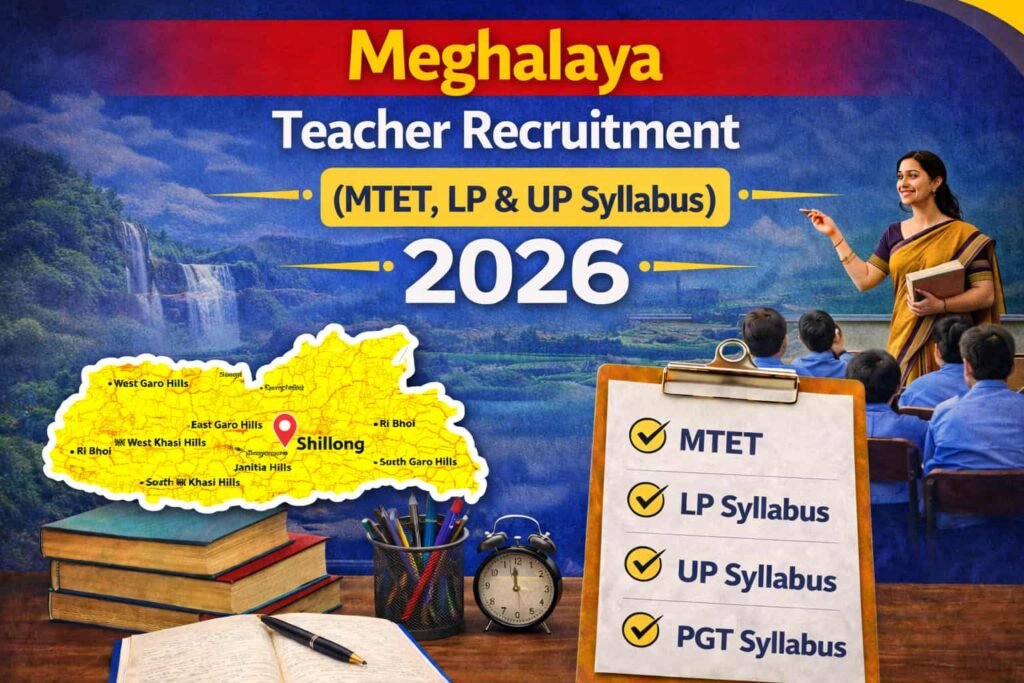
If you are aspiring to secure a government teaching job in Meghalaya in 2026, you need a clear, actionable roadmap. The state’s recruitment process is decentralized and depends heavily on the teaching level you are applying for.
This comprehensive guide removes the fluff and gives you exactly what you need to know: the exam bodies, the detailed MTET syllabus, strict OMR instructions, the newly updated 2026 salary charts, and the latest reservation policies.
1. Who Conducts the Exams? (The Administrative Framework)
In Meghalaya, teacher recruitment is not handled by a single board. It is divided among specific authorities based on the level of the post:
- DERT (Directorate of Educational Research and Training): Responsible for conducting the Meghalaya Teacher Eligibility Test (MTET), which is the mandatory gateway for Primary (Classes 1-5) and Upper Primary (Classes 6-8) teachers.
- DSC (District Selection Committee): Hires Group C and D auxiliary staff for schools. A mandatory “Knowledge of Local Language” paper is required to pass this level.
- MPSC (Meghalaya Public Service Commission): Recruits Post Graduate Teachers (PGTs) for Higher Secondary schools and Class-I Gazetted Officers.
- MERB (Meghalaya Education Recruitment Board): Specifically recruits Assistant Professors and Lecturers for Government Colleges using a direct 100-point Academic Performance Indicator (API) score and an interview, bypassing a written exam entirely.
2. MTET 2026: Detailed Syllabus & Exam Pattern
The Meghalaya Teacher Eligibility Test (MTET) certificate now comes with Lifetime Validity (applied retrospectively from 2011). There is no negative marking in the MTET exam.
Core Exam Pattern (For both Paper I & Paper II):
- Total Questions: 150 MCQs
- Total Marks: 150
- Duration: 150 minutes (2.5 hours)
- Qualifying Marks: 60% (90 marks) for General; relaxed to 68 marks for SC/ST/OST of Meghalaya and PwD candidates.
Paper I: Lower Primary (Classes I – V) Micro-Syllabus
- Child Development & Pedagogy (30 Marks): Focuses on the 6–11 age group. Topics include Piaget’s cognitive development, inclusive education, gender socialization in matrilineal societies, and assessment techniques (formative/summative).
- Language I (Khasi/Garo/Assamese/Bengali/Hindi/Nepali) (30 Marks): Reading comprehension, basic grammar (Sandhi, Samas), and local literary works.
- Language II (English) (30 Marks): Oral language development, Listening, Speaking, Reading, Writing (LSRW) skills, phonemic awareness, vocabulary, and basic grammar.
- Mathematics (30 Marks): Number systems, counting, fractions, geometry, LCM/HCF, area/perimeter, and pedagogical issues like “Mathematics Phobia” and using games/puzzles to teach.
- Environmental Studies – EVS (30 Marks): Natural resources, pollution, food, matter, and specific Meghalaya geography (physical features, vegetation, origin and life of Khasi and Garo tribes).
Paper II: Upper Primary (Classes VI – VIII) Micro-Syllabus
- Child Development & Pedagogy (30 Marks): Focuses on the 11–14 age group. Topics cover adolescent psychology, Kohlberg’s moral development, Vygotsky’s theories, and cross-sectional child study methods.
- Language I & Language II (30 Marks each): Advanced comprehension, role of schema in reading, process-oriented writing, and the use of reflective journals in classrooms.
- Mathematics & Science OR Social Science (60 Marks):
- Maths: Algebra, linear equations, statistics (mean/median/mode), and geometry.
- Science: Motion, heat, electricity, plant/animal cells, acids, bases, and salts.
- Social Science: History (ancient civilizations, regional freedom fighters like U Tirot Sing and U Kiang Nangbah), Geography (map skills, climate), Civics (Constitution), and Economics.
3. Strict OMR Sheet Rules (2026 Guidelines)
Objective exams in Meghalaya (conducted by MPSC, DSC, or DERT) use OMR sheets evaluated by optical scanners. A single mistake can lead to rejection.
- Pen Required: You must use ONLY a Black Ballpoint Pen. Pencils, gel pens, or blue pens are strictly prohibited.
- Writing Your Name: The candidate’s name must be written in CAPITAL (BLOCK) LETTERS. You must leave exactly one empty box between your first name, middle name, and surname.
- Signature Rule (Crucial): While your name must be in block letters, your Candidate Signature MUST be in running handwriting (cursive) with the date. Block letter signatures are flagged as impersonation and will invalidate your sheet.
- Bubbling: Darken only one circle completely. Overwriting, using correction fluid, or crossing out a bubbled circle will result in zero marks. There is no negative marking, so do not leave questions blank.
4. Assistant Professor Recruitment (100-Point API Score)
For college-level recruitment via MERB, there is no written exam. Candidates are shortlisted using an Academic Performance Indicator (API) matrix, followed by a Personal Interview.
| Qualification / Achievement | Maximum Marks Allotted |
|---|---|
| Graduation | Up to 21 points (80% & above = 21 pts) |
| Post-Graduation | Up to 25 points (80% & above = 25 pts) |
| M.Phil + Ph.D. (Combined max) | Maximum 25 points |
| JRF / NET / SET (Combined max) | Maximum 10 points (NET with JRF = 10 pts) |
| Research Publications | Maximum 06 points (2 marks per UGC-CARE publication) |
| Teaching Experience | Maximum 10 points (2 marks per year) |
| Awards (National / State) | Maximum 03 points |
| Total Maximum Score | 100 Points |
Reference: MERB Shortlisting Criteria.
5. 2026 Salary Structure & Allowances Chart
The financial compensation for educators in Meghalaya is highly attractive. Regular teachers are paid under the 5th Meghalaya Pay Commission, while Ad-hoc and SSA teachers are being transitioned to a new “Structured Pay Framework” from April 2026.
A. Regular Teachers (5th Meghalaya Pay Commission)
Regular teachers enjoy a Basic Pay multiplied by a fitment factor of 2.68, plus a Dearness Allowance (DA) that has crossed 50% (currently around 51%).
Special State Allowances :
- HRA: 15% for Greater Shillong (max ₹8,000), 12.5% for District HQs, and 10% for other areas.
- Hill Compensatory Allowance: ₹ 500 per month (for all employees across the state).
- Winter Allowance: ₹ 600 per month (paid for 4 months from Nov-Feb for stations above 1000m MSL).
- Medical Allowance: ₹ 1,000 per month.
| Academic Designation | Pay Level | Starting Basic Pay | Expected DA (~51%) | HRA (15% for Shillong) | Estimated Gross Monthly Salary |
|---|---|---|---|---|---|
| Primary Teacher (PRT) | Level 6 | ₹ 35,400 | ₹ 18,054 | ₹ 5,310 | ₹ 60,264 |
| Trained Graduate (TGT) | Level 7 | ₹ 44,900 | ₹ 22,899 | ₹ 6,735 | ₹ 76,034 |
| Post Graduate (PGT) | Level 8 | ₹ 47,600 | ₹ 24,276 | ₹ 7,140 | ₹ 80,516 |
| Assistant Professor | Level 15 | ₹ 57,700 | ₹ 29,427 | ₹ 8,000 (Capped) | ₹ 96,627 |
B. Ad-hoc & SSA Teachers (Structured Pay Framework – April 2026)
To end the flat-salary grant system, the state cabinet approved a new framework for over 23,000 Ad-hoc and SSA teachers effective April 1, 2026.
- Seniority-Based Pay: Base pay is determined by years of service (e.g., an LP teacher with 28+ years of service gets a base of ₹ 27,000).
- Annual Increment: A guaranteed 3% Composite Annual Increment (CAI) based on performance appraisal.
- Provident Fund: An 8% Contributory Provident Fund (CPF) matched by the state.
6. Top 10 Frequently Asked Questions (FAQs)
1. What is the validity of the Meghalaya Teacher Eligibility Test (MTET) certificate? Ans: Following the latest NCTE guidelines, the Meghalaya government has officially extended the validity of the MTET qualifying certificate from seven years to a lifetime. You do not need to rewrite the exam if you have already passed it.
2. Can B.Ed degree holders apply for Primary Teacher (Classes 1-5) jobs in Meghalaya? Ans: No. Based on a 2023 Supreme Court ruling, a B.Ed degree is legally invalid for primary teaching. You must hold a 2-year Diploma in Elementary Education (D.El.Ed) to apply for Lower Primary (PRT) posts.
3. What is the current Reservation Policy for recruitment in Meghalaya? Ans: Following the Expert Committee Report tabled in February 2026, the state has retained the 1972 Reservation Policy. It reserves 85% of jobs for Scheduled Tribes (40% for Khasi & Jaintia, 40% for Garo, and 5% for other STs). 5% is reserved for SC, and 10% is Unreserved.
4. Is there any negative marking in the MPSC or MTET objective exams? Ans: No. Whether you are taking the MTET (conducted by DERT) or screening tests by MPSC/DSC, there is absolutely no negative marking for incorrect or unattempted answers.
5. How do I sign the OMR sheet correctly during the exam? Ans: Your printed name must be written in CAPITAL (BLOCK) LETTERS, but your signature must be in running handwriting (cursive). Signing in block letters is considered a violation of instructions and will lead to the rejection of your OMR sheet.
6. Do I need a Permanent Resident Certificate (PRC) to apply for teaching jobs? Ans: Yes. To apply for state government teaching jobs, particularly those recruited via the District Selection Committees (DSC) or DERT, candidates must be indigenous inhabitants or permanent residents of Meghalaya and must possess a valid PRC issued by the Deputy Commissioner.
7. How are Assistant Professors selected under MERB? Ans: There is no written examination. The Meghalaya Education Recruitment Board (MERB) shortlists candidates purely based on a 100-point Academic Performance Indicator (API) score (which factors in graduation, PG, NET/Ph.D., and publications). The final job offer is based strictly on performance in a Personal Interview.
8. What is the “Structured Pay Framework” for SSA teachers? Ans: Effective April 1, 2026, the government is abolishing the flat-grant salary for over 23,000 Ad-hoc and SSA teachers. They will now receive a seniority-linked base pay, a 3% annual increment, and retirement benefits through an 8% Contributory Provident Fund (CPF).
9. What is the Hill Compensatory Allowance? Ans: To support employees working in the state’s challenging terrain, the Meghalaya government provides a flat Hill Compensatory Allowance of ₹ 500 per month to all state government employees, regardless of their specific place of posting.
10. What are the qualifying marks for the MTET exam? Ans: General category candidates must score 60% (90 out of 150 marks) to pass. However, SC/ST/OST and PwD candidates from Meghalaya receive a relaxation and only need to score 68 marks (approx. 45%) out of 150 to qualify.