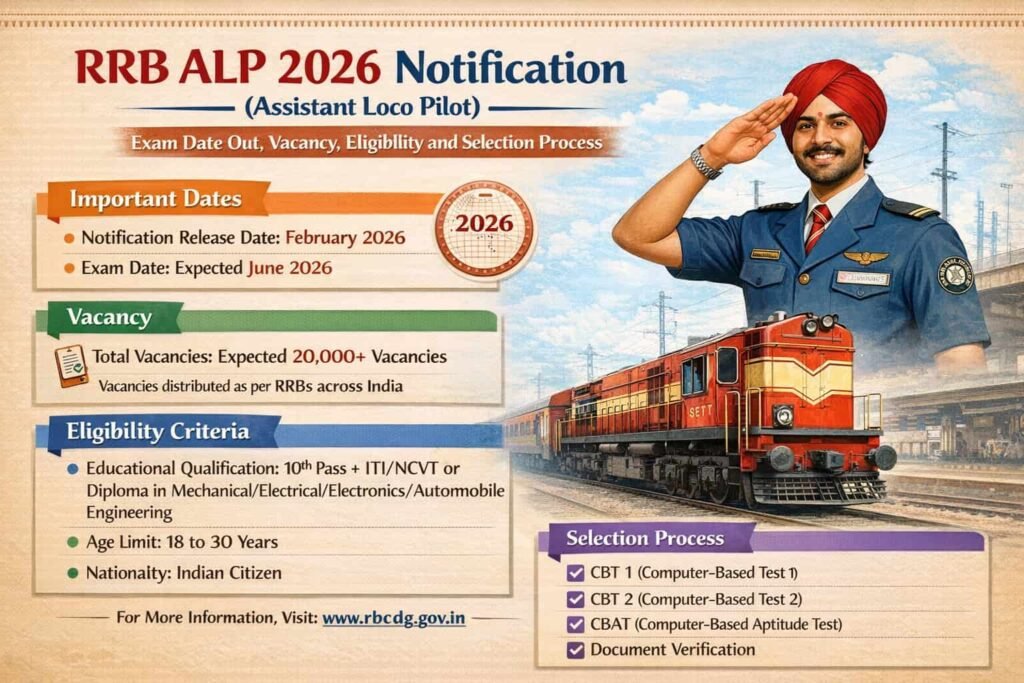
RRB ALP Recruitment: The Centralised Employment Notification published by the Railway Recruitment Board establishes the official regulatory, administrative, and technical parameters for the induction of Assistant Loco Pilots into the national railway network. The notification outlines a massive recruitment drive aiming to fill thousands of vacancies across multiple regional zones. The Assistant Loco Pilot position acts as the foundational operational tier for locomotive engineering and freight/passenger transit management. The recruitment protocol is designed to filter candidates through a multi-tiered assessment matrix that measures cognitive processing, mechanical aptitude, technical proficiency, and psychomotor coordination.
Thank you for reading this post, don't forget to subscribe!Systemic Vacancy Distribution and Zonal Allocation
The total allocated vacancies are distributed systematically across the national railway zones to address localized operational deficits and maintain high-frequency transit corridors. High-density freight corridors, particularly those operating in mineral-rich and heavily industrialized regions, record the highest allocation of personnel. The Railway Recruitment Board utilizes this centralized notification to process manpower requests originating from the respective zonal administrative headquarters.
The structural allocation of vacancies across the participating railway zones is detailed below:
| Zonal Railway | Total Allocated Vacancies | Operational Context |
| East Coast Railway | 1625 | Heavy freight movement, coastal transit lines, and mineral transport logistics. |
| South Eastern Railway | 1531 | Primary industrial, coal, and mineral transit routes connecting major mining sectors. |
| Central Railway | 1400 | Centralized passenger convergence and mixed cross-country freight operations. |
| Northeast Frontier Railway | 1276 | Challenging geographical terrain requiring specialized border connectivity logistics. |
| Northern Railway | 740 | High-density passenger transit networks and agricultural freight movement. |
| East Central Railway | 700 | Coal and heavy industrial goods transportation networks. |
| South Central Railway | 674 | Peninsular connectivity integrating both passenger and industrial freight. |
| Eastern Railway | 608 | Historic passenger corridors and densely populated suburban transit networks. |
| North Western Railway | 600 | Desert terrain transit and regional commercial connectivity. |
| West Central Railway | 541 | Central corridor bypass routes and high-speed transit sections. |
| North Central Railway | 457 | High-speed passenger train operations and central trunk route management. |
| Southern Railway | 250 | Southern peninsular network operations and port-connectivity logistics. |
| Western Railway | 214 | Western coastal transit, commercial hubs, and inter-city express lines. |
| South East Central Railway | 200 | Specialized bulk freight operations and heavy haulage circuits. |
| South Western Railway | 200 | Peninsular technological and commercial hub connectivity. |
| North Eastern Railway | 105 | Regional passenger connectivity and localized agricultural freight. |
| Chittaranjan Locomotive Works | 6 | Specialized locomotive manufacturing, testing, and prototype operational unit. |
The variation in vacancy numbers is a direct reflection of the physical tonnage and passenger footfall managed by each respective zone. Zones with heavy reliance on coal, iron ore, and heavy manufacturing output systematically require a larger workforce of locomotive operators to sustain continuous, uninterrupted supply chains.
Candidate Eligibility Parameters
The eligibility criteria act as the primary structural filter for the recruitment process. The Railway Recruitment Board enforces strict baseline requirements regarding age, academic qualifications, and medical fitness to ensure that only capable individuals enter the locomotive operation pipeline. The rigors of operating heavy machinery moving at high velocities necessitate a workforce that meets exact physiological and educational standards.
Demographic Criteria and Age Matrix
The baseline age requirement mandates that applicants must fall within a specific operational age bracket to apply for the position. The administrative framework integrates mandatory age relaxations to accommodate specific social categories, internal employees, and ex-service personnel, aligning with federal equity and internal workforce integration policies.
| Candidate Category | Permissible Age Relaxation |
| Unreserved (UR) | Baseline maximum age limit applies without relaxation. |
| Scheduled Caste (SC) / Scheduled Tribe (ST) | 5 years beyond the baseline maximum. |
| Other Backward Classes (OBC – Non-Creamy Layer) | 3 years beyond the baseline maximum. |
| Ex-Servicemen | Total service period rendered plus an additional 3 years. |
| Persons with Disabilities (PWD) – Unreserved | 10 years beyond the baseline maximum. |
| Persons with Disabilities (PWD) – OBC (NCL) | 13 years beyond the baseline maximum. |
| Persons with Disabilities (PWD) – SC/ST | 15 years beyond the baseline maximum. |
| Railway Staff (3+ years of continuous service) | Relaxed to an absolute ceiling of 40 years (UR), 43 years (OBC), and 45 years (SC/ST). |
| Widowed/Divorced Women | Relaxed to an absolute ceiling of 35 years (UR), 38 years (OBC), and 40 years (SC/ST). |
| Act Apprentices | Relaxed to an absolute ceiling of 35 years (UR), and 38 years (OBC). |
Academic and Technical Credentials
Operating a multi-ton locomotive requires an inherent understanding of mechanical systems, electrical fault resolution, and real-time hardware maintenance. The academic requirement is structured to source candidates with formalized vocational or engineering training. The baseline educational threshold is the completion of Matriculation (10th standard) or the Secondary School Leaving Certificate (SSLC).
This secondary education baseline must be supplemented by a formal technical certification. Candidates must possess a certificate from an Industrial Training Institute (ITI) recognized by the National Council for Vocational Training (NCVT) or the State Council for Vocational Training (SCVT).
The specific technical trades approved for the Assistant Loco Pilot profile include the following precise disciplines:
| Mechanical and Automotive Trades | Electrical and Electronic Trades |
| Fitter | Electrician |
| Millwright / Maintenance Mechanic | Instrument Mechanic |
| Mechanic (Motor Vehicle) | Electronics Mechanic |
| Tractor Mechanic | Wireman |
| Mechanic (Diesel) | Armature & Coil Winder |
| Heat Engine | Mechanic (Radio & TV) |
| Turner | Refrigeration & Air-Conditioning Mechanic |
| Machinist |
The syllabus limits recruitment exclusively to these trades because they correspond directly to the hardware systems present in diesel and electric locomotives. Alternatively, candidates who have completed a formalized Act Apprenticeship in the specified trades are fully eligible. The Railway Recruitment Board also permits candidates holding a three-year Diploma in Mechanical, Electrical, Electronics, or Automobile Engineering to apply, recognizing the higher theoretical capacity of these individuals. Candidates with a full Bachelor’s Degree in the aforementioned engineering disciplines are accepted in lieu of the diploma requirement, allowing graduate engineers to enter the operational workforce.
Medical and Visual Standards (A-1 Category)
The Assistant Loco Pilot position demands the highest medical classification within the railway operational matrix: the A-1 Standard. The inability to accurately perceive track conditions, interpret color-coded signaling mechanisms at high speeds, and maintain focus in varied lighting directly compromises the safety of the rolling stock and passengers. The physical demands of the job involve enduring high-decibel environments, severe vibrations, and irregular sleep cycles, necessitating flawless physical health.
The A-1 medical standard is absolute and uncompromising, particularly regarding optical metrics. Candidates whose visual parameters deviate from the prescribed limits are systematically rejected during the final medical examination phase.
| Medical Parameter | A-1 Standard Requirement and Testing Methodology |
| General Physical Fitness | Must be completely physically fit in all respects, demonstrating standard cardiopulmonary and musculoskeletal health. |
| Unassisted Distance Vision | 6/6 and 6/6 without glasses in both eyes. The candidate must read standard Snellen charts from the mandated distance without optical correction. |
| Fogging Test Tolerance | Must not accept more than +2D (Diopters). This test ensures the candidate does not suffer from latent hypermetropia, which could degrade distance vision under stress. |
| Unassisted Near Vision | Sn: 0.6 and 0.6 without glasses. The candidate must read close-range technical manuals and cabin dials clearly. |
| Color Vision | Mandatory pass. The candidate must successfully identify Ishihara plates to ensure they can differentiate between red, yellow, and green track signals. |
| Binocular Vision | Mandatory pass. Evaluates the ability to maintain focus on an object with both eyes simultaneously to gauge depth and speed. |
| Field of Vision | Mandatory pass. Ensures the candidate has standard peripheral vision to detect trespassers, obstacles, and lateral signaling. |
| Night Vision | Mandatory pass. Tests the optical ability to see clearly in low-light conditions, an absolute requirement for nocturnal freight runs. |
| Mesopic Vision | Mandatory pass. Tests visual acuity in twilight or transitionary lighting conditions. |
The medical protocol explicitly outlaws surgical interventions intended to correct refractive errors. Procedures such as LASIK, customized SMART, or TransPRK, which involve reshaping the cornea to achieve 6/6 vision, render a candidate permanently ineligible for the A-1 medical classification. The railway medical examination incorporates advanced ophthalmic equipment, including slit-lamp checks and fundoscopy, to detect any microscopic evidence of prior surgical vision correction. Candidates found attempting to bypass these optical parameters face immediate disqualification.
Multi-Stage Selection Architecture
The evaluation process for the Assistant Loco Pilot role is divided into five sequential phases. Candidates must secure qualifying marks at each tier to progress, with specific phases acting as merit determinants and others acting purely as elimination mechanisms. The methodology is structured to test theoretical knowledge first, followed by specialized technical competence, psychological resilience, and finally physiological suitability.
Phase 1: First Stage Computer-Based Test (CBT 1)
The First Stage CBT operates strictly as a screening mechanism to filter the massive applicant volume down to a manageable cohort for the subsequent technical examinations. The marks obtained in CBT 1 do not contribute to the final merit list ranking.
The examination consists of 75 multiple-choice questions to be solved within a strict 60-minute time constraint. The assessment penalizes inaccurate responses with a negative marking ratio of 1/3 mark per incorrect answer, mathematically discouraging blind guessing. The minimum qualifying percentage is fixed at 40% for Unreserved and EWS candidates, 30% for OBC and SC candidates, and 25% for ST candidates.
| Academic Section | Question Count | Marks Allocated |
| Mathematics | 20 | 20 |
| General Intelligence & Reasoning | 25 | 25 |
| General Science | 20 | 20 |
| General Awareness & Current Affairs | 10 | 10 |
| Total Allocation | 75 Questions | 75 Marks |
Phase 2: Second Stage Computer-Based Test (CBT 2)
Candidates who clear the regional CBT 1 cutoff thresholds advance to CBT 2. This stage serves as the primary academic merit determinant. It is a comprehensive examination totaling 175 questions with a cumulative time limit of 2 hours and 30 minutes. The examination is partitioned into Part A and Part B, maintaining the 1/3 negative marking rule across both sections.
Part A (Merit Determinant): This section dictates the candidate’s standing in the final academic hierarchy. It contains 100 questions to be resolved in 90 minutes. The curriculum covers Mathematics, General Intelligence & Reasoning, and Basic Science and Engineering. The score from this specific section forms 70% of the final recruitment metric.
Part B (Technical Qualification): This segment acts as a domain-specific trade test. Candidates answer 75 questions based on their selected technical discipline (ITI trade or Engineering equivalent) within a 60-minute window. Part B is strictly qualifying in nature; marks secured here do not aggregate into the final merit score, provided the candidate meets the baseline qualifying threshold specific to their trade.
Phase 3: Computer-Based Aptitude Test (CBAT)
Candidates successfully clearing CBT 2 Part A and qualifying in Part B are shortlisted for the CBAT, commonly referred to as the Psycho Test. The CBAT measures psychological suitability, cognitive reaction times, spatial awareness, and sustained concentration. These are attributes directly correlated with safe locomotive operation under stress.
The CBAT architecture mandates that candidates achieve a minimum T-Score of 42 in each of the individual test batteries to proceed. A T-score is a standardized metric that measures an individual’s performance relative to the statistical mean of the testing cohort. There is no negative marking applied in this phase, allowing candidates to attempt all psychological patterns without numerical penalty. The final merit list assigns a 30% weightage to the CBAT score and a 70% weightage to the CBT 2 Part A score.
Phase 4 and Phase 5: Document Verification and Medical Examination
The culminating phases require candidates to present original academic certificates, technical diplomas, identity proofs, and demographic category documentation for stringent authenticity checks. Any discrepancy in birth records, academic scoring, or social category certificates results in immediate expulsion from the recruitment cycle. Following successful verification, the candidate undergoes the A-1 medical examination conducted by railway medical authorities to confirm physiological and visual fitness as detailed in the medical criteria parameters. Selected personnel are then dispatched to Zonal Railway Training Institutes for an intensive technical training module lasting approximately 48 days before assuming active pilot duties.
Comprehensive Syllabus Breakdown
The academic scope of the Assistant Loco Pilot examination demands deep conceptual clarity across mathematics, logical reasoning, core physics, and engineering drawing. The syllabus is meticulously compartmentalized to test both abstract problem-solving and applied mechanical knowledge. The detailed breakdown of topics demonstrates the administration’s intent to test practical cognitive abilities rather than mere rote memorization.
Mathematics Curriculum
The mathematics curriculum evaluates numerical processing speed and the ability to solve applied arithmetic and algebraic equations. A locomotive pilot constantly utilizes operational mathematics to calculate braking distances, fuel consumption, average speeds, and time-to-destination metrics.
| Mathematical Domain | Specific Syllabus Topics |
| Arithmetic & Number Theory | Number System frameworks, BODMAS rules for equation solving, Decimals, Fractions, LCM and HCF derivations, and Square Roots. |
| Commercial Mathematics | Ratio and Proportion, Percentages, Simple and Compound Interest calculations, Profit and Loss analysis. |
| Operational Mechanics | Time and Work calculations, Time and Distance velocity equations, Pipes and Cisterns flow mechanics. |
| Advanced Mathematics | Core Algebra, basic Geometry, functional Trigonometry, and Elementary Statistics. |
| Applied Calculations | Age Calculations, Calendar configurations, Clock problem solving, and volumetric Mensuration. |
General Intelligence and Reasoning Curriculum
The reasoning modules assess cognitive flexibility, pattern recognition, and logical deduction under severe time constraints. In an operational context, a pilot must rapidly process multiple conflicting data points (signals, track conditions, control room instructions) and deduce the safest course of action.
| Reasoning Domain | Specific Syllabus Topics |
| Pattern Recognition | Analogies, Alphabetical and Number Series extrapolation, Coding and Decoding, and Jumbling. |
| Analytical Logic | Mathematical operations, Syllogism, Venn Diagrams, and abstract Analytical Reasoning. |
| Spatial and Relational Logic | Blood relationships, Direction and Distance calculations, Similarities and differences, and visual Classification. |
| Decision Matrices | Data Interpretation and Sufficiency, Conclusions and Decision Making, and Statement-Arguments and Assumptions. |
RRB ALP Recruitment General Science and Awareness
The General Science component of the initial screening is restricted to the 10th-standard educational level, covering foundational Physics, Chemistry, and Life Sciences. The General Awareness segment requires candidates to possess a working knowledge of Current Affairs related to Science and Technology, Sports, Culture, Personalities, Economics, and Politics.
Basic Science and Engineering (Merit Determinant)
The Basic Science and Engineering module forms the core of the merit-determining stage. It assesses practical engineering knowledge required for interpreting technical schematics and understanding the physical forces acting upon rolling stock.
Engineering Drawing
Loco Pilots frequently consult mechanical diagrams and structural schematics when diagnosing faults in the engine room. This section tests the candidate’s proficiency in reading and interpreting standard engineering blueprints, focusing on exact dimensional standards and symbolic shorthand used globally in mechanical engineering.
| Engineering Drawing Component | Detailed Topic Coverage |
| Drawing Instruments | Understanding the standardized dimensions of Drawing Sheets (A0, A1, A2, A3, A4, A5 designations, length, and breadth). Specifications of Drawing Boards (D0, D1, D2, D3, D4 shapes, sizes, and material compositions). Operational use of T-Squares, Mini Drafters, Set Squares, Protractors, and Drawing Instrument Boxes. |
| Lines and Draftsmanship | Identification and application of various types of lines (Horizontal, Vertical, Inclined, Parallel, Perpendicular, Curved, Dashed, Dotted). Geometric constructions including bisecting lines and angles, drawing perpendicular and parallel coordinates, finding centers, drawing tangents, and dividing lines into equal segments. |
| Geometric Figures | Properties and construction methods for Polygons, Ellipses, Cylinders, and Cones. Angle classifications (Acute, Right, Obtuse, Reflex, Adjacent, Complementary, Supplementary). Structural properties of Triangles (Equilateral, Isosceles, Scalene) and Quadrilaterals (Square, Rectangle, Rhombus, Trapezoid). Identification of Circle components (Radius, Diameter, Sector, Segment). |
| Projections and Views | Spatial interpretation of Pictorial views, Isometric, Oblique, and Perspective drawings. |
| Symbolic Representation | Identifying industry-standard blueprint symbols for Fasteners (Rivets, Bolts, Nuts). Interpretation of Pipe Joints (Screwed, Welded, Flanged). Representation of solid Bars, profile sections, and basic electrical schematics (Resistor, Inductor, Capacitor symbols). |
Applied Physics and Mechanical Concepts
This segment assesses the physical laws governing motion, thermal dynamics, and mechanical force multiplication. A pilot must understand these forces to safely brake a train weighing several thousand tons.
| Physics Sub-Domain | Detailed Topic Coverage |
| Units and Measurements | Fundamental versus Derived units. Classification of metric systems (FPS, CGS, MKS). Measurement of mechanical and electrical quantities, and conversion factors. |
| Mass, Weight, and Density | Core definitions and comparative analysis. Understanding specific gravity. Volume calculations for standard geometric solids (Cubes, Cylinders, Cones, Spheres) and calculating cargo density. |
| Kinematics and Dynamics | Application of Work, Power, and Energy formulas. Speed and Velocity differentials and deceleration mathematics. |
| Thermal Physics | Principles of Heat and Temperature, thermodynamics basics, and understanding engine overheating metrics. |
| Mechanical Advantage | Operational physics of Levers and Simple Machines, utilized during manual track adjustments and minor mechanical interventions. |
Basic Electricity and Professional Environments
The modern railway relies extensively on electric locomotives and digitized control systems. A baseline understanding of electrical architecture is mandatory for identifying fuse blowouts, relay failures, and circuit overloads.
| Systems Sub-Domain | Detailed Topic Coverage |
| Basic Electricity | Power sources (Battery, Generator, Thermocouple). Distinctions between Direct Current (DC) and Alternating Current (AC). Mathematical application of Ohm’s Law and Kirchhoff’s Law. Relationships between Resistance, Current, Voltage, and Power. Solving problems for circuits in Series and Parallel configurations. Properties and classifications of Conductors and Insulators. Calculation of Electric Power and Horse Power. |
| Professional Environment | Occupational Safety and Health protocols, industrial Environment Education, and baseline IT Literacy required to operate computerized cabin interfaces. |
Psychological Profiling: The Computer-Based Aptitude Test
The psychological screening phase evaluates cognitive processing parameters utilizing specialized test batteries. Each battery evaluates a distinct mental faculty necessary for the execution of duties within the locomotive cabin under duress.
| Test Battery | Cognitive Objective | Testing Methodology |
| Memory Test | Evaluates short-term spatial retention and visual recall. | This includes the Track Memory Test. Candidates are given a limited time window (usually three minutes) to study a complex railway station map with specific names assigned to various geographic locations. The test page then presents the exact same map, but the names are replaced with alphabetic markers. The candidate must accurately recall which alphabet corresponds to which station name based purely on their short-term visual memory. |
| Following Directions Test | Assesses the capacity to process and execute multi-step textual instructions accurately. | Tests comprehension, logical sequencing, and reaction time. Candidates are presented with a matrix of letters and numbers and given complex, layered instructions (e.g., finding the letter three spaces to the left of the number above a specific symbol). The test measures adherence to procedural rules without deviation. |
| Depth Perception Test | Measures spatial awareness, three-dimensional distance judgment, and object intersection. | Candidates analyze a two-dimensional image depicting a complex, three-dimensional stack of uniform bricks. Specific bricks within the stack are labeled with letters. The task requires the candidate to mentally map the structure and calculate exactly how many adjacent bricks physically touch the designated labeled brick. This tests the ability to perceive depth and hidden physical relationships, simulating track distance judgment. |
| Concentration Test | Examines absolute focus, detail orientation, and visual consistency under severe time pressure. | Evaluates the ability to maintain attention over extended periods without succumbing to cognitive fatigue. Candidates typically compare long sequences of numbers or similar visual patterns to identify minute discrepancies, simulating the continuous observation of track signals during a long haul. |
| Perceptual Speed Test | Evaluates data processing velocity and rapid pattern matching. | Candidates quickly and accurately compare visual information, matching complex geometric figures or identifying specific symbols within a cluttered visual field. This measures reaction time and the speed at which a candidate can accurately process external visual stimuli. |
Compensation Structure and Financial Allowances
The remuneration architecture for the Assistant Loco Pilot is governed by the regulations set forth in the Seventh Central Pay Commission framework. The position is classified under Pay Level 2. While the base salary metric is standardized across all government employees in this tier, the total gross compensation for running staff is significantly augmented by a unique set of allowances tailored to the operational demands of running railway stock.
The financial structure is highly dynamic, fluctuating based on the geographical classification of the posting (X, Y, or Z tier cities) and the physical volume of active duty kilometers logged by the employee.
Base Compensation Formulation
The standard monthly formulation involves the baseline pay scale combined with federal allowances designed to offset living expenses and monetary inflation.
| Salary Component | Approximate Valuation (INR) | Structural Function |
| Basic Pay | 19,900 | Core Pay Level 2 metric. |
| Grade Pay | 1,900 | Hierarchical classification metric. |
| Dearness Allowance (DA) | 10,752 | Inflation offset mechanism, frequently adjusted to represent approximately half of the basic pay depending on economic indicators. |
| House Rent Allowance (HRA) | 1,005 to 5,000 | Housing support calculated at varying percentages (9%, 18%, or 27%) scaling directly with the city tier classification. |
| Transport Allowance (TA) | 828 to 3,600 | Daily commute offset scaling based on the posting location. |
| Night Duty Allowance (NDA) | 387 to 500 | Direct financial compensation for shift rotations operating during nocturnal hours, recognizing the disruption to standard circadian rhythms. |
The aggregate Gross Pay generally fluctuates between Rs. 26,752 and Rs. 40,000 depending on the assignment matrix and location. A mandatory deduction of approximately Rs. 1,848 is routed into the New Pension Scheme to secure post-retirement financial stability. Consequently, the net in-hand salary falls within the Rs. 24,904 to Rs. 35,000 parameter, exclusive of high-volume running allowances.
The Kilometrage and Running Allowance Mechanism
The most distinctive financial component for locomotive staff is the Running Allowance, also documented as the Allowance in Lieu of Kilometrage. Unlike stationary administrative railway personnel, running staff receive direct financial compensation calculated against the physical distance traversed during active duty.
The regulatory framework establishes precise per-kilometer payout rates that scale with both the seniority of the pilot and the class of the train being operated. The rates undergo periodic upward revisions triggered by specific economic thresholds, ensuring the compensation remains competitive.
The structured payout rates for locomotive personnel are categorized rigorously as follows:
| Designation Category | Kilometrage Rate (Per 100 km) | Allowance in Lieu of Kilometrage (ALK Per 160 km) |
| Loco Pilot (Mail/Express) | Rs. 606 | Rs. 969 |
| Loco Pilot (Passenger/Sr. Motorman) | Rs. 600 | Rs. 960 |
| Loco Pilot (Goods) | Rs. 594 | Rs. 951 |
| Loco Pilot (Shunting) Grade I | Rs. 461 | Rs. 737 |
| Loco Pilot (Shunting) Grade II | Rs. 447 | Rs. 715 |
| Senior Assistant Loco Pilot | Rs. 447 | Rs. 715 |
| Assistant Loco Pilot | Rs. 430 | Rs. 688 |
This variable component drastically increases the total monthly take-home pay for personnel assigned to long-haul freight or high-speed inter-city passenger routes. A reference baseline of Rs. 6,050 is often utilized in standard predictive salary calculations, but the actual disbursement scales linearly with total duty distance completed within the calendar month.
Institutional Benefits
Railway employment integrates robust welfare infrastructure for the employee and immediate dependents. Personnel receive comprehensive travel allowances for home city transits and cross-country assignments, utilizing the railway network itself. Medical facilities are provided free of cost at dedicated railway hospitals, encompassing both the employee and their family. The leave structure permits 30 days of earned leave, 12 days of casual leave, and 30 days of medical leave annually. Long-serving employees also qualify for end-of-service gratuity payouts.
Operational Dynamics, Job Profile, and Career Progression
The role of an Assistant Loco Pilot operates at the critical juncture of mechanical hardware management and transit safety. The operational environment is highly pressurized, requiring rapid assimilation of sensory data, physical stamina, and strict adherence to established protocols.
Operational Duties and Challenges
The Assistant Loco Pilot functions in tandem with the senior Loco Pilot inside the control cabin. The primary directive is to monitor the mechanical and electrical status of the locomotive while simultaneously observing external track infrastructure.
Before initiating a transit run, the personnel review the brake certificates supplied by train examiners, cross-reference caution orders issued by station masters regarding track maintenance, and analyze the train manifest. During operation, the assistant maintains non-stop vigilance over the rail signals. The architecture of the rail network requires the operators to recall the geographic location of signals, calculate braking distances in varying weather conditions such as thick fog or heavy rain, and identify permanent speed restriction boards or level crossings.
The assistant pilot also conducts minor hardware repairs mid-journey to prevent transit delays and performs efficiency assessments on the engine hardware. The working conditions demand physiological adaptability, as shifts do not adhere to standard diurnal cycles. Operators face irregular rest intervals, frequently utilizing localized dormitories between transits, and must report for duty at entirely unpredictable hours based on the logistical flow of the freight and passenger network.
Career Progression Pathway
The organizational structure maintains a highly codified internal promotion hierarchy. An Assistant Loco Pilot operates within a defined career graph, moving up the ranks based on accumulated operational hours, experience, and the successful clearance of internal departmental examinations.
| Hierarchical Position | Estimated Experience Required | Compensation Scale Progression | Operational Role |
| Assistant Loco Pilot | Entry Level (0-3 years) | Rs. 25,000 to 40,000 | Assisting the primary pilot, continuous signal observation, minor repairs. |
| Senior Assistant Loco Pilot | Next Promotion Tier | Variable adjustment | Enhanced assistance duties, training junior inductees. |
| Loco Pilot (Goods) | 3-8 years | Rs. 40,000 to 56,000 | Primary operator for massive freight and cargo logistics networks. |
| Loco Pilot (Passenger) | Middle Management | Rs. 50,000 to 66,000 | Primary operator for regional, multi-stop passenger transit trains. |
| Loco Pilot (Mail/Express) | 8-15 years | Rs. 60,000 to 78,000 | Elite operation of high-speed intercity express transit corridors. |
| Power/Crew Controller | Advanced Management | Administrative Scale | Logistical management of running staff, duty assignment, and asset coordination. |
| Chief Loco Inspector | 15-20+ years | Rs. 50,000 to 65,000+ | Supervisory authority, protocol enforcement, and post-incident investigations. |
Historical Cut-off Analysis and Competitive Metrics
The quantitative evaluation of past recruitment cycles provides structural insight into the competitive thresholds required to secure a position. The cut-off marks vary significantly based on the volume of zonal applications, the difficulty index of the examination shifts, and the internal mathematical normalization formulas applied by the Railway Recruitment Board to equalize the scoring across multiple testing days.
The system institutes mandatory minimum qualifying percentages to establish an absolute baseline of theoretical competence, regardless of competitive dynamics. Unreserved and Economically Weaker Section candidates must achieve a minimum of 40%. Candidates in the Other Backward Classes and Scheduled Caste categories must secure at least 30%, while the threshold for Scheduled Tribe candidates is fixed at 25%.
In examining historical CBT 1 cut-off patterns evaluated out of 75 maximum marks, the Unreserved category typically registers cut-offs ranging between 40.09 and 67.59 based on the respective zone.
| Railway Zone | Unreserved (UR) | Other Backward Classes (OBC) | Scheduled Caste (SC) | Scheduled Tribe (ST) |
| Ajmer | 54.33 | 39.27 | 36.19 | 27.99 |
| Chandigarh | 40.09 | 30.01 | 30.01 | 25.02 |
| Mumbai | 57.17 | 44.08 | 36.68 | 30.48 |
| Ranchi | 61.61 | 48.47 | 39.67 | 31.05 |
| Guwahati | 59.91 | 49.18 | 37.48 | 26.24 |
| Bengaluru | 58.49 | Data Not Listed | Data Not Listed | Data Not Listed |
| Prayagraj | 59.58 | Data Not Listed | Data Not Listed | Data Not Listed |
The CBT 2 analysis demonstrates significantly higher competitive compression, as the testing pool is reduced to only the most academically capable candidates. Zones operating high-density networks exhibit steep qualification benchmarks.
| Railway Zone | Unreserved (UR) | Other Backward Classes (OBC) | Scheduled Caste (SC) | Scheduled Tribe (ST) |
| Kolkata (ER) | 82.31 | 79.49 | 77.34 | 68.60 |
| Malda (ER) | 80.94 | 79.83 | 73.57 | 65.71 |
| Ajmer | 80.11 | 77.58 | 74.65 | 70.35 |
| Ahmedabad | 79.97 | 77.78 | 73.67 | 68.90 |
| Bhopal (WCR) | 79.19 | 78.28 | 74.96 | 69.80 |
| Gorakhpur | 78.64 | 76.04 | 68.78 | 40.24 |
| Mumbai (SCR) | 76.83 | 76.33 | 72.02 | 66.55 |
| Chennai | 77.38 | 74.70 | 69.09 | 49.02 |
| Bhubaneswar | 73.75 | 71.74 | 66.66 | 62.10 |