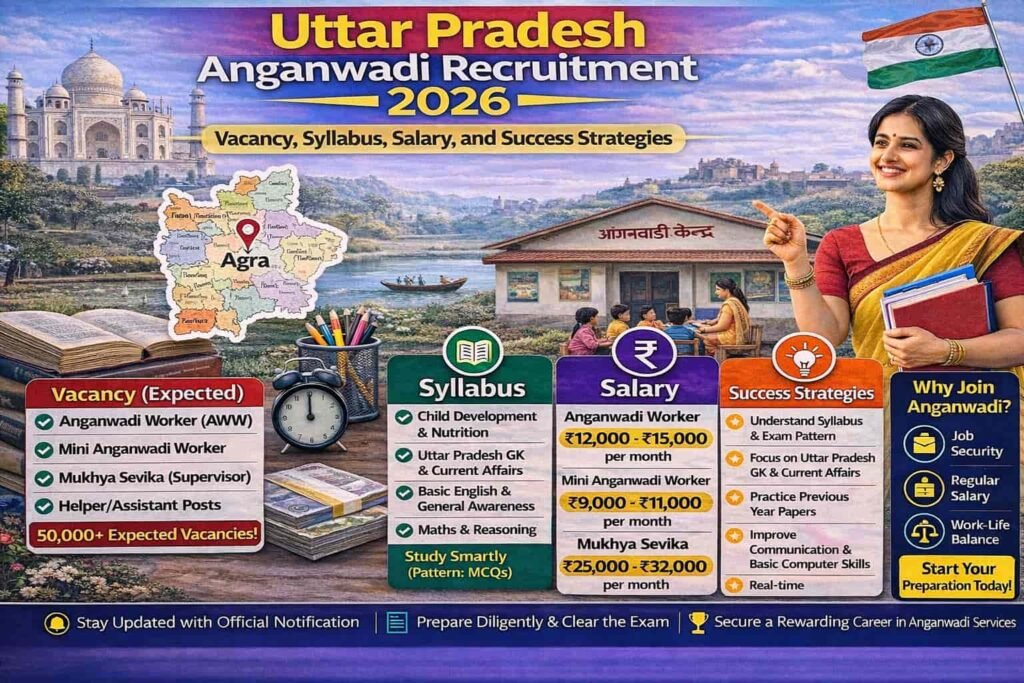
The Integrated Child Development Services (ICDS) scheme forms the fundamental backbone of maternal health, child nutrition, and early preschool education across India. In Uttar Pradesh, the most populous state in the country, the Department of Women and Child Development (Bal Vikas Seva Evam Pushtahar Vibhag, UP) operates a monumental network of Anganwadi Centres. These centres are critical lifelines for millions of rural and urban beneficiaries, driving the state’s battle against malnutrition, infant mortality, and female illiteracy.
Thank you for reading this post, don't forget to subscribe!The highly anticipated UP Anganwadi Recruitment 2026 brings a massive, decentralized employment opportunity for female candidates across all 75 districts. The government is actively processing the recruitment for thousands of vacant posts for Anganwadi Workers (Karyakatri) and Anganwadi Helpers (Sahayika) at the Gram Sabha and municipal ward levels. Alongside these grassroots roles, the highly coveted Mukhya Sevika (Lady Supervisor) posts are recruited centrally through the Uttar Pradesh Subordinate Services Selection Commission (UPSSSC).
This SEO-optimized, expert-level guide covers every critical detail for Uttar Pradesh aspirants. From an exhaustively detailed >1000-word syllabus breakdown for UPSSSC Mukhya Sevika to the latest 2026 salary hike announcements by CM Yogi Adityanath, promotion rules, and the best Hindi-medium book recommendations, here is your ultimate roadmap to success.
Overview of Bal Vikas UP Anganwadi Vacancy 2026
To ensure localized community integration, the recruitment for grassroots workers is heavily decentralized to the District Programme Officer (DPO) and Child Development Project Officer (CDPO) levels, utilizing the dedicated state portal (upanganwadibharti.in). Supervisory roles, however, fall under the stringent competitive framework of the UPSSSC.
| Parameter | Uttar Pradesh Recruitment Details |
|---|---|
| Administrative Authority | Bal Vikas Seva Evam Pushtahar Vibhag, UP / UPSSSC |
| Designated Roles | Anganwadi Karyakatri (Worker), Sahayika (Helper), Mukhya Sevika |
| Application Modality | Online via upanganwadibharti.in (Grassroots) / UPSSSC Portal (Supervisor) |
| Primary Selection Mechanism | Direct Merit-Based (Grassroots); PET + Mains Written Exam (Supervisor) |
| Target Demographic | Exclusively female candidates holding Uttar Pradesh Domicile |
Comprehensive Eligibility Criteria for 2026
The Uttar Pradesh Government enforces strict educational and demographic criteria to ensure the workforce is highly capable of managing grassroots health and educational challenges in the state’s vast rural expanses.
- Educational Qualifications: For the Anganwadi Sahayika (Helper) post, candidates must have passed the 10th standard (High School). For the Anganwadi Karyakatri (Worker) role, the educational requirement has been strictly upgraded to passing the 12th standard (Intermediate) from a recognized board. For the UPSSSC Mukhya Sevika post, candidates must possess a Bachelor’s Degree specifically in Sociology, Social Work, Home Science, or Nutrition/Child Development from a recognized university.
- Age Limit: The baseline age limit for aspiring Anganwadi Workers and Helpers in UP is tightly regulated between 18 and 35 years (calculated as of January 1st of the recruitment year). For UPSSSC Mukhya Sevika posts, the age limit is 21 to 40 years, with standard upper age relaxations applied for SC, ST, and OBC candidates.
- Local Residency: Applicants must be permanent residents of Uttar Pradesh. Crucially, for grassroots posts, the candidate must be a permanent resident of the exact Gram Sabha (village) or urban municipal ward where the Anganwadi centre’s vacancy is notified.
Decoding the Selection Process and UPSSSC Exam Pattern
The selection methodology in Uttar Pradesh is clearly divided based on the level of responsibility.
For Anganwadi Karyakatri and Sahayika (Merit & Document Verification): Selection for these grassroots posts does not involve a competitive written exam. Candidates apply online at the official portal. The software generates an automatic merit list based primarily on the percentage of marks secured in the 12th standard (and 10th standard for helpers). The District Selection Committee then conducts rigorous document verification.
For UPSSSC Mukhya Sevika (PET + Mains Written Exam): The recruitment for Lady Supervisors is conducted by the UPSSSC and is fiercely competitive.
- Stage 1 (PET): Candidates must have a valid score in the UPSSSC Preliminary Eligibility Test (PET). Only candidates with a positive PET score are shortlisted for the Mains exam.
- Stage 2 (Mains Exam): An objective-type (MCQ) written examination. The exam contains 100 questions carrying 100 marks, to be completed in 2 Hours (120 minutes). There is a strict negative marking of 0.25 marks (1/4th) for every incorrect answer.
🛑 IN-DEPTH SYLLABUS ANALYSIS FOR UPSSSC MUKHYA SEVIKA EXAM 2026 🛑
To successfully clear the Uttar Pradesh Subordinate Services Selection Commission (UPSSSC) examination for the post of Mukhya Sevika (Lady Supervisor), candidates must possess an extraordinarily deep, comprehensive, and meticulous understanding of the prescribed syllabus. The Mukhya Sevika acts as the critical administrative and technical linchpin between the grassroots Anganwadi Workers (Karyakatris) and the block-level Child Development Project Officers (CDPOs). She monitors the functioning of 25 to 30 Anganwadi centres, ensures the equitable distribution of supplementary nutrition, and acts as a frontline public health educator.
Therefore, the Main Examination completely skips generic subjects like Maths or English and is 100% domain-specific. It rigorously evaluates a candidate’s competency in Sociology, Home Science, Food Science, Child Psychology, and Public Health Epidemiology. Below is an exhaustive, highly granular breakdown of the 100-mark syllabus that candidates must thoroughly master for the 2026 recruitment cycle.
1. Administrative Roles and Sociological Foundations
This foundational module bridges the administrative duties of the post with the complex social fabric of rural Uttar Pradesh.
- Role and Responsibilities of Mukhya Sevika: Candidates must deeply understand the bureaucratic hierarchy of the ICDS scheme. Topics include the methodology for inspecting Anganwadi centres, conducting physical verification of Take-Home Ration (THR) stocks, auditing the attendance registers of children and pregnant women, training Anganwadi workers in non-formal pre-school education, and generating Monthly Progress Reports (MPRs) for the CDPO.
- Marriage, Family, Caste, Gender Inequality, Religion, and Languages: A deep sociological dive into the Indian social structure. Candidates must study the types of marriages (monogamy, polygamy, polyandry) and related legislations (Hindu Marriage Act, Special Marriage Act). The structure of families (nuclear, joint, extended) and the disintegration of the joint family system. The origin and functional aspects of the caste system, caste-based stratification, and untouchability offenses. Understanding gender inequality, patriarchy, and the socio-economic status of women in rural UP.
- Social Problems and Issues related to Women and Children: Analyzing the root causes and legislative remedies for social evils. This includes an in-depth study of Poverty lines, Dowry (Dowry Prohibition Act, 1961), Domestic Violence (PWDVA, 2005), Divorce mechanisms, Female Foeticide, Child Labour, and Child Marriage (PCMA, 2006). Candidates must also understand inter-generational and intra-generational conflicts in modernizing societies.
- Population Explosion, Growth, and Control: Demographic trends in India and Uttar Pradesh. Causes of high birth rates, the impact of overpopulation on resource allocation, maternal mortality, and infant mortality. Detailed study of family planning methods (temporary and permanent contraceptive techniques) and the role of the Mukhya Sevika in mobilizing rural women for family planning.
- Social Change and Social Control: The mechanisms through which society evolves. Factors of social change (technological, cultural, economic). Agencies of social control (family, religion, state, education, and law).
2. Food Science, Human Nutrition, and Metabolism
Nutrition is the absolute core of the ICDS mandate. Candidates must have clinical-level knowledge of food science to combat severe acute malnutrition (SAM) in the state.
- Energy and Basal Metabolism: Understanding Basal Metabolic Rate (BMR), factors affecting BMR (age, gender, climate, endocrine secretions), and the calculation of daily energy requirements for different occupational groups (sedentary, moderate, and heavy workers).
- Balanced Diet, Caloric Value, and Weight Management: Defining a balanced diet across the lifespan. Measuring the caloric value of food items using bomb calorimetry. Strategies for healthy weight gain in malnourished children and weight management for obese adults.
- Essential Food Components (Macronutrients & Micronutrients): This requires extensive biochemical knowledge:
- Proteins: Amino acids (essential vs. non-essential), biological value of proteins, sources, and protein-energy malnutrition (PEM).
- Carbohydrates & Fats: Monosaccharides, disaccharides, and polysaccharides. Saturated vs. unsaturated fats, cholesterol, and their role in energy provision.
- Vitamins: Fat-soluble vitamins (A, D, E, K) and Water-soluble vitamins (B-complex and C). Their specific physiological functions, dietary sources, and detailed clinical signs of deficiency (e.g., Night Blindness, Xerophthalmia, Beriberi, Pellagra, Scurvy, Rickets, Osteomalacia).
- Minerals & Water: The vital role of Calcium, Phosphorus, Iron, Iodine, Sodium, and Potassium. Diseases linked to mineral deficiency like Nutritional Anemia and Goitre. The physiological importance of water and electrolyte balance.
3. Child Development and Psychology
This segment strictly evaluates the candidate’s competency in pediatric development and early learning pedagogies.
- Stages of Child Development: A highly detailed tracking of human development from the prenatal stage (germinal, embryonic, fetal stages) through infancy, toddlerhood, early childhood, and late childhood.
- Factors Affecting Development: Understanding the interplay between genetics (heredity) and the environment (nutrition, parenting, socio-economic status, peer influence).
- Domains of Development: Milestones in physical and motor development (gross and fine motor skills), cognitive and intellectual development, language acquisition, and social/emotional development. The psychology of play-way learning methods in Anganwadi centres.
4. Epidemiology, Communicable Diseases, and Immunization
A Mukhya Sevika must actively collaborate with the Health Department (ASHA and ANM workers) to prevent disease outbreaks and ensure 100% vaccination coverage.
- Immunity and Immunization Schedule: Understanding innate (natural) and acquired (active/passive) immunity. A complete, unshakeable mastery of the Universal Immunization Programme (UIP) and the National Immunization Schedule. Candidates must know the exact timing, dosage, and route of administration for vaccines given before birth (Tetanus Toxoid for pregnant women) and after birth (BCG, OPV, IPV, Pentavalent, Rotavirus, Measles-Rubella, DPT boosters, and Vitamin A supplementation).
- Pathology and Management of Specific Diseases: The syllabus explicitly names several diseases. Candidates must know the causative agent (virus/bacteria/parasite), vector, mode of transmission, incubation period, clinical symptoms, and preventive treatments for:
- Bacterial Infections: Diphtheria, Pertussis (Whooping Cough), Tetanus, Tuberculosis (TB), Typhoid, Cholera.
- Viral Infections: Polio Myelitis, Measles, Chickenpox, Hepatitis (A, B, C, D, E), Dengue.
- Parasitic & Other Infections: Malaria, Diarrhea (management via ORS and Zinc therapy), Worm infections (deworming protocols using Albendazole), and Nutritional Anemia.
5. Public Health Agencies and Counseling Skills
- Health Agencies: Extensive factual knowledge regarding the headquarters, founding years, core mandates, and India-specific programs of major national and international health organizations. This includes WHO (World Health Organization), UNICEF (United Nations Children’s Fund), UNFPA (United Nations Population Fund), UNDP (United Nations Development Programme), the Red Cross Society, ICCW (Indian Council for Child Welfare), and FPAI (Family Planning Association of India).
- Counseling and Communication: Since Mukhya Sevikas must resolve conflicts and counsel reluctant rural mothers on nutrition and family planning, this section tests the psychological aspects of counseling. Meaning, scope, and need for counseling. Techniques of effective counseling (directive, non-directive, eclectic). The elements of effective interpersonal communication, overcoming barriers to communication in rural settings, and active listening skills.
Highly Recommended Books for Preparation (Hindi Medium)
Since the UPSSSC Mukhya Sevika exam is primarily attempted in Hindi and the syllabus is heavily tailored towards Home Science and Sociology, relying on top-tier Hindi-medium publications is an absolute must. Here is the curated list of the best books for the 2026 exam:
| Subject Domain | Recommended Book / Resource | Author / Publisher |
|---|---|---|
| Comprehensive Guide (Hindi) | Chakshu UPSSSC Mukhya Sevika Bharti Pariksha Complete Study Guide Book | Chakshu Panel of Experts / SRR Publications |
| Alternative Guide & Practice | UPSSSC Mukhya Sevika Bharti Pariksha 2023 Magdarshika & Practice Workbook | Vidya Editorial Board |
| Sociology Concepts | Samajshastra (Sociology for Competitive Exams) | Ram Ahuja / Standard BA Hindi Texts |
| Home Science & Nutrition | Grih Vigyan (Class 11 & 12 NCERT in Hindi) | NCERT |
| General Awareness | Lucent’s Samanya Gyan (Hindi) | Lucent Publications |
| Departmental Policy | Official UP ICDS Scheme PDFs | https://balvikasup.gov.in/ |
Uttar Pradesh Anganwadi Salary Structure & 2026 Hike News
The UP Anganwadi Salary 2026 structure comprises the Central Government’s baseline honorarium and a State Government top-up.
Latest 2026 Salary Announcements: In February 2026, during his speech in the legislative council, Chief Minister Yogi Adityanath officially announced a significant increase in the honorarium of Anganwadi workers, helpers, ASHA workers, and Shiksha Mitras. While the exact gazetted monetary increments are currently being processed by the finance department, this announcement comes as a massive relief to the state’s 1.82 lakh Anganwadi workers and 1.28 lakh helpers.
| Designation | Total Monthly Honorarium / Pay (Estimated 2026) |
|---|---|
| Anganwadi Karyakatri (Worker) | ₹6,500 – ₹10,000 per month (Honorarium based) |
| Mini Anganwadi Worker | ₹3,500 – ₹5,000 per month (Honorarium based) |
| Anganwadi Sahayika (Helper) | ₹3,000 – ₹4,500 per month (Honorarium based) |
| Mukhya Sevika (Supervisor) | ₹29,200 – ₹92,300 (Level 5 Pay Matrix) |
Note: Mukhya Sevikas recruited via UPSSSC are regularized Group ‘C’ Non-Gazetted state government employees and enjoy full pay-scale benefits, including Dearness Allowance (DA) and House Rent Allowance (HRA).
Job Profile Comparison: Anganwadi Karyakatri vs. ASHA
Understanding the difference between frontline workers is crucial in UP’s massive rural healthcare system:
- Anganwadi Karyakatri (WCD Dept): A highly structured, center-based role. The worker focuses on non-formal preschool education, distributing supplementary nutrition (THR), and maintaining developmental charts on the Poshan Tracker. They receive a fixed monthly honorarium.
- ASHA Worker (Health Dept): A mobile, field-based community health activist under the National Health Mission. They focus on medical emergencies, mobilizing pregnant women for institutional deliveries, and immunizations across difficult terrains. Their income relies heavily on task-based performance incentives rather than a high fixed salary.
Departmental Promotion Hierarchy
The Bal Vikas Seva Evam Pushtahar Vibhag offers a legally codified promotional pathway, ensuring that dedicated grassroots workers have the opportunity to ascend to regularized administrative ranks.
- Sahayika to Karyakatri: Under standard ICDS guidelines, a specific quota of all vacant Anganwadi Worker posts is reserved to be filled by promoting existing Anganwadi Helpers (Sahayikas) who possess the necessary 12th-class educational qualifications and have served continuously for 5 years.
- Karyakatri to Mukhya Sevika: To reward long-term service, 50% of the Mukhya Sevika vacancies are exclusively meant to be filled through the internal promotion of eligible Anganwadi Workers. Candidates must possess a Graduation degree and have completed sufficient years of service (usually 5 to 10 years depending on the specific state gazette rules). This promotion completely transforms a worker from an honorary position into a regularized state government employee with full administrative powers.
Motivation and Real-World Success Stories
The true motivation for becoming an Anganwadi worker in Uttar Pradesh lies in overcoming deep-rooted social barriers to bring health, education, and nutritional literacy to the most vulnerable communities.
Sangeeta Rahul: The Nutrition Innovator of Gorakhpur: Sangeeta Rahul, an Anganwadi Karyakatri from Gorakhpur, UP, has become a state-wide inspiration. Realizing that children in her centre were refusing to eat the standard dry supplementary nutrition provided by the government, she took matters into her own hands. Sangeeta developed simple, highly nutritious, and tasty local recipes using the exact same government-provided ingredients (Pushtahar). By teaching these recipes to mothers in her village, she dramatically improved the children’s appetite, weight, and energy levels. Her localized nutrition model successfully implemented the goals of the Poshan Abhiyaan at the grassroots level, making her a celebrated model for Anganwadi workers across the state.
Mamta Rani: Breaking Taboos in Moradabad: In Niyamatpur, a village in the Moradabad district, Anganwadi worker Mamta Rani transformed her centre into a bustling hub for out-of-school adolescent girls. Due to deep-seated rural myths and misconceptions, families in her village were strictly against allowing their daughters to consume Iron and Folic Acid (IFA) tablets, leading to severe anemia. Unfazed, Mamta teamed up with the village Gram Pradhan and launched a relentless door-to-door awareness campaign. She turned her Anganwadi centre into a vibrant health information hub lined with interactive charts. Today, girls flock to her centre every Wednesday for their supplements, making Mamta a true “Anaemia Warrior” and a beacon of hope in the fight against adolescent malnutrition.
Transforming Pre-School Education in Aligarh: Nidhi Sharma, a seasoned Anganwadi worker with 17 years of experience in Kishanpur, Aligarh, is leading the charge in modernizing early childhood education. She successfully implemented a 12-week intensive school readiness programme in her centre. By meticulously preparing lesson plans and gathering interactive resources before her classes, she has created an environment where rural toddlers are excited to learn. “Even before entering the classroom, my children start sharing their stories about their life and families – it is very rewarding!” she notes, proving that Anganwadi workers are the most critical foundational educators in the country.
Top 10 Frequently Asked Questions (FAQs)
Q1: What is the new educational qualification required for the UP Anganwadi Karyakatri post in 2026? The minimum educational qualification has been upgraded. Candidates applying for the Anganwadi Worker (Karyakatri) post must now have passed their 12th standard (Intermediate) from a recognized board. For the Helper (Sahayika) post, a 10th-class pass is generally required.
Q2: Is there a written exam for the post of Anganwadi Karyakatri or Sahayika in UP? No. There is no written exam for the grassroots posts. The selection is entirely direct and based on an automated merit list generated from your 10th and 12th standard board exam marks, followed by document verification.
Q3: What is the exam pattern for the UPSSSC Mukhya Sevika post? The UPSSSC Mukhya Sevika exam requires candidates to first clear the Preliminary Eligibility Test (PET). Shortlisted candidates then take the Mains Written Exam, which consists of 100 objective questions for 100 marks, to be completed in 2 hours, with a negative marking of 0.25 marks per wrong answer.
Q4: Did the UP Government announce a salary hike for Anganwadi workers in 2026? Yes. In February 2026, Chief Minister Yogi Adityanath announced in the legislative council that the honorarium for Anganwadi workers, helpers, and ASHA workers will be increased. The exact revised payout structures are currently being finalized.
Q5: Can candidates from Bihar or Madhya Pradesh apply for UP Anganwadi posts? No. A strict local residency rule applies. You must be a permanent resident of Uttar Pradesh. For grassroots posts, you must be a resident of the exact Gram Sabha or urban ward where the vacancy is located.
Q6: What is the promotion rule for an Anganwadi Karyakatri to become a Mukhya Sevika in UP? Under departmental guidelines, 50% of the Mukhya Sevika (Supervisor) posts are reserved for the promotion of eligible Anganwadi Workers who have adequate field experience (5-10 years) and possess a Graduation degree.
Q7: Which Hindi medium books are best for the UPSSSC Mukhya Sevika exam? The Chakshu UPSSSC Mukhya Sevika Bharti Pariksha Complete Study Guide Book (SRR Publications) and the UPSSSC Mukhya Sevika Bharti Pariksha Magdarshika & Practice Workbook by Vidya Editorial Board are highly recommended for Hindi medium students.
Q8: Are mathematics or English questions asked in the UPSSSC Mukhya Sevika Mains exam? No. The UPSSSC Mukhya Sevika Mains syllabus is 100% domain-specific. It focuses entirely on Sociology, Home Science, Food & Nutrition, Child Psychology, and Public Health Epidemiology.
Q9: Who is eligible to apply for the UPSSSC Mukhya Sevika exam? Only female candidates who possess a Bachelor’s Degree in Sociology, Social Work, Home Science, or Nutrition and Child Development, and hold a valid UPSSSC PET scorecard, are eligible to apply.
Q10: What documents are required for the UP Anganwadi grassroots application? You will need your 10th/12th original mark sheets, a valid digital Domicile/Residential Certificate (Niwas Praman Patra), Income Certificate, Caste Certificate (if claiming reservation), Aadhaar Card, and recent passport-size photographs.