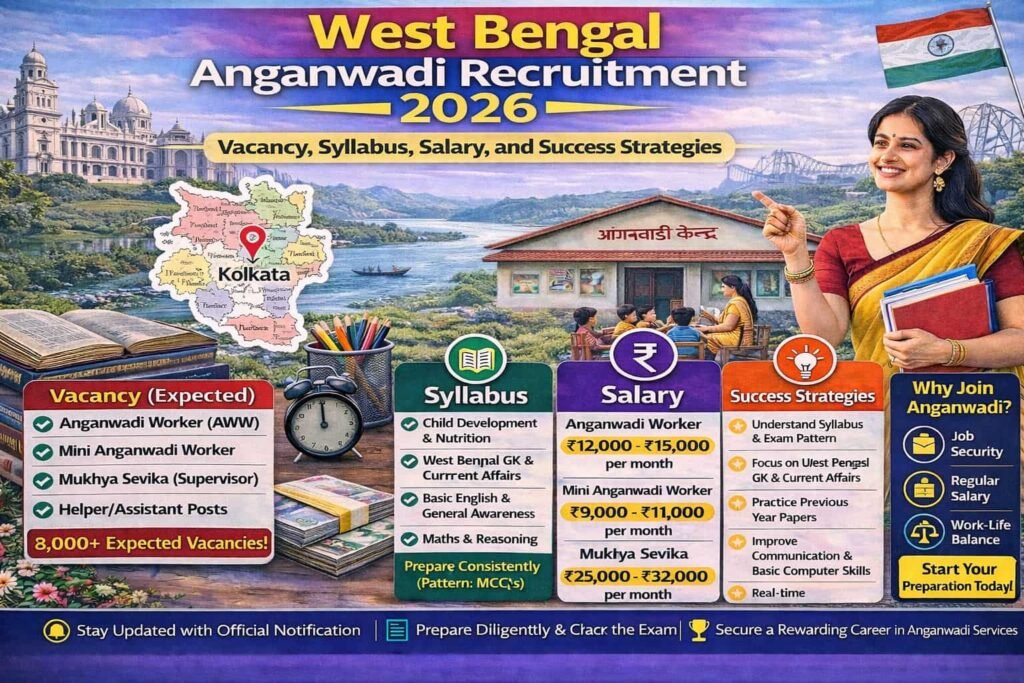
The Integrated Child Development Services (ICDS) scheme forms the fundamental backbone of maternal health, child nutrition, and early preschool education across India. In West Bengal, the Department of Women & Child Development and Social Welfare (WCD & SW) operates a monumental network of Anganwadi Centres. From the remote tea gardens of Darjeeling to the riverine islands of the Sundarbans, these grassroots hubs are the primary lifeline for eradicating malnutrition, providing immunization, and initiating foundational learning.
The highly anticipated West Bengal Anganwadi Recruitment 2026 brings a massive, decentralized employment opportunity for female candidates across all districts. The government is actively processing the recruitment for thousands of vacant posts for Anganwadi Workers (Karmi) and Anganwadi Helpers (Sahayika) at the district and block levels. Alongside these grassroots roles, the highly coveted ICDS Supervisor (Female Only) posts are recruited centrally through the West Bengal Public Service Commission (WBPSC).
This SEO-optimized, expert-level guide covers every critical detail for West Bengal aspirants. From an exhaustively detailed >1000-word syllabus breakdown for the WBPSC ICDS Supervisor Exam to the latest April 2026 salary hikes announced by CM Mamata Banerjee, promotion rules, and the best Bengali-medium book recommendations, here is your ultimate roadmap to success.
Overview of WCD West Bengal Anganwadi Vacancy 2026
To ensure localized community integration, the recruitment for grassroots workers is heavily decentralized to the District Magistrate and Child Development Project Officer (CDPO) levels, while supervisory roles fall under the stringent competitive framework of the WBPSC.
| Parameter | West Bengal Recruitment Details |
|---|---|
| Administrative Authority | Dept. of WCD & Social Welfare, WB / WBPSC |
| Designated Roles | Anganwadi Worker (Karmi), Helper (Sahayika), ICDS Supervisor |
| Application Modality | Online/Offline via District Portals (Grassroots) / WBPSC Portal (Supervisor) |
| Primary Selection Mechanism | Direct Merit & Interview (Grassroots); Prelims + Mains Written Exam (Supervisor) |
| Target Demographic | Exclusively female candidates holding West Bengal Domicile |
Comprehensive Eligibility Criteria for 2026
The West Bengal Government enforces strict educational and demographic criteria to ensure the workforce is highly capable of managing grassroots health and educational challenges in the state’s vast rural and urban expanses.
- Educational Qualifications: For the Anganwadi Helper (Sahayika) post, candidates must have passed the 8th standard or 10th standard (Madhyamik), depending on the specific district notification. For the Anganwadi Worker (Karmi) role, passing the 10th or 12th standard (Higher Secondary) is strictly required. For the WBPSC ICDS Supervisor post, candidates must possess a Bachelor’s Degree in any discipline from a recognized university.
- Age Limit: The baseline age limit for aspiring Anganwadi Workers and Helpers in WB is tightly regulated between 18 and 35 years. For WBPSC ICDS Supervisor posts, the maximum age limit extends to 39 years, with standard upper age relaxations applied for SC, ST, and OBC candidates as per state norms.
- Local Residency: Applicants must be permanent residents of West Bengal. Crucially, for grassroots posts, the candidate must be a permanent resident of the exact Gram Panchayat or urban municipal ward where the Anganwadi centre’s vacancy is notified.
Decoding the Selection Process and WBPSC Exam Pattern
The selection methodology in West Bengal is clearly divided based on the level of responsibility.
For Anganwadi Karmi and Sahayika (Merit & Interview): Selection for these grassroots posts generally does not involve a high-level competitive written exam. Candidates apply via the local CDPO or District Magistrate’s office. A selection committee evaluates candidates based on their academic merit (percentage of marks) and a viva-voce/interview.
For WBPSC ICDS Supervisor (Prelims + Mains Written Exam): The recruitment for Lady Supervisors is conducted by the WBPSC and is fiercely competitive. The selection is based on a rigorous three-stage process:
- Preliminary Screening Test: A 100-mark objective-type (MCQ) examination lasting 1 hour. It serves as a qualifying screening test.
- Main Examination: A conventional (descriptive) written examination comprising four separate papers, totaling 400 marks.
- Viva-Voce Test: A 50-mark personality test/interview for candidates who clear the Mains.
🛑 IN-DEPTH SYLLABUS ANALYSIS FOR WBPSC ICDS SUPERVISOR EXAM 2026 🛑
To successfully clear the West Bengal Public Service Commission (WBPSC) examination for the post of ICDS Supervisor, candidates must possess an extraordinarily deep, comprehensive, and meticulous understanding of the prescribed syllabus. The ICDS Supervisor acts as the critical administrative and technical linchpin between the grassroots Anganwadi Workers and the block-level Child Development Project Officers (CDPOs). Because this role demands impeccable administrative communication, deep sociological empathy, and clinical-level knowledge of public health, the Mains examination completely avoids multiple-choice formats in favor of rigorous, descriptive, conventional-type papers.
Below is the exhaustive, highly granular, and heavily expanded breakdown of the syllabus encompassing both the Preliminary and Main Examinations that candidates must thoroughly master for the 2026 recruitment cycle. This expansive curriculum leaves no stone unturned in preparing future administrators for the Department of Women & Child Development and Social Welfare.
THE PRELIMINARY SCREENING TEST (100 Marks)
The Preliminary exam is a 1-hour objective test designed purely for screening purposes. Marks obtained here do not count toward the final merit list.
- General Knowledge: Static GK, Indian history, geography, environmental science, and recent current affairs (national and international).
- Arithmetic: Madhyamik (10th) standard mathematics, testing computational speed and accuracy.
- Test of Reasoning: Verbal and non-verbal logic, blood relations, series completion, and coding-decoding.
THE MAIN EXAMINATION (400 Marks – Conventional/Descriptive Type)
The Mains Exam determines the candidate’s actual merit. It consists of four distinct 100-mark papers, each with a duration of 90 minutes.
Paper I: English (Class-XII Standard) – 100 Marks
As supervisors must regularly draft official reports and communicate with central ministries, flawless English proficiency is non-negotiable. This paper is entirely descriptive.
- Report Drafting: Candidates must master the art of administrative reporting. They will be tasked with writing structured, objective, and chronological reports based on specific field scenarios. Examples include drafting a report on the sudden outbreak of waterborne diseases in an Anganwadi sector, reporting on the physical verification of Take-Home Ration (THR) stocks, or summarizing the outcomes of a local immunization drive. The focus is on a formal tone, brevity, and accurate formatting.
- Translation into English: Candidates will be provided with a complex passage in a vernacular language (Bengali, Hindi, Urdu, Nepali, or Santali) and must translate it into grammatically flawless English. This tests the candidate’s ability to interpret grassroots issues and escalate them to higher English-speaking authorities without losing semantic meaning.
- Summary / Precis Writing: This tests the ability to condense information. Candidates will read a lengthy 400-500 word administrative or socio-economic passage and must reduce it to precisely one-third of its length. The precis must contain a suitable title, retain all core arguments, and be written entirely in the candidate’s own words, avoiding mere copy-pasting of original sentences.
- English Grammar: A rigorous test of mechanical grammar. Topics include Voice Change (Active/Passive used in official instructions), Narration Change (Direct/Indirect for recording statements), Transformation of Sentences (Simple/Compound/Complex), correction of erroneous sentences, appropriate use of prepositions, and mastering common idioms, phrases, synonyms, and antonyms.
Paper II: Vernacular Language (Bengali/Hindi/Urdu/Nepali/Santali) – 100 Marks
To effectively communicate with Anganwadi Workers, village panchayats, and rural mothers, the Supervisor must possess absolute mastery over the local state language. The standard is set at the Class XII level.
- Drafting of Report (Pratibedan Rochona): Writing descriptive reports in the chosen vernacular language concerning local socio-political or public health events. The vocabulary used must be formal and respectful.
- Translation from English to Vernacular (Anubad): Translating official English circulars, guidelines, or policy documents into simple, accessible Bengali (or other chosen languages) so that it can be easily understood by grassroots workers.
- Summary / Precis Writing (Saransha Rochona): Condensing a lengthy vernacular passage into a concise summary with a title.
- Vernacular Grammar (Byakaran): Deep knowledge of linguistic rules, including Sandhi, Samas, Karok, Bibhokti, Bakya Poriborton (Sentence transformation), and Shudho Banan (Spelling correction).
Paper III: General Studies & Current Affairs (Class-X Standard) – 100 Marks
This is the core professional and social science paper. It evaluates the candidate’s technical competency regarding public health, pediatrics, history, and social welfare schemes.
- Life Science with Special Emphasis on Nutrition and Health: This is the most vital module. Candidates must possess clinical-level knowledge of food science.
- Macronutrients & Micronutrients: The biochemical role, dietary sources, and daily requirements (RDA) of Carbohydrates, Proteins, Fats, Vitamins (A, B-complex, C, D, E, K), and essential minerals (Iron, Calcium, Iodine, Zinc).
- Malnutrition & Diseases: The etiology, clinical signs, and preventive strategies for Protein-Energy Malnutrition (Kwashiorkor and Marasmus), Nutritional Anemia, Night Blindness, Goitre, Scurvy, and Rickets. Growth monitoring techniques using WHO charts to identify Severe Acute Malnutrition (SAM).
- Maternal & Infant Health: Nutritional requirements during pregnancy and lactation. The critical importance of the “First 1000 Days” of life. The necessity of colostrum feeding, exclusive breastfeeding for the first six months, and the timely introduction of complementary feeding. Knowledge of the Universal Immunization Programme (BCG, Polio, Pentavalent, Measles-Rubella).
- Women Empowerment Issues: A deep sociological and legislative dive into the Indian social structure. Understanding gender inequality, patriarchy, and the socio-economic status of women. Detailed study of state and central schemes: Kanyashree Prakalpa (conditional cash transfers to prevent child marriage), Rupashree Prakalpa, Lakshmir Bhandar, Swasthya Sathi, POSHAN Abhiyaan, and Pradhan Mantri Matru Vandana Yojana (PMMVY). Awareness of legislation against domestic violence, dowry, and female foeticide.
- General Knowledge (History, Geography, Environmental Science, Physical Science):
- Indian History: Ancient and Medieval history, with a highly pronounced emphasis on the Indian Freedom Struggle. Topics include the Revolt of 1857, the Indian National Congress, the Partition of Bengal, the Swadeshi Movement, the Non-Cooperation Movement, and the Quit India Movement. Special focus on Bengal’s revolutionaries like Netaji Subhas Chandra Bose, Surya Sen, and Matangini Hazra.
- Geography & Environment: Physical geography of India and West Bengal (rivers like Hooghly and Teesta, the Sundarbans delta, Darjeeling hills). Environmental science topics including global warming, climate change, pollution control, and ecosystem preservation.
- Physical Science: Everyday science, basic laws of physics, and common chemical compounds used in daily life.
- Current Affairs: National and international events, awards, sports, and major government policies from the past 12 months.
- Verbal and Non-Verbal Reasoning: Logic puzzles, blood relations, syllogisms, and data interpretation, tested in a descriptive or analytical format.
Paper IV: Arithmetic (Class-X Standard) – 100 Marks
Mathematical aptitude is absolutely crucial for calculating nutritional requirements, maintaining accurate stock registers of food supplies, and managing the financial records of multiple Anganwadi centres. Candidates must show their step-by-step working in this conventional paper.
- Basic Numeracy: Number system, simplification, fractions, and decimals. LCM and HCF and their real-world applications.
- Commercial Mathematics: Percentages (calculating malnutrition rates), Profit and Loss, Simple and Compound Interest (useful for SHG micro-finance tracking).
- Ratio and Proportion: Mixture and alligation problems (e.g., determining the correct ratio of ingredients when preparing supplementary nutrition meals at the centre).
- Time and Measurement: Time and Work (calculating worker efficiency), Time and Distance, and speed calculations.
- Mensuration: Calculating the area, perimeter, surface area, and volume of 2D and 3D geometric figures (circles, squares, rectangles, cylinders, spheres), which is practically useful in assessing Anganwadi infrastructure and storage capacities.
Highly Recommended Books for Preparation (Bengali Medium)
Since the vast majority of candidates attempt the WBPSC ICDS Supervisor exam in Bengali, relying on top-tier Bengali-medium publications is an absolute must to grasp the complex technical vocabulary. Here is the curated list of the best books for the 2026 exam:
| Subject Domain | Recommended Book / Resource | Author / Publisher |
|---|---|---|
| Comprehensive Guide (Bengali) | Crack ICDS Supervisor (Mains) Exam Guide in Bengali | Lila Roy |
| Comprehensive Guide (Bengali) | Guide Book For ICDS Sadharankarmi O Supervisor (Bengali Version) | Jiban Lal Sarker |
| Alternative Guide (Bengali) | Complete Guide to ICDS (Supervisor & Anganwadi) | Rita Publication (ERDRC) |
| General English & Grammar | General English for All Competitive Examinations | S.C. Gupta |
| Arithmetic & Maths | Fast Track Objective Arithmetic (Translated / Bengali Versions available) | Rajesh Verma |
| Departmental Policy | Official WCD West Bengal Scheme PDFs | wcdsw.wb.gov.in |
West Bengal Anganwadi Salary Structure & April 2026 Hike News
The West Bengal Anganwadi Salary 2026 structure comprises the Central Government’s baseline honorarium and a significant State Government top-up. The WB government has consistently focused on improving the livelihoods of its scheme workers to combat inflation.
Latest Salary Hikes (Effective April 2026): In a major decision ahead of the upcoming elections, West Bengal Chief Minister Mamata Banerjee announced a significant hike in the salaries of Anganwadi workers, helpers, and ASHA workers as part of the state budget.
- The monthly remuneration of Anganwadi Workers has been officially increased by ₹750, bringing their total monthly honorarium to ₹9,000 (up from ₹8,250).
- The salaries of Anganwadi Assistants (Helpers) have been hiked by ₹500, bringing their new total to ₹6,500 per month.
- Additionally, a death compensation of ₹5 lakh for the nearest kin has also been introduced for these frontline workers.
| Designation | Total Monthly Honorarium / Pay (Post-April 2026 Hike) |
|---|---|
| Anganwadi Worker (Karmi) | ₹9,000 per month |
| Anganwadi Helper (Sahayika) | ₹6,500 per month |
| ICDS Supervisor (WBPSC) | ₹27,000 – ₹37,600 (Approx. Regular Pay Scale) |
Note: Supervisors recruited via WBPSC are regularized state government employees and enjoy full pay-scale benefits, including Dearness Allowance (DA) and House Rent Allowance (HRA).
Job Profile Comparison: Anganwadi Worker vs. ASHA
Understanding the difference between frontline workers is crucial in West Bengal’s rural healthcare system:
- Anganwadi Worker (WCD & SW Dept): A highly structured, center-based role. The worker focuses on non-formal preschool education, distributing supplementary nutrition, and maintaining developmental charts. They receive a fixed monthly honorarium of ₹9,000 following the 2026 hike.
- ASHA Worker (Health Dept): A mobile, field-based community health activist under the National Health Mission. They focus on medical emergencies, mobilizing pregnant women for institutional deliveries, and immunizations. Their income relies heavily on task-based performance incentives, though they also receive a state-provided baseline honorarium.
Departmental Promotion Hierarchy
The WCD & SW Department of West Bengal offers a legally codified promotional pathway, ensuring that dedicated grassroots workers have the opportunity to ascend to higher administrative ranks.
- Helper to Worker: Under the departmental guidelines, an impressive 75% of the vacancies for Anganwadi Workers are reserved for the promotion of existing Anganwadi Helpers. To be eligible, the helper must possess a minimum qualification of Class VIII pass and have at least 5 years of working experience. Crucially, the department has removed the upper age limit barrier, explicitly stating that an Anganwadi Helper is eligible for promotion to a Worker till she reaches 60 years of age.
- Worker to Supervisor: To reward long-term service, a specific quota of the ICDS Supervisor vacancies is exclusively filled through the internal promotion of eligible Anganwadi Workers who possess a Graduation degree and have completed 10 years of continuous service. This promotion completely transforms a worker from an honorary position into a regularized state government employee.
Motivation and Real-World Success Stories
The true motivation for becoming an Anganwadi worker in West Bengal lies in overcoming deep-rooted social barriers and geographical challenges to bring health and empowerment to the most vulnerable communities.
Jyotsna: The Boat-Riding Guardian of Maternal Health: In the complex, riverine, and flood-prone terrains of West Bengal, reaching a health centre is often an arduous journey. Jyotsna, a deeply dedicated frontline health and Anganwadi worker, has made it her life’s mission to ensure that geography does not dictate maternal mortality. Understanding the critical importance of safe childbirth, she single-handedly ensures that every pregnant mother in her jurisdiction gets the facility of institutional delivery.
Despite acute poverty in her region and the logistical nightmare of having to take a boat just to reach the nearest health centre, Jyotsna’s sheer determination never wavers. Through her tremendous goodwill and sustained, persuasive communication with the Health Department, she ensures that her Anganwadi centre successfully observes the Village Health Sanitation and Nutrition Day (VHSND) without fail. Her story is a profoundly inspiring testament to the fact that an Anganwadi worker is not just a government employee; she is the resilient, unsung hero protecting the lives of mothers and children against all odds.
Top 10 Frequently Asked Questions (FAQs)
Q1: What is the new salary of a West Bengal Anganwadi Worker after the April 2026 hike? Following the recent state budget announcement by CM Mamata Banerjee, the honorarium for an Anganwadi Worker (Karmi) has been increased to ₹9,000 per month, and for an Anganwadi Helper (Sahayika) to ₹6,500 per month.
Q2: What is the educational qualification required for the WBPSC ICDS Supervisor post? Candidates must possess a Bachelor’s degree (Graduation) in any discipline from a recognized university.
Q3: What is the exam pattern for the West Bengal ICDS Supervisor post? The WBPSC exam consists of a Preliminary screening test (100 marks, MCQ) and a Main Examination. The Mains consists of 4 conventional (descriptive) papers of 100 marks each, covering English, Vernacular Language, General Studies, and Arithmetic, followed by a 50-mark Viva-Voce.
Q4: Is there a written exam for the post of Anganwadi Worker or Helper in West Bengal? No. There is no competitive written exam for the grassroots posts. The selection is purely direct and based on a merit list generated from academic marks, followed by a personal interview at the CDPO or District level.
Q5: Can candidates from Bihar or Assam apply for West Bengal Anganwadi posts? No. A strict local residency rule applies. You must be a permanent resident of West Bengal. For grassroots posts, you must be a resident of the specific Gram Panchayat or urban ward where the vacancy is located.
Q6: What is the promotion rule for an Anganwadi Helper to become a Worker in West Bengal? 75% of Anganwadi Worker vacancies are reserved for the promotion of Helpers. A Helper who is 8th pass and has 5 years of experience is eligible for promotion. Notably, they remain eligible for this promotion up to the age of 60 years.
Q7: Which Bengali medium books are best for the WBPSC ICDS Supervisor exam? The Crack ICDS Supervisor (Mains) Exam Guide in Bengali by Lila Roy and the Guide Book For ICDS Sadharankarmi O Supervisor by Jiban Lal Sarker are highly recommended for Bengali medium students.
Q8: Are mathematics or English questions asked in the WBPSC ICDS Supervisor Mains exam? Yes, they are extremely crucial. Paper I is entirely dedicated to descriptive English (Drafting, Precis, Grammar) for 100 marks, and Paper IV is entirely dedicated to Class-X standard Arithmetic for 100 marks.
Q9: Do West Bengal Anganwadi workers receive any death compensation benefits? Yes. Along with the recent salary hikes, the state government also introduced a death compensation benefit of ₹5 lakh for the nearest kin of ASHA and Anganwadi workers.
Q10: What documents are required for the West Bengal Anganwadi application? You will need your 8th/10th/12th original mark sheets, a valid West Bengal Domicile/Residential Certificate, Caste Certificate (if applicable), Aadhaar Card, Voter ID, and recent passport-size photographs.