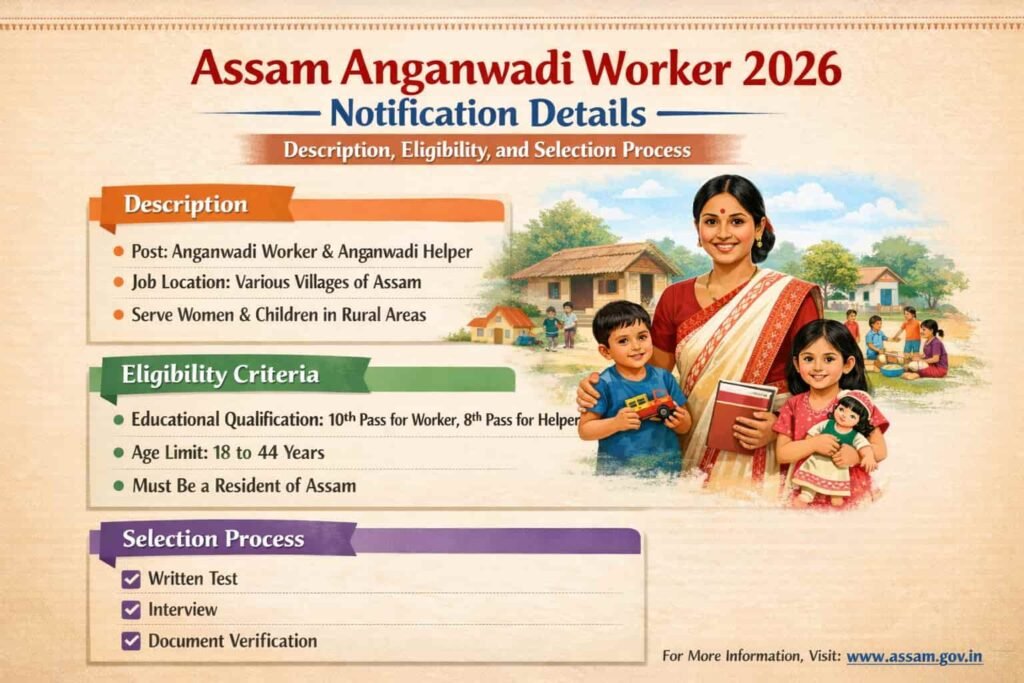
Assam Anganwadi Recruitment 2026. The Integrated Child Development Services (ICDS) program is a large government initiative started to fight child hunger and malnutrition. It runs through local village centers known as Anganwadis. The Assam Anganwadi Worker 2026 recruitment drive is a major employment event that offers local women a chance to get stable jobs while helping their own communities.
Thank you for reading this post, don't forget to subscribe!The government plans to fill nearly 18,000 vacancies across the country for the years 2025 and 2026. Assam will soon release district-wise notifications to hire workers, helpers, and supervisors. The state needs local women who can operate smartphones, understand basic health rules, and teach young children.
1. Basic Job Information
Here are the basic points about the recruitment:
- Department Name: Department of Women and Child Development (WCD), Government of Assam.
- Total Vacancies: Expected to be part of the 18,000 national vacancies, distributed across 35 districts in Assam.
- Job Location: Placements are strictly local. You will be placed in the exact village or ward where you live.
- Target Audience: This job is strictly reserved for female candidates.
Below is a table breaking down the job titles and their daily duties.
| Job Title | Main Responsibilities | Daily Duties |
| Anganwadi Worker | Center Manager | Opens the center, takes daily attendance, and leads morning prayers. Provides one hour of basic preschool teaching using charts and play methods. Gives basic medicines like oral rehydration salts and tracks child growth using the Poshan Tracker smartphone app. |
| Anganwadi Helper | Center Support | Cleans the center daily. Helps to prepare and serve hot cooked meals to the children. Escorts small children safely from their homes to the center and drops them back. |
| Anganwadi Supervisor | Area Manager | Travels to multiple villages to inspect Anganwadi centers. Checks if workers are following government rules. Verifies the data entered in the Poshan Tracker app and solves local food supply issues. |
2. Assam Anganwadi Recruitment 2026 Eligibility Criteria
The government has set specific rules regarding education, age, and local residency to ensure the right candidates are selected.
Educational Qualification
The educational rules have been updated to match the new digital duties given to the workers.
| Job Role | Minimum Education Required | Reason for Requirement |
| Anganwadi Helper | 8th or 10th Standard Pass | Needs basic reading skills to assist with center duties, read food labels, and help with attendance. |
| Anganwadi Worker | 12th Standard (Intermediate) Pass | Needs higher education to teach preschool children, read health manuals, and use the Poshan Tracker app. |
| Anganwadi Supervisor | Graduation Degree | Needs a college degree to manage large data sets, write official reports, and train junior workers. |
Age Limit and Relaxation
The minimum age to apply for any post is 18 years. The maximum age for general category candidates applying for Worker and Helper posts is 35 years. For the Supervisor post, the maximum age is 40 years.
The government provides age relaxations for reserved categories.
| Candidate Category | Age Relaxation | Maximum Age (Worker / Helper) | Maximum Age (Supervisor) |
| General (Unreserved) | No relaxation | 35 Years | 40 Years |
| OBC / MOBC | 3 Years | 38 Years | 43 Years |
| SC / ST | 5 Years | 40 Years | 45 Years |
| Persons with Disability (PwD) | 10 Years | 45 Years | 50 Years |
Local Residence and Experience
For the Worker and Helper jobs, you must be a permanent resident of the exact electoral ward or village where the center is located. Your name must be on the local voter list for that ward. This ensures the worker knows the local language and the families in the village.
There are no physical standards like height or chest measurements required for these jobs. Freshers can apply for Worker and Helper roles. However, for the Supervisor role, the government reserves 50% of the posts for existing Anganwadi Workers who have completed 5 years of continuous service.
3. Salary & Benefits
Anganwadi Workers and Helpers are officially known as “honorary workers.” They do not receive a standard government salary scale. Instead, they receive a fixed monthly honorarium. This payment combines a share from the Central Government and a share from the State Government.
The Assam government recently announced a major hike in its share of the honorarium, which will take effect from October 1, 2025.
| Payment Part | Anganwadi Worker | Anganwadi Helper |
| Central Government Share | Rs. 4,500 | Rs. 2,250 |
| Assam State Share (From Oct 2025) | Rs. 3,500 | Rs. 1,750 |
| Performance Bonus (Poshan Tracker) | Rs. 500 | Rs. 250 |
| Total Monthly Income | Rs. 8,500 | Rs. 4,250 |
Supervisors are regular government employees. They are placed in Pay Band-2, with a basic pay scale ranging from Rs. 14,000 to Rs. 60,500 and a grade pay of Rs. 7,600. With allowances, a new Supervisor earns a starting in-hand salary of around Rs. 32,000 to Rs. 35,000 per month.
Workers and Helpers also get life insurance cover of Rs. 2.00 lakh under the Pradhan Mantri Jeevan Jyoti Bima Yojana and accident cover under the Pradhan Mantri Suraksha Bima Yojana. They get 20 days of annual leave and 180 days of paid maternity leave.
4. Selection Process
The selection method is different depending on the job role you apply for. There are no interviews for the lower-level posts to keep the process fair.
| Job Role | Selection Method | Stages of Selection |
| Worker and Helper | Direct Merit Based | No written exam. The software calculates a merit score based on 10th and 12th standard board exam marks. |
| Supervisor | Exam Based | Written multiple-choice question (MCQ) test followed by a practical Computer Proficiency Test. |
For Workers and Helpers, if two candidates from the same village get the exact same marks, a tie-breaking rule applies. The older candidate is selected first. If their ages are the same, the candidate with a higher educational degree wins the tie. Special preference is given to women from Below Poverty Line (BPL) families, widows, and divorced women.
For Supervisors, there is negative marking in the written exam. For every wrong answer, 0.33 marks (1/3rd of a mark) are deducted from the total score.
5. Syllabus & Exam Pattern
This section is only for candidates preparing for the Supervisor examination. Workers and Helpers do not have a written exam. The Supervisor exam is an objective-type test with multiple-choice questions.
| Subject | Number of Questions | Total Marks | Time Duration |
| General Studies & Awareness | 40 | 40 | Combined 3 Hours |
| Basic Mathematics | 40 | 40 | Combined 3 Hours |
| English Language | 40 | 40 | Combined 3 Hours |
| Logical Reasoning | 40 | 40 | Combined 3 Hours |
| Regional Language (Assamese) | 20 | 20 | Combined 3 Hours |
| Total | 180 Questions | 180 Marks | 3 Hours |
Detailed Syllabus Topics
| Subject | Important Topics to Study |
| General Studies | Indian History, Geography, Indian Polity, Assam History (Ahom Kingdom, famous figures), Current Affairs, Child Development principles, Nutrition (vitamins, balanced diet), Government schemes like Poshan Abhiyaan and Beti Bachao Beti Padhao. |
| Basic Mathematics | Number System, HCF and LCM, Average, Profit and Loss, Simplification, Ratio and Proportion, Speed and Distance, Work and Time, Square and Cube Roots (10th standard level). |
| English Language | Tenses, Active and Passive Voice, Direct and Indirect Speech, Articles, Prepositions, Sentence Correction, Synonyms, Antonyms, and One-word substitution. |
| Logical Reasoning | Blood Relations, Odd One Out, Syllogisms, Alphabet Series, Ranking and Order, Venn Diagrams, Coding and Decoding, Number Series. |
Computer Proficiency Test
The Assam Cabinet has made a computer test mandatory for Supervisors. Candidates must score at least 40% to pass. The test involves three practical tasks on a computer:
- MS Word: Typing an official application letter and formatting a table to show educational details.
- MS PowerPoint: Designing 4 presentation slides showing your name, roll number, document list, and educational percentages.
- MS Excel: Preparing a simple salary statement using basic formulas like sum and percentage.
6. Application Process
The application process is completely online. Paper forms are not accepted. Candidates must apply through the official Assam Women and Child Development portal.
Additionally, the state of Assam requires all candidates to be registered with the local Employment Exchange. You can do this online through the Sewa Setu portal.
| Application Step | Action Required |
| 1. Employment Exchange | Register on the Assam Sewa Setu portal. You can use Aadhaar-based or non-Aadhaar-based registration. Keep your Employment Exchange Registration number ready. |
| 2. Online Registration | Go to the official WCD Assam portal. Click “New Registration” and enter your mobile number and email to get a password. |
| 3. Fill Profile | Log in and fill in your personal details. You must type your exact ward number and village name correctly to prove local residency. |
| 4. Upload Documents | Upload clear, scanned copies of your original documents. |
| 5. Final Submit | Review all details and click submit. Download the confirmation page and print it. |
Required Documents List
You must upload the following documents. If the uploaded documents do not match the details you typed, your application will be rejected.
| Document Type | Details |
| Identification | Aadhaar Card, Passport-size color photograph, and a scanned copy of your signature. |
| Education | Marksheets and passing certificates for 8th, 10th, 12th standard, and Graduation (as per the post requirement). |
| Age Proof | Birth certificate or 10th standard admit card. |
| Residence Proof | Valid Domicile Certificate or a certified copy of the local voter list (Electoral Roll) proving you live in that exact ward. |
| Special Categories | Digital Caste certificate (SC/ST/OBC), EWS certificate, or PwD certificate if applying for reservation. |
| Employment | Assam Employment Exchange Registration certificate. |
For Anganwadi Worker and Helper posts, the application fee is zero for all categories.
7. Cut Off & Previous Year Analysis
For Worker and Helper posts, the cut-off is the minimum percentage of marks you need in your school exams to get on the merit list. The software calculates an average using your 10th and 12th board marks. The cut-off changes from district to district. If many educated women apply from one village, the cut-off goes up.
Here is a look at the historical cut-off trends for general category females in various Assam districts.
| District Name | Expected Cut-Off Percentage (General Female) | Competition Level |
| Baksa | 26.69% to 30.00% | Moderate |
| Barpeta | 20.06% to 25.00% | Low to Moderate |
| Bongaigaon | 23.23% to 28.00% | Moderate |
| Cachar | 20.14% to 25.00% | Moderate |
| Dibrugarh | 25.06% to 28.00% | High |
| Kamrup | 23.76% to 27.00% | High |
| Jorhat | 26.12% to 30.00% | Very High |
Note: The percentage figures represent a specific index score calculated by the department that combines multiple educational qualifications into a single number.
Because the Assam government recently increased the salary, competition will be much higher this year. Candidates applying for Worker posts with 12th standard marks above 65% will have a much safer chance. For the Supervisor exam, candidates should aim to score at least 70% of the total marks.
Preparation Strategy for Supervisor Exam
Candidates targeting the open-market Supervisor post need a solid, disciplined study plan to cover the large written syllabus.
| Timeframe | Study Focus | Daily Routine |
| Days 1 to 15 | Child Development and Nutrition | Study government schemes like Poshan Abhiyaan. Learn about vitamins, common childhood diseases, and early childhood care methods. |
| Days 16 to 30 | Basic Math and Reasoning | Solve at least 50 math and reasoning questions every single day to improve your calculation speed. Practice blood relations, coding, and number series. |
| Days 31 to 45 | General Knowledge and English | Read local daily newspapers for current affairs. Study Assam history, geography, and polity. Practice basic English grammar rules. |
| Days 46 to 60 | Mock Tests and Revision | Take full-length mock tests. Practice leaving questions blank if you do not know the exact answer to avoid the 0.33 negative marking penalty. |
Recommended Books
| Subject Focus | Book Recommendation |
| Complete Guide | Aanganwadi: Supervisor/Worker/Helper Recruitment Exam Guide by Ramesh Publishing House. |
| Assam GK | An Introduction To Assam General Knowledge by Sailen Baishya. |
| General Knowledge | Lucent’s General Knowledge. |
| Mathematics | Fast track objective arithmetic by Rajesh Verma. |
Job Training After Selection
After you are selected, you must pass a training program before starting work. The government provides a 26-day Job Training course at Anganwadi Workers Training Centres (AWTCs). There are centers in Assam located in places like Panjabari in Guwahati. During this training, you will learn how to treat childhood diarrhea, handle fevers, teach children, and use the Poshan Tracker app.
Job Training After Selection
After you are selected and your documents are verified, you do not start working immediately. You must pass a mandatory training program.
The government provides a 26-day Job Training course at special centers called Anganwadi Workers Training Centres (AWTCs). There are currently 27 operational AWTCs spread across Assam. For example, there are training centers located in Panjabari in Guwahati, and others covering districts like East Khasi Hills and Garo Hills regions nearby.
During this intensive 26-day training, you will learn practical skills. You will be taught how to identify malnourished children, how to treat childhood diarrhea, how to handle basic fevers, how to teach preschool children using toys, and how to accurately enter daily data into the Poshan Tracker app.
9. FAQs / Doubts
Here are clear answers to the most common questions candidates ask about the recruitment rules and promotions.
| Common Question | Clear Answer |
| Can a final year college student apply? | No. You must have your final passing certificate and original marksheet in your hand before the last date of form submission. Pending results or expected results are not accepted. |
| Are male candidates allowed to apply? | No. All Anganwadi Worker, Helper, and Supervisor posts are kept exclusively for female candidates. |
| Is there a physical running test for this job? | No. There is no running test, height measurement, or chest measurement required. You just need a doctor’s certificate proving you are in normal good health to play with children and do daily tasks. |
| Can I apply for a job in the next village? | No. You must live in the exact electoral ward or revenue village where the Anganwadi center is located, and your name must be printed on that exact ward’s voter list. |
| Do Anganwadi Workers have to take a computer test? | No. The computer typing and MS Office test is only for the higher-level Supervisor post. Workers and Helpers only need to know how to use a smartphone. |
| What happens if I make a spelling mistake in the online form? | Once you submit the form, you cannot change it. If your form details do not perfectly match your uploaded documents, your application will be rejected during document verification. You must check everything twice before submitting. |
| Can a Helper ever become a Supervisor? | Yes. A Helper can be promoted to a Worker after 5 years of service. After working as a Worker for another 5 years, she can take the departmental exam to become a regular government Supervisor. |
Can a final year college student apply? No. You must have your final passing certificate and original marksheet in your hand before the last date of form submission. Pending results or expected results are not accepted.
Are male candidates allowed to apply? No. All Anganwadi Worker, Helper, and Supervisor posts are kept exclusively for female candidates. Male candidates cannot apply for these roles.
Is there a physical running test for this job? No. There is no running test, height measurement, or chest measurement required. You just need a doctor’s certificate proving you are in normal good health to play with children and do daily tasks.
Can I apply for a job in the next village? No. You must live in the exact electoral ward or revenue village where the Anganwadi center is located, and your name must be printed on that exact ward’s voter list.
Do Anganwadi Workers have to take a computer test? No. The computer typing and MS Office test is only for the higher-level Supervisor post. Workers and Helpers only need to know how to use a smartphone for the Poshan Tracker app.
What happens if I make a spelling mistake in the online form? Once you submit the form, you cannot change it. If your form details do not perfectly match your uploaded documents, your application will be rejected during document verification. You must check everything twice before submitting.
Can a Helper ever become a Supervisor? Yes. A Helper can be promoted to a Worker after 5 years of service. After working as a Worker for another 5 years, she can study further and take the departmental exam to become a regular government Supervisor.
When will the new salary hike take effect? The Assam government has announced that the new hiked honorarium (Rs. 3500 state share for workers) will be effective from October 1, 2025.
What is the exact tie-breaking rule if two candidates get the same marks? If two candidates have the exact same 10th and 12th average marks, the older candidate is selected first. If their dates of birth are also the same, the candidate who passed her 10th standard earlier wins the tie.
Do widows get any special preference in the merit list? Yes. To support vulnerable women, the software gives the highest preference to widows belonging to Below Poverty Line (BPL) families when preparing the merit list for Workers and Helpers.