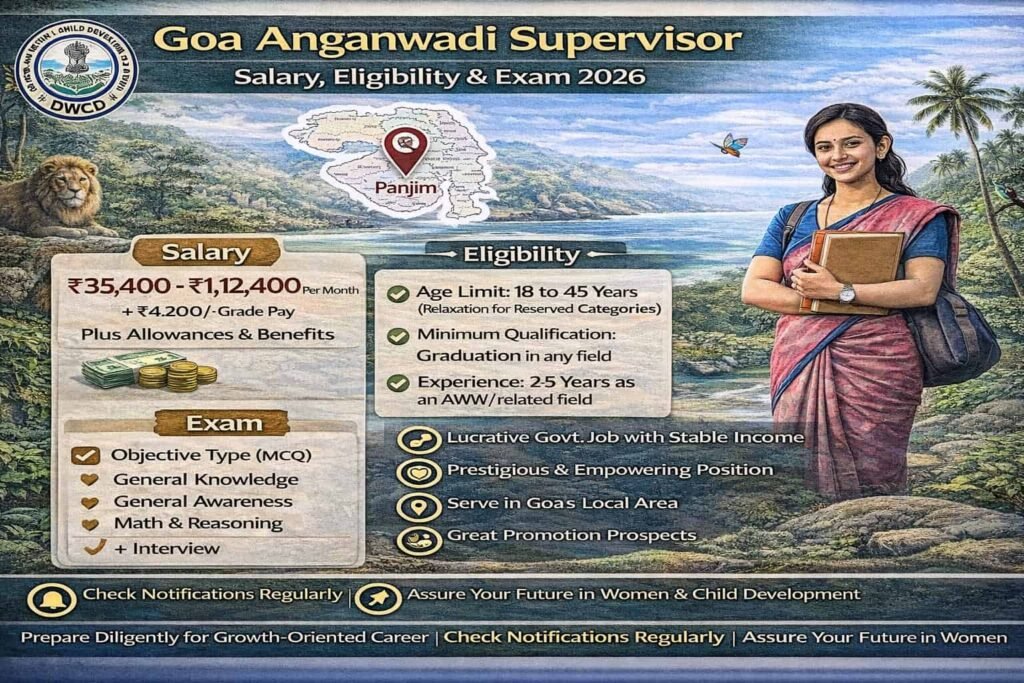
Goa Anganwadi Supervisor . The Directorate of Women and Child Development (DWCD) in the State of Goa operates a vast network of grassroots welfare programs, most notably the Integrated Child Development Services (ICDS). While the Anganwadi Workers (AWWs) form the frontline of this initiative, the operational success, data integrity, and administrative execution of the entire ICDS scheme rely heavily on the middle-management tier. This critical tier is spearheaded by the Anganwadi Supervisor, officially designated in the state nomenclature as the Supervisor (Women), Grade-I or Mukhya Sevika.
Thank you for reading this post, don't forget to subscribe!Unlike Anganwadi Workers and Helpers who are classified as “honorary workers” drawing a monthly honorarium, the Anganwadi Supervisor is a regular, full-time, permanent Government Employee holding a Group ‘C’ Non-Gazetted post. Acting as the vital administrative bridge between the grassroots Anganwadi Centres (AWCs) and the block-level Child Development Project Officers (CDPOs), the Supervisor is responsible for monitoring, auditing, and guiding the delivery of early childhood education, maternal health, and supplementary nutrition programs.
This exhaustive, 2500+ word research report provides a highly analytical, strategic, and dimensional breakdown of the Supervisor (Women) Grade-I post in Goa. From micro-analyzing the newly gazetted 2024 Recruitment Rules and the lucrative 7th Pay Commission Level-6 salary matrix to exploring the 50% promotion quota, the Goa Staff Selection Commission (GSSC) exam syllabus, and the rigorous field duties, this guide serves as the ultimate administrative blueprint for aspirants aiming to secure a mid-level executive position in Goa’s DWCD.
Part 1: Official Recruitment Rules and Cadre Strength (2024 Guidelines)
The Government of Goa recently overhauled the administrative framework for this post to ensure better governance and clear career progression. The recruitment, classification, and deployment of Supervisors are strictly governed by the newly notified “Department of Women and Child Development, Supervisor (Women), Grade-I, Recruitment Rules, 2024”.
1.1 Cadre Classification and Strength
| Administrative Parameter | Official Gazette Specification |
|---|---|
| Name of the Post | Supervisor (Women), Grade-I / Mukhya Sevika |
| Total Number of Sanctioned Posts | 57 Posts (as of 2024, subject to variation dependent on workload) |
| Service Classification | Group ‘C’, Non-Gazetted, Non-Ministerial, Ex-Cadre |
| Target Demographic | The recruitment process is exclusively restricted to female candidates due to the sensitive nature of maternal and child welfare duties. |
1.2 Disqualification and Marital Constraints
To maintain strict administrative discipline, the 2024 Recruitment Rules outline specific disqualifications. No female candidate shall be eligible for appointment to the post of Supervisor if she has entered into or contracted a marriage with a person who already has a living spouse. Exemptions to this rule are only granted by the Government if it is satisfied that such marriage is permissible under the personal law applicable to the candidate and there are other substantial grounds for doing so.
Part 2: Comprehensive Eligibility Criteria
Because the role of a Supervisor involves auditing government funds, verifying legal documents for flagship schemes, and training frontline workers, the educational criteria are significantly higher than those required for Anganwadi Workers.
2.1 Educational and Professional Qualifications
| Qualification Type | Mandatory Requirement for Direct Recruitment |
|---|---|
| Essential Educational Qualification | The candidate must possess a Bachelor’s Degree (Graduation) in any discipline (Arts, Science, or Commerce) from a recognized University or Institute. |
| Essential Language Proficiency | Absolute proficiency and knowledge of Konkani is mandatory for all candidates appearing for the Goa Staff Selection Commission exams. |
| Desirable Qualifications | Knowledge of the Marathi language is considered highly desirable for field communications. Additional degrees in Social Work, Home Science, Nutrition, or Child Psychology provide a practical advantage during departmental training. |
| Residency Requirement | Candidates must possess a valid 15-year continuous Residence Certificate issued by the competent Mamlatdar in the State of Goa. |
2.2 Goa Anganwadi Supervisor Age Limit and Relaxations
For candidates applying through the direct recruitment channel via the Goa Staff Selection Commission (GSSC), the age parameters are strictly defined:
- Standard Age Limit: The candidate must be between 18 years and 40 years of age at the time of submitting the application.
- SC/ST Category Relaxation: An upper age relaxation of 5 years (up to 45 years) is granted to candidates belonging to Scheduled Castes and Scheduled Tribes.
- OBC Category Relaxation: An upper age relaxation of 3 years (up to 43 years) is granted to candidates belonging to the Other Backward Classes.
- Government Servants: Relaxable for existing Government servants by up to 5 years in accordance with instructions issued by the Government.
Part 3: The 50-50 Recruitment Quota and Selection Methodology
The Government of Goa ensures that the Supervisor cadre benefits from a healthy mix of highly educated fresh talent (direct recruits) and highly experienced grassroots veterans (promoted workers).
3.1 The 50% Direct Recruitment Quota
Exactly 50% of the total sanctioned vacancies for the post of Supervisor are filled through open, direct recruitment. This recruitment is completely handled by the Goa Staff Selection Commission (GSSC). Candidates must undergo a rigorous Computer Based Test (CBT) and document verification process.
3.2 The 50% Departmental Promotion Quota
In a massive policy shift under the Mission Saksham Anganwadi and Poshan 2.0 guidelines, the promotional avenues for grassroots workers were doubled. Previously, only 25% of Supervisor posts were reserved for Anganwadi Workers.
- Now, 50% of all Supervisor vacancies are strictly reserved to be filled by the promotion of existing Anganwadi Workers (AWWs).
- Eligibility for Promotion: To be eligible for elevation to the rank of Supervisor, an Anganwadi Worker must have completed a minimum of 5 years of continuous, regular service and must acquire a recognized Graduate degree.
Part 4: Salary Matrix and Financial Allowances (7th CPC)
Unlike the “honorarium” model used for AWWs and AWHs, the Anganwadi Supervisor is integrated directly into the State Government’s formal pay scales under the 7th Central Pay Commission (CPC).
4.1 Standard Pay Matrix (Level 6)
The post of Supervisor (Women) Grade-I is placed in Pay Matrix Level – 6.
- Basic Pay Scale: ₹ 35,400 to ₹ 1,12,400 per month.
- Starting Basic Pay: A newly recruited or promoted Supervisor draws a starting basic pay of ₹ 35,400.
4.2 Detailed Monthly Salary Breakdown (Approximate)
In addition to the basic pay, Supervisors are entitled to massive state allowances, pushing their gross monthly income significantly higher.
| Salary Component | Calculation Metric | Estimated Monthly Amount (INR) |
|---|---|---|
| Basic Pay | Entry Level Matrix for Level 6 | ₹ 35,400 |
| Dearness Allowance (DA) | Adjusted bi-annually (Approx 50% of Basic) | ₹ 17,700 |
| House Rent Allowance (HRA) | Depending on Posting (Approx 18% for Goa) | ₹ 6,372 |
| Transport Allowance (TA) | Fixed Government Rate + DA on TA | ₹ 2,400 – ₹ 3,600 |
| Medical / Other Allowances | Fixed State Allowances | ₹ 1,500 |
| Gross Monthly Salary | Total of above components | ₹ 63,372 to ₹ 64,572 |
| Net In-Hand Salary | After NPS (10%), Professional Tax deductions | ₹ 55,000 to ₹ 58,000 |
Strategic Insight: The transition from an Anganwadi Worker (earning an ₹ 18,000 honorarium) to a Supervisor (earning an in-hand salary of ~₹ 55,000 with full pension and medical benefits) represents one of the most lucrative vertical career jumps within the Goa state administration.
Part 5: GSSC Written Examination Syllabus and Pattern
For the 50% direct recruitment quota, the Goa Staff Selection Commission (GSSC) conducts a highly competitive Computer Based Test (CBT). Understanding the exact syllabus and marking scheme is critical for aspirants.
5.1 The CBT Examination Rules
- No Negative Marking: A massive advantage for candidates is that the GSSC applies absolutely zero negative marking for wrong answers in the CBT. Aspirants are advised to attempt all questions.
- Minimum Qualifying Marks: To even be considered for the merit list, candidates must score a minimum threshold:
- Unreserved (General) Category: 45%.
- OBC / PwD Categories: 40%.
- SC / ST Categories: 35%.
- The Konkani Language Trap: Passing the Test of Konkani language is strictly mandatory for deciding the final merit. If the Konkani test is worth 10 marks, a candidate must independently score a minimum of 04 marks just in this section. Failing to secure the minimum Konkani score results in immediate disqualification, regardless of performance in other subjects.
5.2 Detailed Syllabus Breakdown
The syllabus is generally structured to test administrative aptitude, logical reasoning, and subject-specific pedagogy required for child development.
A. Test of English Language & Comprehension
- Grammar & Usage: Spotting errors, active/passive voice, direct/indirect narration, fill in the blanks.
- Vocabulary: Synonyms, antonyms, spelling detection, idioms, phrases, and one-word substitution.
- Comprehension: Reading passages and answering inferential questions.
B. Test of Numerical Ability / Quantitative Aptitude
- Basic Arithmetic: Number Systems, HCF, LCM, Simplification, Decimals, and Fractions.
- Commercial Math: Percentage, Ratio & Proportion, Average, Profit & Loss, Simple & Compound Interest.
- Advanced: Time & Work, Time & Distance, Mensuration (Volumes and Area), and Data Interpretation (Tables and Pie Charts).
C. Test of Reasoning Ability
- Verbal Reasoning: Blood relations, syllogisms, coding and decoding, ranking and order, analogues.
- Non-Verbal Reasoning: Mirror images, water images, figure completion, paper folding, and Venn diagrams.
D. General Knowledge & Current Affairs
- State Focus: History, geography, and current affairs specific to the State of Goa.
- National Focus: Indian Constitution, Polity, Science Inventions, and Famous Books and Authors.
E. Subject Specific: Methodology / Education Pedagogy / Nutrition
- This section tests the candidate’s core competency for the Supervisor role. Topics include Child Psychology, Early Childhood Care and Education (ECCE) methodologies, basic human nutrition, prevention of malnutrition, and knowledge of major Central and State welfare schemes (like POSHAN Abhiyaan, Mamta Scheme, and Laadli Laxmi).
Part 6: Micro-Level Job Profile, Duties, and Field Responsibilities
The Mukhya Sevika is the eyes and ears of the DWCD at the block level. She does not sit in an office; her job is highly dynamic and field-oriented. According to the ICDS District Manual, a single Supervisor is placed in direct charge of overseeing 17 to 25 Anganwadi Centres.
6.1 Grassroots Supervision and Mentoring
- AWC Inspections: The Supervisor must conduct routine and surprise inspections of all 17-25 AWCs under her jurisdiction to ensure that the centers open on time, maintain strict hygiene, and deliver quality services.
- Mentoring AWWs: She provides supportive supervision, coaching, and on-the-job orientation to Anganwadi Workers. If an AWW struggles with maintaining physical registers or the digital ‘Poshan Tracker’ app, the Supervisor is responsible for retraining her.
- ECCE Leadership: The Supervisor is strictly required to attend at least two Early Childhood Care and Education (ECCE) meetings per month at the village level, ensuring that semi-structured play and learning methods are being properly utilized by the AWWs.
6.2 Health, Nutrition, and Supply Chain Coordination
- VHND Coordination: She liaises closely with the Health Department’s peripheral staff, primarily the ASHA (Accredited Social Health Activist) and ANM (Auxiliary Nurse Midwife), to successfully execute Village Health and Nutrition Days (VHNDs).
- Growth Monitoring: She cross-verifies the growth charts (height and weight records) maintained by the AWWs to identify children suffering from Severe Acute Malnutrition (SAM) and ensures their immediate referral to the Primary Health Centre (PHC).
- Logistics Management: She monitors the supply chain, ensuring the uninterrupted delivery of Take-Home Rations (THR) and raw materials for Hot Cooked Meals to the centers.
6.3 Administrative and State Scheme Execution
- Reporting: She compiles the monthly progress reports from all her 25 AWCs and submits a consolidated block report to the Child Development Project Officer (CDPO).
- Scheme Verification: As the first gazetted-level checking authority, she scrutinizes and verifies the applications collected by AWWs for Goa’s flagship schemes like the MAMTA Scheme (financial incentives for the birth of a girl child) and the Laadli Laxmi Scheme (financial aid for girl’s marriage/education) before forwarding them to the CDPO for final financial sanction.
Part 7: Career Progression and Promotion Hierarchy
Joining as an Anganwadi Supervisor opens the door to the upper echelons of the state’s administrative machinery. The promotion path is highly structured:
- Supervisor (Women) Grade-I: Entry-level Group ‘C’ executive (Level 6).
- Child Development Project Officer (CDPO): Supervisors with exemplary service records and administrative acumen are promoted to the post of CDPO. The CDPO is a Group ‘B’ Gazetted Officer (Pay Level 7) and acts as the principal executive functionary of an entire ICDS Block/Taluka. A significant 75% of CDPO vacancies are typically filled through the promotion of Supervisors.
- District Programme Officer (DPO): CDPOs are further promoted to District Programme Officers, overseeing operations for entire districts (North Goa or South Goa).
- Deputy Director / Joint Director: The highest strategic levels within the DWCD headquarters in Panaji.
Part 8: 10 Frequently Asked Questions (FAQs) – Expert Clarifications
Q1: What is the exact pay scale of an Anganwadi Supervisor (Mukhya Sevika) in Goa? Answer: The Anganwadi Supervisor is a regular government employee placed in Pay Matrix Level-6 as per the 7th Central Pay Commission. The basic pay ranges from ₹ 35,400 to ₹ 1,12,400. Including Dearness Allowance, HRA, and Transport Allowance, the starting gross monthly salary is approximately ₹ 60,000 to ₹ 64,000.
Q2: Is the Anganwadi Supervisor a contractual or permanent government post? Answer: Unlike Anganwadi Workers and Helpers who are “honorary workers,” the Supervisor (Women) Grade-I is a permanent, full-time Group ‘C’ Non-Gazetted post under the Directorate of Women and Child Development, Government of Goa.
Q3: Can an Anganwadi Worker (AWW) be promoted to the post of Supervisor? Answer: Yes, absolutely. Under the latest Mission Saksham Anganwadi and Poshan 2.0 guidelines, the promotional quota has been enhanced. Currently, a massive 50% of all Supervisor vacancies are strictly reserved to be filled through the promotion of existing Anganwadi Workers.
Q4: What are the eligibility criteria for an Anganwadi Worker to get promoted to Supervisor? Answer: To be eligible for this promotion, the Anganwadi Worker must have completed a minimum of 5 years of continuous, regular service in her current role. Additionally, she must upgrade her educational qualifications and possess a recognized University Graduate (Bachelor’s) degree.
Q5: What is the minimum educational qualification for Direct Recruitment to the Supervisor post? Answer: Candidates applying through the direct recruitment channel via the Goa Staff Selection Commission (GSSC) must possess a Bachelor’s Degree (Graduation) in any discipline from a recognized university. Degrees in Sociology, Home Science, or Child Psychology are highly beneficial.
Q6: Is there any negative marking in the GSSC Computer Based Test (CBT) for Supervisors? Answer: No. As per the official syllabus and scheme of examination issued by the Goa Staff Selection Commission, negative marking will not be applicable for the Computer Based Test (CBT). Candidates are highly encouraged to attempt all questions.
Q7: Why is the Test of Konkani Language considered a “trap” in the GSSC exam? Answer: The GSSC rules state that passing the Test of Konkani language is strictly mandatory for deciding the merit. For example, out of 10 marks allocated for the Konkani language section, securing a minimum of 04 marks is compulsory. If a candidate scores 100% in Math and English but fails to secure 4 marks in Konkani, they are immediately disqualified from the merit list.
Q8: What is the age limit for applying for the Anganwadi Supervisor post? Answer: For direct recruitment, candidates must be between 18 and 40 years of age. However, standard upper age relaxations apply: 5 years for SC/ST candidates (up to 45 years), 3 years for OBC candidates (up to 43 years), and up to 5 years for existing Government servants.
Q9: How many Anganwadi Centres does a single Supervisor manage? Answer: A Mukhya Sevika or Supervisor is the primary field-level manager and is typically placed in direct charge of overseeing, monitoring, and auditing between 17 to 25 Anganwadi Centres within a specific block or taluka.
Q10: What role does the Supervisor play in Goa’s “Mamta” and “Laadli Laxmi” schemes? Answer: The Supervisor acts as the crucial verification authority. Grassroots Anganwadi Workers collect and assist beneficiaries in filling out applications for the Mamta Scheme (financial aid for the birth of a girl child) and the Laadli Laxmi Scheme. The Supervisor audits these files, verifies the residence and income certificates, and approves them before forwarding the batch to the Block CDPO for final financial disbursement.